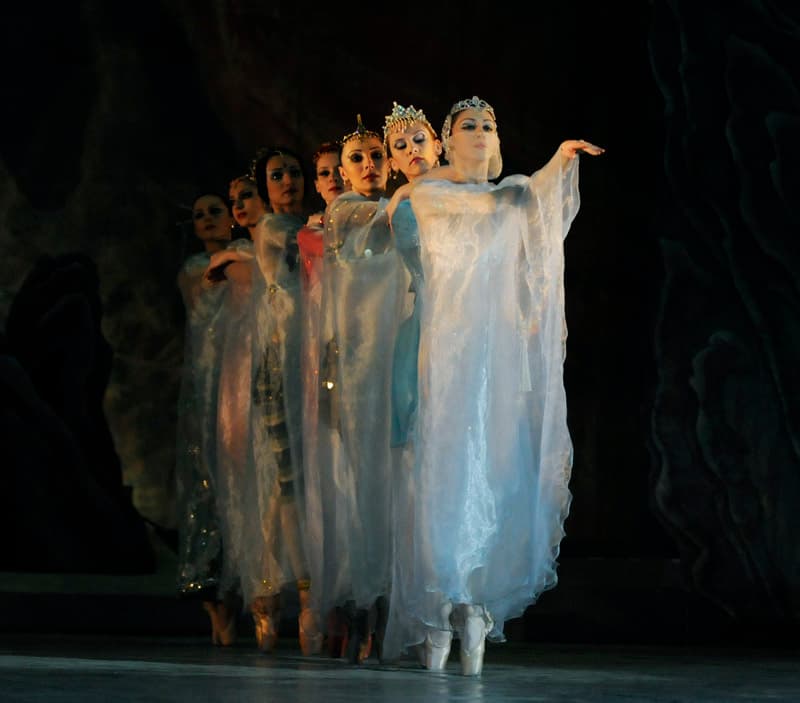
Ilgar Jafarov — Own collection of Ilgar Jafarov · CC BY-SA 4.0
Seven Beauties is a full-length narrative ballet by Azerbaijani composer Gara Garayev, composed 1947–48 to mark the 800th anniversary of the poet Nizami Ganjavi and drawn from Ganjavi's Haft Peykar (1197). It premiered in Baku on 7 November 1952 at the Azerbaijan State Academic Opera and Ballet Theater, and stands as one of the foundational works of Soviet-era Azerbaijani ballet repertoire.
What is danced
The article gives a detailed libretto-style synopsis but almost no direct description of steps, technique, or staging convention. The one explicit dance moment it names is the vision scene: the hermit shows Bahram Shah images of seven beauties representing different nations (Indian, Byzantine, Khorezmian, Slav, Maghrebian, Chinese, Persian), who 'come to life and perform amazing dances for him' before vanishing at daybreak — a structure recognisable as a national-character divertissement embedded in a narrative ballet, in the manner of the 'dances of the nations' set pieces common to nineteenth- and twentieth-century full-length ballets. This vision sequence recurs later when the vizier shows Bahram a silk textile bearing the seven beauties' images, triggering the same imagined dances again.
Beyond this, the synopsis is built around dramatic action — a hunt, an archery contest, a court conspiracy, an uprising by craftsmen and peasants, a village burning, and a final confrontation — rather than named dance numbers. The article does not specify pointe work, character-shoe sequences, mime conventions, or any named pas de deux, variation, or corps formation, so no technical vocabulary can be attributed to specific scenes with confidence.
Context
The work belongs to the wave of Soviet republic-level 'national ballets' commissioned in the postwar decades to build a classical-ballet repertoire rooted in local literary and folk material — here anchored to Nizami Ganjavi, a canonical figure for Azerbaijani cultural identity, and reinforced musically by orchestration using Azerbaijani folk instruments 'which give it a national tint.' The article notes the score's grounding in a 1949 symphonic suite and an acknowledged debt to Aram Khachaturian, situating the work within the broader Soviet-Caucasian symphonic-ballet idiom of the period.
Staging history
The ballet premiered 7 November 1952 in Baku. It was restaged in 2008 at the Azerbaijan State Opera and Ballet Theater under Russian choreographer Vasiliy Medvedev, with a new libretto by Turkish writer Yana Temiz, conducting by Elshad Bagirov (previously of the Bolshoi and the Istanbul Opera and Ballet Theatre), designs by Bolshoi artist Dmitriy Cherbadji, and costumes by Tahir Salahov. Its United States premiere came on 13 October 2014 at the Civic Theatre in San Diego, California, before an audience of 3,000.
How to watch it
Watch for the framing device of the seven beauties as a repeated vision-within-the-ballet — a hermit's images and later a piece of silk textile both trigger the same imagined dance sequence, so the choreography of that divertissement is likely staged twice as a structural echo. The surrounding drama (contest, conspiracy, popular uprising) is carried through mimed narrative action rather than described set dances, so the emotional and political plot beats should be read as pantomime-driven rather than pure divertissement.
Credits
- composer: Gara Garayev