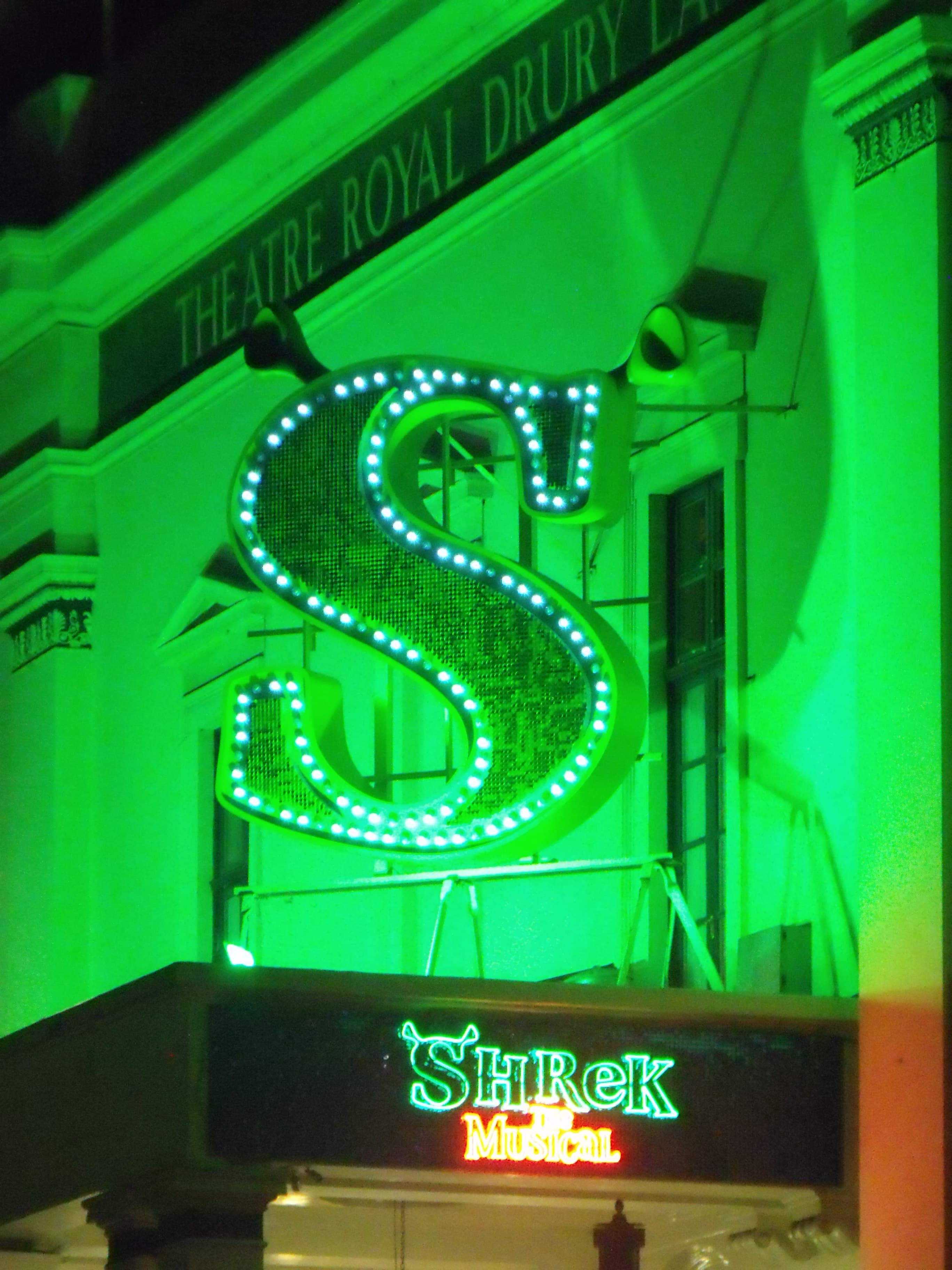
Elliott Brown from Birmingham, United Kingdom — Theatre Royal Drury Lane - Catherine Street - London - Shrek the Musical Uploaded by Oxyman · CC BY 2.0
Shrek the Musical is a book musical adapting DreamWorks' 2001 animated film Shrek (plus elements of its sequels and William Steig's 1990 picture book) for the stage, with music by Jeanine Tesori and book/lyrics by David Lindsay-Abaire. It began as a 2002 development project, tried out in Seattle in 2008, opened on Broadway that December, and subsequently toured North America and played a re-staged West End run (2011–13) plus productions in Brazil, Australia and across Europe and elsewhere.
What is danced
The source article is overwhelmingly a production-history document — opening dates, casts, cut and reinstated songs, orchestration lists, box-office and awards detail — and it does not describe choreography, step vocabulary, or technique at any point. The one moment where movement is implied rather than told is Lord Farquaad's entrance number, where he is 'accompanied by his cheerful cookie-cut army of Duloc Dancers' in the song 'What's Up Duloc?'; this phrasing gestures at a uniform chorus-line pastiche but the article gives no description of steps, formations, or holds, so it cannot support a coded style claim under this catalogue's evidence bar. Similarly, 'Freak Flag' is noted as an ensemble performance piece (used at the Tony Awards and Olivier Awards) but again with no movement detail — only that the company performed it.
Because of this, no dance vocabulary claims can be responsibly coded from this article alone. A choreographer is named in our record (Martin Michel) but the article itself never credits an original choreographer for the Seattle, Broadway, tour, or West End stagings — the only choreography credit it gives at all is Danny Mefford, for the 2024 non-equity revival ('new direction and choreography by Danny Mefford'). Anyone building a movement picture of this show would need a source that actually describes the staging (e.g. interviews with Josh Prince, the Broadway choreographer of record in other sources, which this article does not mention) rather than this synopsis-and-production-history account.
Context
The show belongs to the wave of 2000s Broadway 'movie musicals' adapted from popular animated or live-action films (a lineage the article itself gestures at by comparing the show's satirical tone to The Producers and noting its heavy reliance on 'winking satire' and nods to Gypsy and A Chorus Line). It was mounted on a large commercial scale — one of the most expensive Broadway musicals to open at the time, at an estimated $24–25 million — reflecting the era's appetite for spectacle-driven, franchise-based stage adaptations rather than dance-first musical theatre.
Staging history
After the Seattle tryout (2008) and Broadway run (2008–10, 441 performances), the production was substantially reworked for a North American tour beginning 2010, including a new dragon puppet and design changes, and again scaled down for the West End (2011–13). Further non-Equity US tours followed (2011–13, and a shortened 2024 tour with new direction and choreography by Danny Mefford aimed at children's theatre), alongside separate productions in Brazil (2012–14), Australia (2020), and UK/Ireland tours (2014–16, 2017–19, 2023–24), plus non-replica stagings in Israel, Poland, Spain, France, Italy, the Netherlands, Germany, Mexico and Argentina.
How to watch it
Because the surviving account is a production and reception history rather than a staging record, a viewer should watch for the show's satirical stage-musical pastiches (its allusions to Gypsy, A Chorus Line and dating-show formats such as 'This Is Your Wife') and for the large puppet/design elements (the dragon, Farquaad's 'walk on his knees' sight gag) that the article does flag as staging highlights, rather than expecting a dance-driven show.
Structure
- Act I · What's Up Duloc?Shrek and Donkey arrive in Duloc, where Lord Farquaad expresses his love for his kingdom accompanied by his cheerful cookie-cut army of Duloc Dancers.
- Act II · Freak FlagThe Fairytale Creatures, rallied by Gingy and Pinocchio, declare their acceptance of themselves and march on Duloc to overthrow Farquaad.
Structure read from an encyclopaedia article, not from a libretto or score we hold. Confirm against a programme before treating the numbering as authoritative.