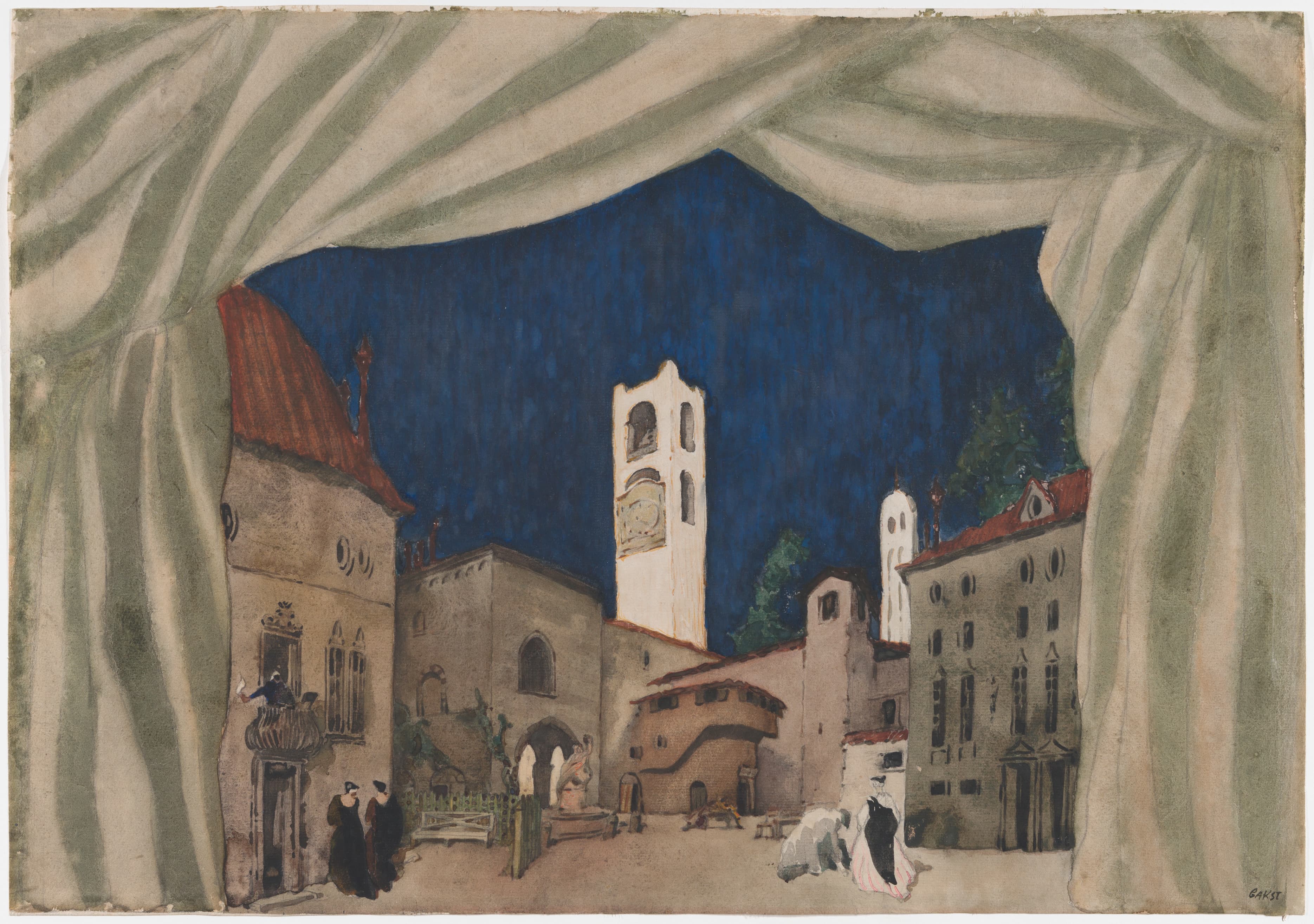
Léon Bakst — This file was donated to Wikimedia Commons as part of a project by the Metropolitan Museum of Art. See the Image and Data Resources Open Access Policy · CC0
The Good-Humoured Ladies (Le donne di buon umore) is a one-act ballet made for Diaghilev's Ballets Russes in 1917, with choreography by Léonide Massine set to sonatas by Domenico Scarlatti arranged and orchestrated by Vincenzo Tommasini. The scenario, drawn from Carlo Goldoni's comedy of the same name, follows the intrigues of a count who disguises himself as a woman during a carnival, giving the ballet its comic, character-driven premise.
What is danced
The source article does not describe the choreography itself — no step vocabulary, mime conventions, ensemble patterns, or named variations are recorded, only that Massine choreographed the piece, Bakst designed scenery and costumes, and the plot concerns a disguised count's carnival diversions. Without a synopsis broken into scenes or a description of what the dancers actually do, no reliable claim can be made about technique, pointe versus character shoe work, or the balance of mime to dance.
Context
The ballet belongs to the Ballets Russes's Italian period during the First World War, when the company, unable to tour freely in France, based itself partly in Italy and drew on Italian subjects and music: an 18th-century Goldoni comedy and Scarlatti's harpsichord sonatas, repurposed via Tommasini's orchestration for a modern theatrical stage. This pairing of Baroque-derived score with a commedia-flavoured carnival plot situates the work within Diaghilev's broader turn toward historical pastiche and neoclassicism in the years around and after 1917, alongside pieces built on similarly antiquarian musical sources.
Staging history
The article records only the 1917 Rome premiere by Diaghilev's Ballets Russes and the later extraction of a six-movement orchestral suite from the score; it gives no information on revivals, restagings, or which companies have since performed the ballet.
How to watch it
The article supplies no detail on the actual choreography, so there is nothing here to verify about steps or technique — a viewer would need to look elsewhere for that. What can be watched for, based on the plot given, is the comic business built around the disguised count at the carnival, and the way Tommasini's orchestration of Scarlatti's harpsichord sonatas (including the well-known 'Cat's Fugue') sets the tempo and character of the action.
Credits
- composer: Domenico Scarlatti
- composer: Vincenzo Tommasini