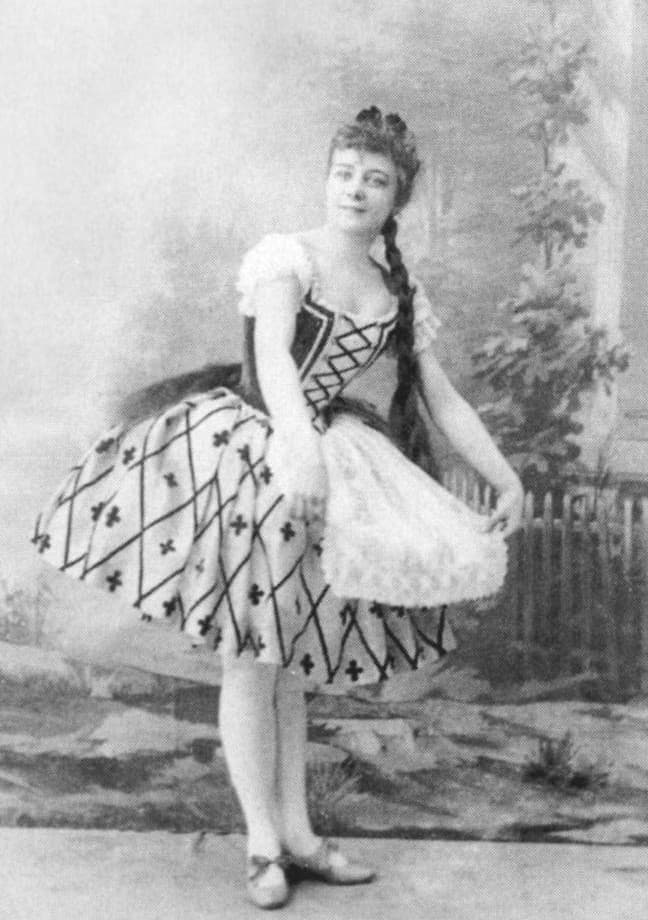
La Tulipe de Haarlem (The Haarlem Tulip) is a "fantastic ballet" in three acts and four scenes made for the Imperial Ballet, with choreography by Lev Ivanov and a score by Baron Boris Fitinhoff-Schell. It was first given at the Imperial Mariinsky Theatre in St. Petersburg on 16 October [O.S. 4 October] 1887, with Emma Bessone, Pavel Gerdt and Alfred Bekefy in the principal roles of Emma, Peters and Andreas.
What is danced
The article does not describe steps, vocabulary or technique anywhere in the work; it records structure (three acts, four scenes), named roles, and casting rather than choreographic content. What can be established is formal rather than technical: the piece carried a Pas de trois as a distinct, nameable number in its 1903 revival cast, danced by Tamara Karsavina, Elena Poliakova and Mikhail Obukhov alongside the principal trio of Vera Trefilova, Nikolai Legat and Gyorgy Kiaksht. Beyond that, no synopsis or musical-number listing survives in the source to say what any of the four scenes actually staged.
Context
The premiere fell within Lev Ivanov's long career as a house choreographer for the Imperial Ballet in St. Petersburg during the era dominated by Marius Petipa, working with dancers who would go on to define the Mariinsky repertoire of the following decades. The article gives no further framing of the ballet's place in the repertory beyond its cast and creative credits.
Staging history
The ballet was revived twice at St. Petersburg venues connected to the Imperial Ballet. Claudia Kulichevskaya and Pavel Gerdt restaged it under the title The Tulip Field for students of the Imperial Ballet School, presented on 16 April [O.S. 3 April] 1902 in the school's own theatre. Alexander Shiryaev mounted a further revival for the Imperial Ballet proper at the Mariinsky Theatre on 29 April [O.S. 16 April] 1903, with Vera Trefilova, Nikolai Legat and Gyorgy Kiaksht in the leads and Tamara Karsavina, Elena Poliakova and Mikhail Obukhov dancing the Pas de trois.
How to watch it
Nothing in the record describes the choreography itself, so there is no staging convention to point to from this source; a viewer or researcher would need to consult the score, libretto or period reviews to reconstruct what was actually danced in each of the four scenes.
Credits
- composer: Boris von Vietinghoff-Scheel