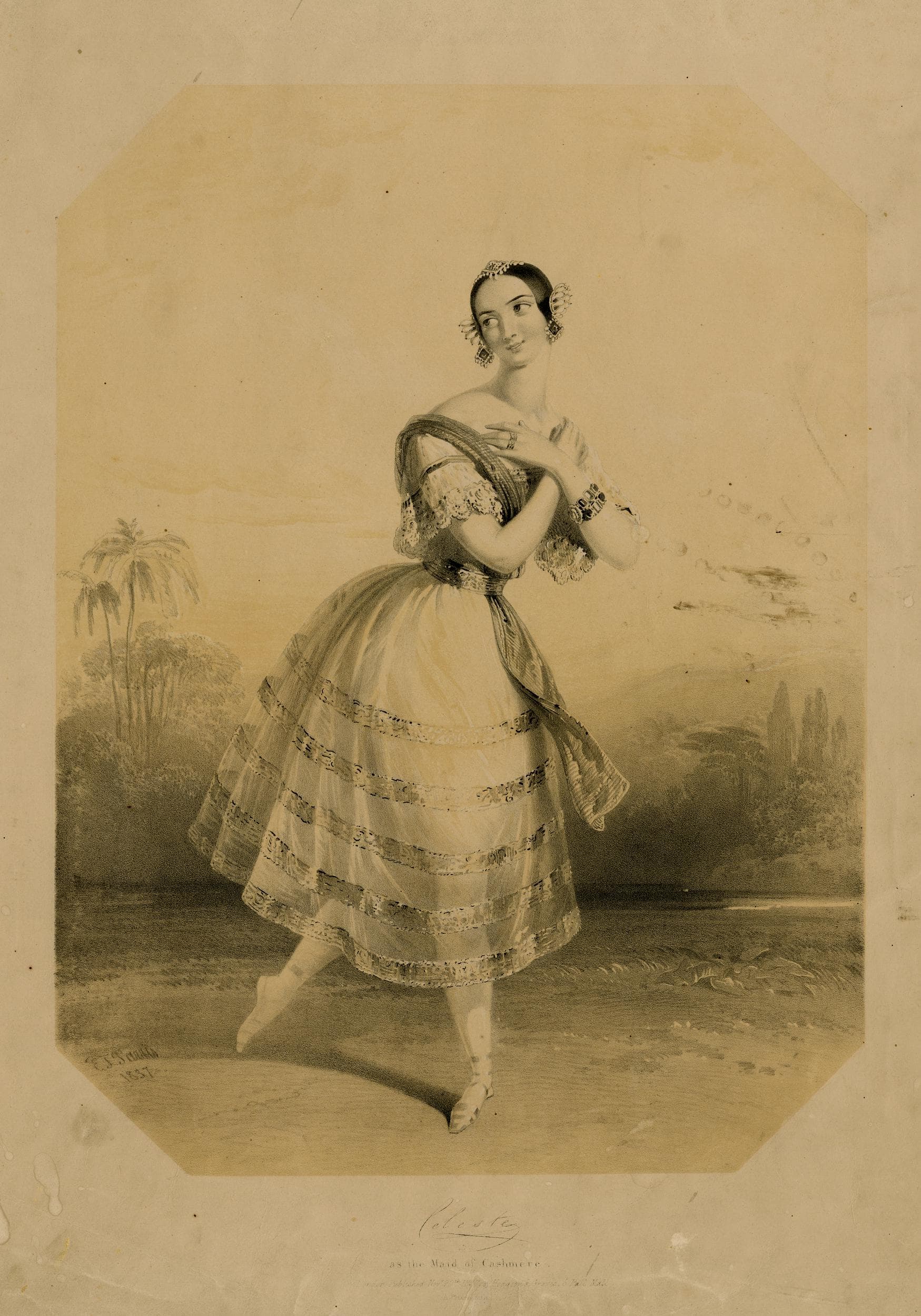
Print made by: Edmund Thomas Parris Published by: Hodgson & Graves Printed by: Andrew Picken — https://www.britishmuseum.org/collection/object/P_1882-0513-12 · Public domain
The Maid of Cashmere (1830)
The Maid of Cashmere is an English-language adaptation, staged at Drury Lane, of Eugène Scribe and Daniel Auber's French opéra-ballet La bayadère amoureuse (Le Dieu et la Bayadère). The English text and additional music were the work of Henry Bishop and Edward Fitzball, grafted onto Auber's score, and the piece functioned as a hybrid opera-and-dance vehicle rather than a pure ballet.
What is danced
The article documents one concrete danced set piece: a shawl dance performed by the female corps de ballet, explicitly staged to showcase the imported French dancer Pauline Duvernay and the 'foreign corps de ballet' alongside her. This places the work in the tradition of specialty exotic-themed display numbers common to 1830s London theatre. The synopsis also distinguishes two Bayadère characters used as rivals in the plot's jealousy test: Leila, 'a singing Bayadère', and Fatima, 'a dancing Bayadère' — implying that Fatima's role was built around a dance solo or set piece, danced rather than sung, though the article gives no detail on its steps or vocabulary.
Context
The production sits in the early 1830s vogue for importing French grand-opera and ballet hybrids to the London stage, and for introducing French-trained dancers to English audiences — Duvernay's local debut is presented as a central purpose of the staging. The 'foreign corps de ballet' billing and the shawl-dance number reflect a period taste for orientalist spectacle built around Indian/Cashmere settings, paralleling the exoticism found elsewhere in Romantic-era stagecraft of the decade.
Staging history
The article records the Drury Lane premiere on 16 March 1833 with Pauline Duvernay as Zelica, and notes that the role was later also taken by Madame Céleste, indicating at least one documented change of lead performer after the opening run.
How to watch it
Watch the shawl dance as the number the whole production was built to showcase — it is the moment the corps and the imported ballerina were presented to the audience, not incidental decoration. Note the doubling of the 'Bayadère' figure into a singing role (Leila) and a dancing role (Fatima); the contrast between the two is the plot's device and would have been staged as a contrast in performance mode as much as character.
Credits
- composer: Daniel François Esprit Auber
- composer: Henry Bishop