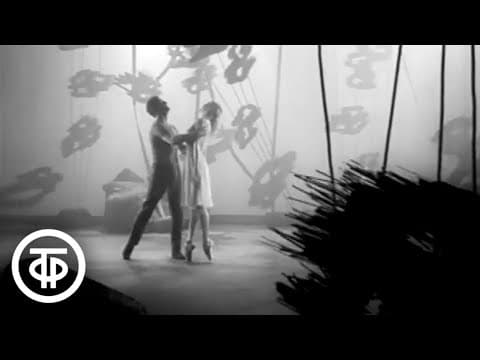
The Path of Thunder is a Soviet three-act ballet with libretto by Yuri Slonimsky, music by Gara Garayev and choreography by Konstantin Sergeyev, premiered in 1958 at what was then the S. M. Kirov Leningrad State Academic Theatre of Opera and Ballet (now the Mariinsky). It adapts Peter Abrahams's 1948 novel of the same name, transposing its story of a forbidden interracial love affair in 1940s Apartheid South Africa onto the ballet stage.
What is danced
The article does not describe steps, holds or specific choreographic vocabulary — it speaks only in terms of the score and dramatic structure. What can be said with confidence is that the work is built dramaturgically in three acts around a love plot and a social conflict, with the music explicitly shaped to those dramatic poles: 'soft, melodic music, which turns lyrical and passionate in the love scene' for the central pas de deux material, against 'harsh, dissonant music' for the confrontation with the girl's father and the white community, and a final collective uprising ('the people rise up') that presumably calls on the corps de ballet rather than the principals alone.
Beyond that dramatic shape, no synopsis of individual scenes, no named numbers, and no technical detail about the choreography survive in this source, so nothing further about the actual movement vocabulary can be stated as fact.
Context
The ballet belongs to the late-Soviet narrative-ballet tradition of the 1950s, staged at the Kirov under Konstantin Sergeyev, and it uses an explicitly anti-racist, anti-apartheid subject drawn from contemporary black South African literature — a choice consistent with the internationalist and socially engaged themes Soviet ballet was expected to dramatize in this period. Its recognition with the Lenin Prize in 1967 marks it as an officially celebrated work within that system.
Staging history
According to the article, 'many other versions of the ballet have been staged throughout the former Soviet Union' following the 1958 Kirov/Mariinsky premiere, indicating it entered repertory beyond its originating company, though no specific companies, dates or choreographic changes for those later versions are named.
How to watch it
Listen for Garayev's deliberate musical polarity — lyrical, passionate writing for the love scenes set against harsh, dissonant music for the scenes of racial conflict — since the article frames this contrast as the ballet's structuring device. Watch for how the ending resolves dramatically: the lovers die, but the crowd's uprising is staged as the payoff of the title's 'Path of Thunder,' the collective 'way of liberation.'
Credits
- composer: Gara Garayev