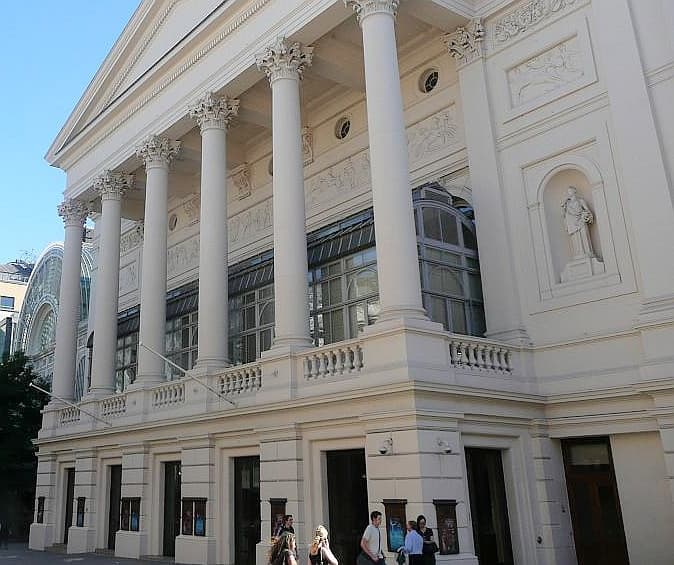
Londres_048..jpg: Simdaperce derivative work: SilkTork (talk) — Londres_048..jpg · CC BY-SA 3.0
The Prince of the Pagodas (1956)
The Prince of the Pagodas is a full-length narrative ballet made for the Royal Ballet (as Sadler's Wells Ballet became), choreographed by John Cranko to a specially commissioned score by Benjamin Britten. The article gives its premiere as 1 January 1957 at the Royal Opera House, Covent Garden, conducted by Britten himself — a detail worth noting since our record holds 1956 and does not currently record a choreographer.
What is danced
The source article is almost entirely about the commissioning history, plot and — at length — the musical construction of the score (Britten's incorporation of Balinese gamelan textures, pentatonic writing, polyphonic stratification). It does not describe the choreography itself: no steps, holds, partnering, or technical vocabulary are given for any scene. What can be drawn from the article is structural rather than kinetic: Cranko built the ballet from 'a list of dances, simply describing the action and giving a total timing for each' before handing this scheme to Britten, which tells us the work was conceived as a sequence of discrete dance numbers organised around the story (Emperor, two daughters, the Salamander/Prince, Pagoda Land) rather than through-danced abstraction — but the article names none of those numbers.
Because the plot synopsis in the article is not broken into acts, scenes or titled numbers, no reliable section spine can be extracted from it, and no specific movement vocabulary (pointe work, mime, character dance, etc.) can be attributed to any part of the ballet on the article's evidence alone.
Context
The commission sits within the Sadler's Wells/Royal Ballet's mid-1950s programme of building a new British narrative-ballet repertoire around home-grown choreographers and composers, continuing from the company's earlier work with Ashton and de Valois; Britten's dedication of the score to Imogen Holst and Ninette de Valois signals its place within that institutional circle. The article's detailed account of Britten's absorption of gamelan music — via Colin McPhee, Poulenc's two-piano concerto, and a 1956 trip to Bali taken while composing — made the score itself unusually significant in mid-century British music, independent of the choreography it served.
Staging history
Cranko's original 1957 production (designs by John Piper, costumes by Desmond Heeley) was recorded commercially by Decca in a slightly cut version, with Britten conducting, in February 1957. The ballet was revived at Covent Garden on 7 December 1989 in a new production by Kenneth MacMillan, dedicated to Margot Fonteyn, with a scenario by Colin Thubron and designs by Nicholas Georgiadis; this staging was noted for Darcey Bussell's performance in a principal role. A further, Japan-set production by David Bintley premiered with the National Ballet of Japan at the New National Theatre Tokyo on 30 October 2011, and was subsequently taken into the Birmingham Royal Ballet repertoire, danced at The Lowry, Salford, in 2014.
How to watch it
Listen for the shift between the pseudo-gamelan passages — layered, differently-tuned statements of the Salamander Prince's theme, gong-and-double-bass colour, pentatonic trumpet fanfares — used for Pagoda Land and the Salamander, and the more conventional Western orchestral writing that returns when he is revealed as human; the choreography in every production follows this musical dramaturgy of transformation. Because the article gives no fixed choreographic text, differences between the Cranko, MacMillan and Bintley versions (the latter relocated to a Japanese setting) are worth comparing directly rather than assumed to be interchangeable.
Credits
- composer: Benjamin Britten