49 works in this view — arrow keys or swipe to move between them.
Dance in Art
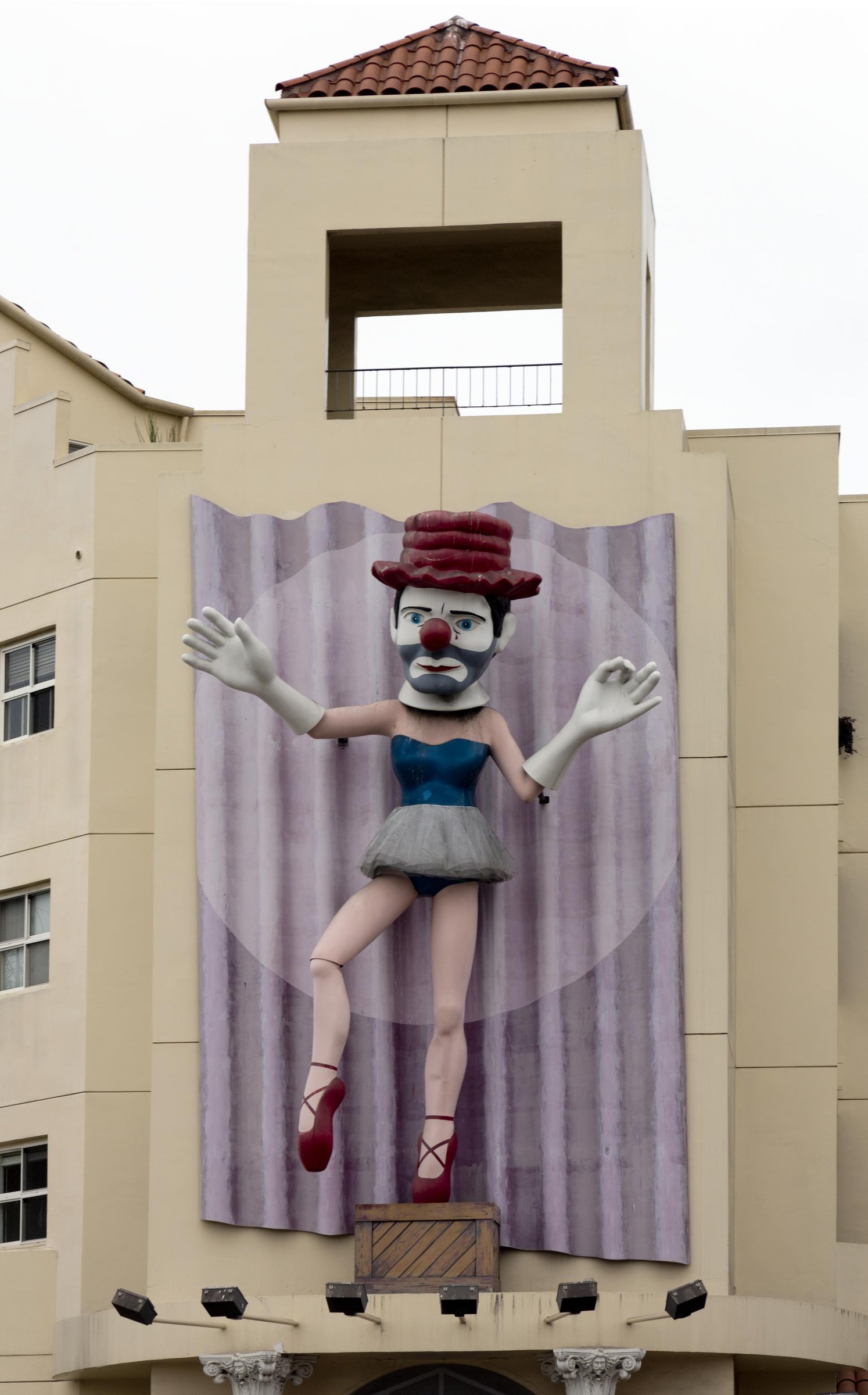
Art "Ballerina Clown" by Jonathan Borofsky in Venice, a beachfront district on the Westside of Los Angeles, California
Unknown artist
- Collection:
- Prints & Photographs
- Source:
- Library of Congress
- Rights:
- Rights vary by item — check the source record before reusing this image. Source record ↗
- Recorded as:
- Library of Congress — no known restrictions (verify per item)
This work matters because it uses dance costume and pose as raw material for conceptual art, rather than as documentation of dance itself. For historians and artists interested in how dance is represented, consumed, and ironized in public culture, the mural demonstrates how ballet's visual codes can be appropriated, inverted, and made grotesque. It asks viewers to think about what ballet costume signifies and what happens when those signs are detached from the balletic body.
What you are looking at
A large-scale public mural mounted on the cream-colored facade of a modernist building in Venice, Los Angeles depicts a figure in theatrical clown costume against a lavender striped backdrop. The figure wears a burgundy top hat, white-painted face with exaggerated features including a red nose, and a blue corset-style top paired with a pale tulle skirt—a hybrid of clown and ballerina dress codes. The legs are bare and extended in a dynamic pose, with red ballet pointe shoes visible at the ankles. White gloved hands are raised expressively to either side of the body at shoulder height, palms outward in a gesture of surprise or dismay. The figure's posture suggests mid-movement, with the body tilted slightly forward. The scale is monumental: the mural dominates the entire facade of a multi-story building topped with a clay tile roof, visible from street level and designed as public art rather than documentation of live dance.
The dancing
A single figure in an impossible hybrid pose: one leg appears grounded while the other extends upward in an exaggerated position suggesting neither classical ballet extension nor clown pratfall, but rather a deliberately awkward and unnatural arrangement. The raised white-gloved hands with splayed fingers suggest astonishment or helplessness rather than any trained port de bras. The posture is stiff and inelegant—the opposite of ballet's fluidity—achieved through what appears to be sculptural construction rather than a moment captured from live movement. The body reads as a constructed object rather than a dancing body.
The dance depicted
This mural does not depict recognizable dance technique. Instead, it stages a conceptual collision between ballet and clowning—two theatrical traditions with opposing aesthetics. The tulle skirt and pointe shoes invoke Romantic or Classical ballet iconography, while the clown makeup, top hat, and ungainly posture mock ballet's pretension to grace and control. The work appears to be a commentary on theatrical spectacle and artifice rather than a representation of how either clowns or ballet dancers actually move. The exaggerated, unnatural pose—especially the extension of one leg—reads as deliberate distortion rather than technical accuracy.
How it was made
This is a large-scale sculptural mural constructed in three dimensions, not a painted or photographic work. The figure appears to be made of molded fiberglass or similar materials, with hand-painted details. It is mounted on the exterior of a building as permanent public sculpture, designed to be viewed from street level. The three-dimensional construction allows the dramatic leg extension and the forward pitch of the body—effects impossible in two-dimensional painted art. The technique positions this work as public spectacle and landmark rather than intimate portraiture or documentation.
About this work
This is a monumental public sculpture in the form of a mural, mounted on a Venice, Los Angeles building, that stages a confrontation between ballet and circus performance. The figure—a clown dressed in pointe shoes and tulle—is impossible as a dancing body: her posture is rigid, her extension awkward, her gesture one of bewilderment rather than elegance. The work plays on the visual codes of theatrical ballet while systematically violating its aesthetic principles. By combining the technical apparatus of classical dance (pointe shoes, tutu, the extended leg) with the painted grotesquerie of clowning, the mural creates an image that is neither ballet nor clown performance, but rather a conceptual artwork about the artificiality of both. It exists at the intersection of dance imagery, public art, and Pop critique.
How to look at it
Pay attention to the deliberate awkwardness of the pose: this is not a moment frozen mid-performance, but rather a constructed impossibility. Notice how the artist has combined the specific visual vocabulary of classical ballet—the pointe shoes, the tutu, the extended leg—with the flattened, cartoonish face of a clown. The raised hands are not a balletic gesture but an expression of surprise or distress. The mural's monumental scale and street-level position demand that viewers recognize it as spectacle and public address, not as a window into an actual dance performance. The work asks you to read the signs of ballet and clowning simultaneously, and to notice the dissonance.
The artist
Jonathan Borofsky (b. 1942) is an American conceptual and public artist known for large-scale sculptural installations and murals that often feature figuration, text, and commentary on everyday spectacle and consumer culture. His work frequently plays with scale, repetition, and the boundary between fine art and public/vernacular visual culture. Borofsky has produced numerous public murals and sculptures in cityscapes, often exploring themes of identity, performance, and the absurdity of popular representation. His approach to figuration is expressionistic rather than naturalistic; he uses distortion, exaggeration, and hybrid imagery to create works that are visually arresting and conceptually provocative.
The period
This work dates to 2012, a moment when public muralism and street art had achieved mainstream cultural status and critical legitimacy. By the early 2010s, large-scale figurative sculpture and mural work were well-established as legitimate fine art media, displayed in museums and major public commissions. The work also reflects the contemporary cultural moment's interest in appropriating, remixing, and ironizing historical and high-cultural forms—particularly the codes of classical ballet, which had become subjects of pop-cultural pastiche and critique. The Venice location positions this within the Los Angeles art scene and the beachfront district's history as a site of both bohemian culture and commercial spectacle.
Where it lives
This is a permanent public mural installed on the exterior of a building in Venice, Los Angeles. The work is documented in the Library of Congress Prints & Photographs collection, indicating it has been catalogued as a significant work of public art. Its status as public sculpture means it has been seen by thousands of pedestrians and is accessible to the community; it is also documented and circulated through photography and institutional records.
Questions about this work
Is this actually ballet?
No. The work uses ballet costume and pose as visual reference, but deliberately violates ballet's aesthetic principles. The clown makeup, the rigid ungainly posture, and the impossible leg extension are all departures from how ballet dancers actually move. This is conceptual art that comments on ballet imagery rather than an artwork documenting ballet.
Why combine ballet and clowning?
The pairing creates cognitive dissonance: ballet is coded as refined, controlled, and aspirational, while clowning is coded as crude, uncontrolled, and comedic. By merging them, Borofsky creates a figure that is neither graceful nor funny, but rather absurd. The work invites viewers to think about what these costume codes mean and what happens when they are mixed.
Why is this in a dance gallery?
While this is not a representation of actual dance technique, it is a major work of visual culture that uses dance imagery as its primary content. For dance historians and artists, it is essential documentation of how dance is appropriated, satirized, and deployed in contemporary art and public space. It also demonstrates the power of dance costume and pose as cultural signifiers, independent of actual movement.
What is the building this is on?
The catalogue record does not provide details about the specific building, only that the mural is located in Venice, a beachfront district on the Westside of Los Angeles. Viewers interested in visiting should contact local Venice art resources or the Library of Congress for precise location information.
More dance artwork





