49 works in this view — arrow keys or swipe to move between them.
Dance in Art
Frank Leslie's Illustrated Newspaper (New York, N.Y.) 1855-1891
Unknown artist
- Collection:
- Prints & Photographs
- Source:
- Library of Congress
- Rights:
- Rights vary by item — check the source record before reusing this image. Source record ↗
- Recorded as:
- Library of Congress — no known restrictions (verify per item)
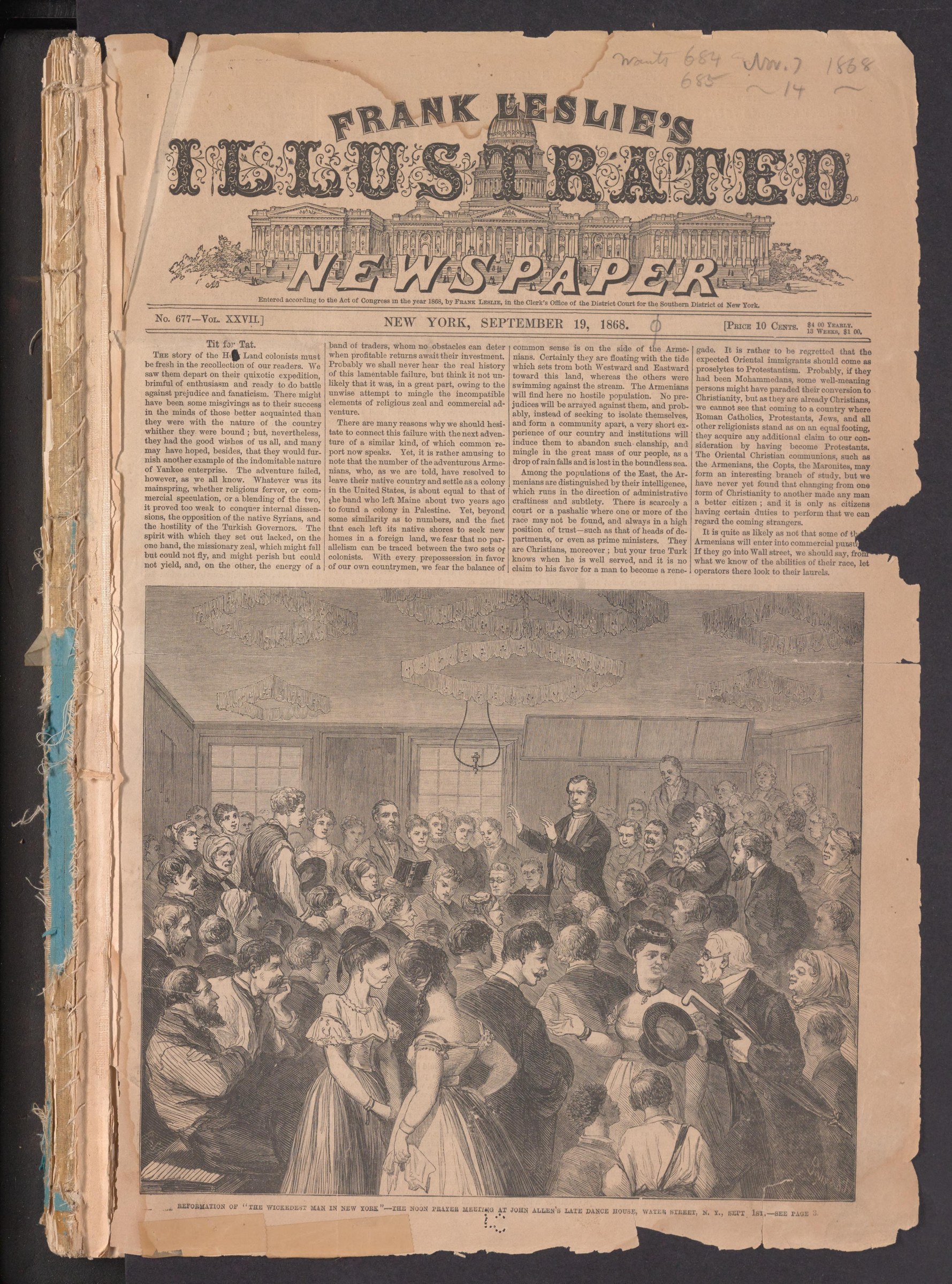
This image records the visual and spatial texture of American urban social life in the 1860s, showing how bodies occupied indoor space during mixed-gender evening assembly. For dance historians it is valuable not for depicting choreographed movement but for documenting the setting and posture conventions of social gathering—the clothing, the proximity, the informal orientation—that contextualize nineteenth-century social dance.
What you are looking at
A crowded indoor assembly or dance gathering fills a wood-paneled room lit by a hanging lamp. Approximately fifty figures pack the space in 1860s dress—women in full skirts with bare shoulders, men in dark suits and jackets. The crowd is densely arranged with little formal structure; some figures stand at the margins while others cluster in the center. A man in light clothing stands elevated or positioned distinctly among the crowd, possibly addressing or leading the assembly. The overall composition is one of social congregation rather than organized performance, with the press of bodies and the casual dispersal of the crowd suggesting an informal dance or social event rather than a formal theatrical presentation. The engraving's fine cross-hatching renders the interior with depth and atmosphere.
The dancing
The figures show no unified dance formation or coordinated movement. Bodies are oriented in multiple directions—some facing the central male figure, others turned toward neighbors or standing at angles. The postures are upright and social rather than dance-like; shoulders are relaxed, arms hang naturally or are raised in conversation. Women's full skirts and bare shoulders are prominent, marking this as fashionable mid-nineteenth-century evening dress. No pair holds a waltz or quadrille position; no group executes a recognizable formation. The overall effect is of people gathered, standing, conversing, and mingling rather than actively dancing.
The dance depicted
The image does not depict an active dance in progress. Instead, it appears to document a social gathering, possibly a ball, reception, or prayer meeting where dancing may occur but is not the primary action captured. The caption reference to 'the widows' man in New York' and 'John Allen's late dance house' suggests this may be a scene of controversial social assembly—likely a working-class gathering space or house of ill repute rather than a genteel ballroom. The crowded, indoor setting and the absence of musicians visible in the frame indicate this is a social or religious gathering rather than a formal dance performance or ball.
How it was made
This is a wood engraving, one of the most common formats for newspaper illustration in the 1860s. The fine parallel hatching and cross-hatching create tonal depth and texture, and the small scale suits reproduction in a weekly illustrated newspaper. The technique allowed rapid composition and printing, making it ideal for timely journalistic reporting. The image's circulation as a newspaper illustration means it reached a broad urban middle-class audience and was produced for immediate consumption as current news rather than as an art object.
About this work
This is a page from Frank Leslie's Illustrated Newspaper, a major American weekly that combined news reporting with engraved illustrations for mass circulation. The scene depicts a crowded indoor social gathering in New York City in the 1860s, related to a controversial religious or social institution. The engraving captures not a formal dance performance but rather the social texture of an urban assembly—the density of bodies, the mix of men and women in fashionable dress, and the informal spatial arrangement typical of a crowded public or semi-public interior. As a news illustration, it serves a documentary function: to show readers what such a place and gathering looked like, combining journalistic interest in current events with visual representation of social life.
For dance historians, the image documents mid-nineteenth-century social assembly practices and the visual culture of urban gathering spaces. It shows how bodies congregated in confined urban interiors, the dress conventions of mixed-gender evening assembly, and the informal, standing-and-mingling pattern of social interaction—very different from the formal seated or processional arrangements of earlier periods or from the choreographed movement of theatrical dance.
How to look at it
Look at the spatial arrangement rather than individual gesture. The viewer should notice the density of the crowd, the multiple orientations of bodies, and the absence of any paired or line formation. Observe the dress—the women's bare shoulders and full skirts, the men's dark jackets—as a marker of 1860s evening assembly rather than dance costume. Note that the central standing male figure draws attention and possibly leads or addresses the group, but no choreographed movement is visible. The engraving's cross-hatching creates an atmosphere of crowded interiority; the hanging lamp and wood paneling establish an indoor urban setting. The composition prioritizes the social fact of gathering over the aesthetic fact of movement.
The artist
Frank Leslie's Illustrated Newspaper was founded in 1855 by Frank Leslie (Henry Carter) and became one of the most widely circulated illustrated weeklies in America before the Civil War. The paper employed numerous engravers and illustrators to produce weekly scenes of current events, society, crime, and urban life. The artists and engravers of these scenes are often uncredited in the historical record; this particular engraving is attributed only to the publication itself. The paper's visual style—dense cross-hatching, attention to crowd scenes and social interiors, journalistic specificity—became a dominant mode of American visual journalism.
The period
The 1860s saw the rapid expansion of illustrated mass-market journalism in America. Wood engraving, despite the emergence of photography, remained the primary technology for reproducing images in newspapers and magazines because it could be printed alongside type on standard printing presses. Frank Leslie's Illustrated Newspaper competed with Harper's Weekly to provide urban readers with weekly images of contemporary events—wars, disasters, society scandals, and scenes of urban life. The particular interest in scenes of urban working-class social life, especially scenes of religious assembly or houses associated with controversy, reflects the period's anxieties about immigrant urban communities, religious enthusiasm, and public morality. In dance terms, the 1860s were marked by the dominance of the waltz and quadrille in ballroom contexts, but also by growing interest in theatrical spectacle (ballet and burlesque), and by the largely invisible but widespread social dancing in working-class and immigrant community spaces documented only through journalism.
Where it lives
This page is held in the Prints & Photographs collection at the Library of Congress and comes from Frank Leslie's Illustrated Newspaper, a weekly publication produced in New York from 1855 to 1891. The newspaper was a major vehicle for visual journalism in antebellum and Civil War-era America, combining news reporting with wood-engraved illustrations.
Questions about this work
Is this a dance scene?
Not in the sense of choreographed movement. The image shows a crowded social gathering or assembly where people are standing, conversing, and mingling in formal dress. It documents the setting and social practice of nineteenth-century urban assembly rather than depicting people actively dancing.
What is the setting and why does it matter?
The caption references 'John Allen's late dance house' in New York, suggesting this is a working-class or controversial social space, not a genteel ballroom. This makes the image valuable for understanding how urban communities of the 1860s gathered and socialized, outside the formal ballroom context that dominates dance history.
How was this image made and distributed?
It is a wood engraving, a technique that allowed images to be printed directly alongside type in newspapers. This made it possible for readers across America to see images of contemporary New York scenes within days of their occurrence. The technique was faster and cheaper than photography for mass reproduction.
What does the dress tell us?
The women's bare shoulders, full skirts, and fitted bodices, and the men's dark jackets and formal suits, are typical evening wear of the 1860s. This marking of formal dress indicates that the gathering was understood as a significant social occasion, not ordinary domestic or work space.
More dance artwork





