49 works in this view — arrow keys or swipe to move between them.
Dance in Art
Frank Leslie's Illustrated Newspaper (New York, N.Y.) 1855-1891
Unknown artist
- Collection:
- Prints & Photographs
- Source:
- Library of Congress
- Rights:
- Rights vary by item — check the source record before reusing this image. Source record ↗
- Recorded as:
- Library of Congress — no known restrictions (verify per item)
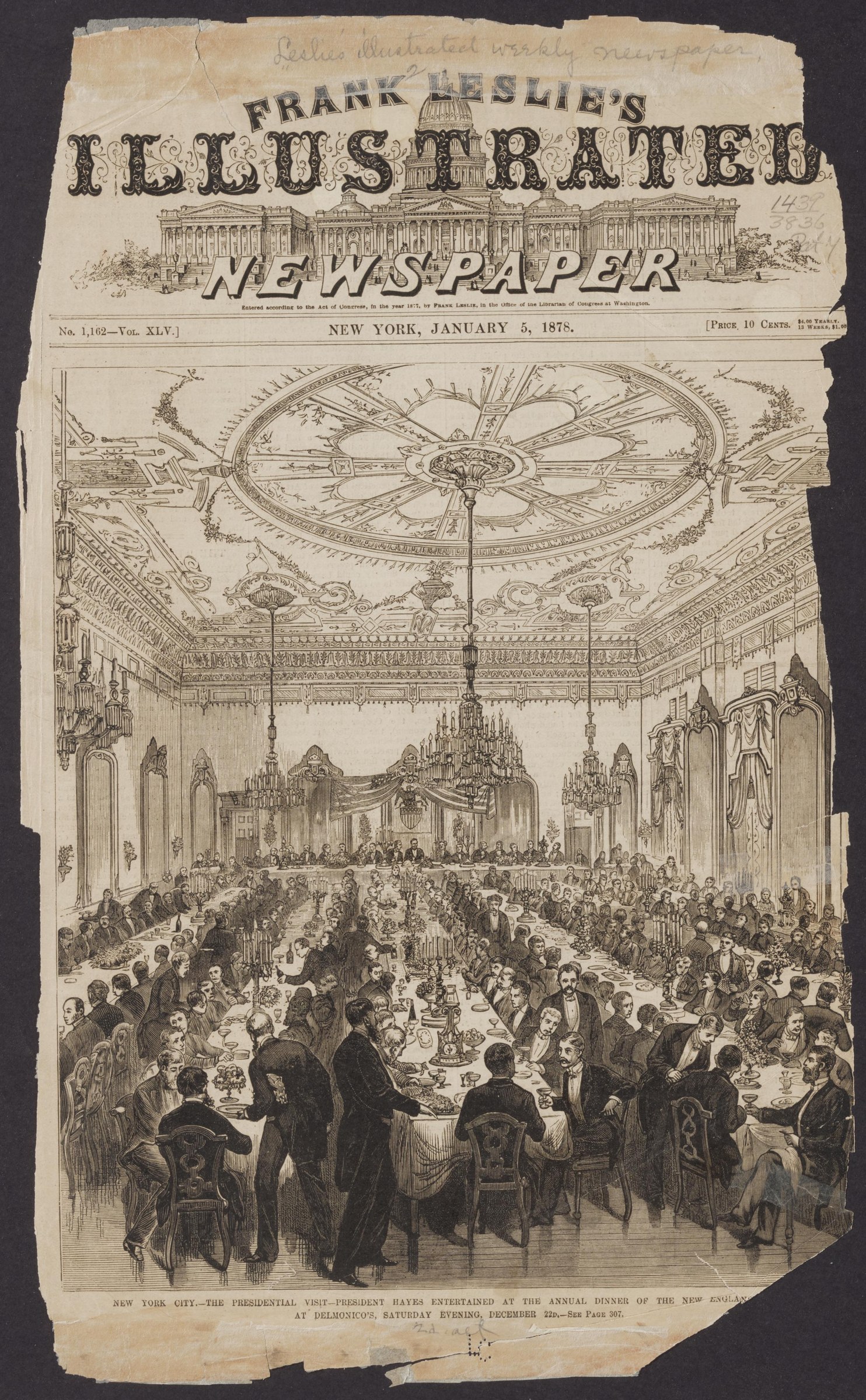
Dancers and historians of the Gilded Age should attend to this image as evidence of the settings, dress codes, and social formality in which ballroom dancing took place. The scale of the space, the density of the crowd, the architectural elaboration, and the strict gender and class protocols visible here frame the context for understanding how dance functioned in this period—not as a primary entertainment, but as one element of a larger ritual of formal socializing, eating, and display.
What you are looking at
This is a wood engraving from Frank Leslie's Illustrated Newspaper depicting a formal state dinner at Delmonico's restaurant in New York on Saturday evening, December 28th. The composition shows an elaborate interior with an ornate coffered ceiling, hanging chandeliers, and decorative wall panels. Hundreds of formally dressed guests—men in dark suits and tails, women in evening gowns—are seated at long dining tables laden with place settings, flowers, and serving dishes. A grand architectural centerpiece dominates the middle distance, featuring spires and elaborate ornamentation. The perspective draws the eye down the length of the hall, emphasizing the scale and grandeur of the occasion. The crowd fills the entire depth of the space, with guests standing, seated, and moving between tables. The engraving captures a moment of formal social ritual rather than active dancing.
The dancing
The figures are almost entirely sedentary, seated at tables or standing in conversation and circulation. There is no visible dancing or organized group choreography. Posture is formal and upright, consistent with Victorian dinner etiquette. Men are in evening dress with jackets and high collars; women wear long gowns appropriate to 1870s evening wear. The density of figures and their positioning suggests mingling, dining, and formal socializing rather than any coordinated movement or dance.
The dance depicted
This image does not depict dancing. It shows a formal presidential state dinner—the caption identifies it as entertainment of President Hayes at the annual dinner of the New England Society. While dance may have occurred at such events, none is visible in this engraving. The scene is one of formal dining and social circulation typical of Gilded Age high society, not ballroom dancing or any other organized dance performance.
How it was made
This is a wood engraving, a relief printing technique that allowed for mass reproduction in newspapers. The fine cross-hatching and careful line work create depth and texture; the technique permitted intricate architectural detail and crowd effects. As a page from Frank Leslie's Illustrated Newspaper, a major American illustrated weekly, this image was produced for a broad middle- and upper-class audience hungry for images of current events and high society. The engraving's tonal range—achieved through varying densities of parallel lines—allows the artist to suggest the play of gaslight or candles across the formal interior.
About this work
Frank Leslie's Illustrated Newspaper was among the most influential illustrated periodicals of the nineteenth century, bringing wood-engraved news images of current events, society, and spectacle to American readers. This particular image documents a state dinner of the Gilded Age—a moment when formal entertaining, architectural display, and social performance were inseparable. The work is valuable not for depicting dance but for showing the context in which dance occurred: the formal social world of the late 1870s, the scale and expense of high-society entertaining, and the visual language newspapers used to represent that world to readers who would never attend such events. It sits at the intersection of social history, material culture, and visual media.
How to look at it
Look at the architecture first: the coffered ceiling, the proportions of the room, the hanging fixtures. These establish the scale and cost of the event. Then follow the crowd from foreground to background: notice how figures are arranged, how dress distinguishes gender, how the composition moves the eye toward the central ornamental feature. The engraver has used density of line work to suggest distance and atmosphere. Look for any figures in motion—there are none; everyone is either seated or standing still. This frozen moment is characteristic of the newspaper's approach: not capturing a dance in progress, but documenting the social fact of the gathering itself.
The artist
Frank Leslie's Illustrated Newspaper was founded by the British-born publisher Frank Leslie (pen name of Henry Carter, 1821–1880). The publication pioneered the use of wood engraving to bring topical imagery to a mass audience. The newspaper employed numerous engravers and artists, most uncredited. The house style was detailed, narrative-driven, and designed to make readers feel present at events they could not attend. This particular engraving is typical of the newspaper's coverage of high society: a bird's-eye or distant perspective that emphasizes architectural grandeur and crowd composition over individual portraiture.
The period
The Gilded Age (1870s–1890s) was a period of rapid wealth accumulation, architectural ambition, and new forms of public display by the American elite. Formal entertaining at establishments like Delmonico's—one of New York's most prestigious restaurants—was a key means by which the wealthy performed their status. State dinners and society events were regularly covered by illustrated newspapers, which treated them as spectacle. Ballroom dancing in this period remained an important marker of social refinement and courtship ritual, but occurred within these larger formal frameworks. The date of this image (December 1877) falls within the presidency of Rutherford B. Hayes (1877–1881).
Where it lives
This page is from Frank Leslie's Illustrated Newspaper (New York, N.Y.), 1855–1891. The image comes from the issue of January 5, 1878, No. 1,162 (Volume XLV), and is housed in the Library of Congress Prints and Photographs collection. It was one of thousands of pages that made up the newspaper's archive of American social and political life.
Questions about this work
Is this an actual state dinner or an imaginative recreation?
The caption identifies this as a report of an actual event: President Hayes entertained at the annual dinner of the New England Society at Delmonico's on December 28, 1877. The newspaper's house style was to render actual events as detailed engravings, often based on sketches made by artists present or later accounts. Whether this is drawn from direct observation or from description cannot be determined from the image alone, but it is presented as reportage, not fiction.
Was dancing part of this dinner?
Formal dinner followed by dancing was a standard formula for high-society entertaining in the Gilded Age. However, this engraving captures only the dinner portion. Ballroom dancing, if it occurred, would have happened later in the evening and in a different space, and is not visible here.
Why is there an ornate architectural structure in the middle of the dining hall?
The elaborate structure appears to be a decorative centerpiece, possibly a temporary architectural installation created for the occasion. Such ornamental set pieces were common at grand dinners of the period, designed to impress guests and demonstrate the host's wealth and taste. It may have held flowers, food, or candles.
How many people are shown here?
The engraving depicts hundreds of guests, though an exact count is difficult. The dense arrangement of figures and the receding perspective create an impression of a very large gathering—consistent with a major state dinner of the 1870s.
More dance artwork





