49 works in this view — arrow keys or swipe to move between them.
Dance in Art
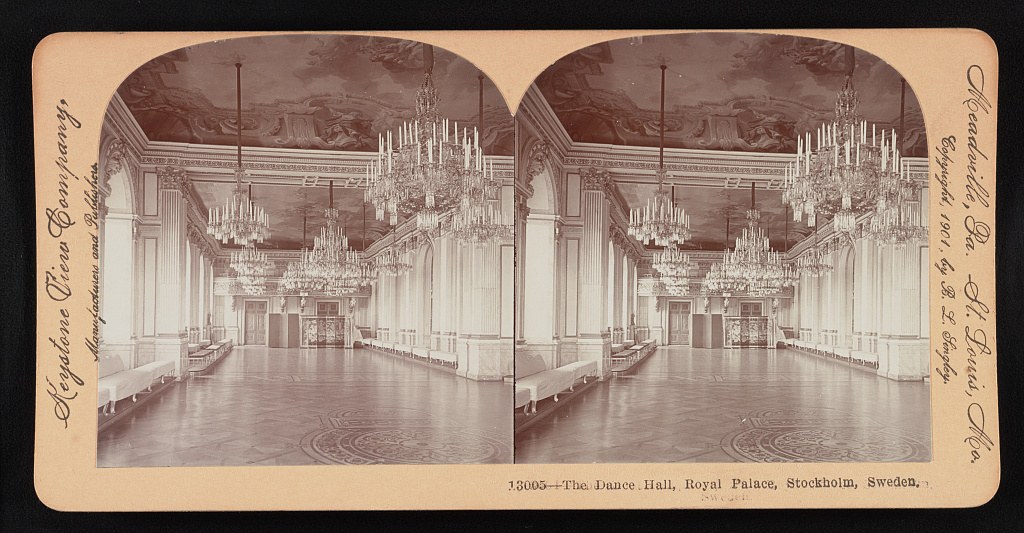
The dance hall, Royal Palace, Stockholm, Sweden
Unknown artist
- Collection:
- Prints & Photographs
- Source:
- Library of Congress
- Rights:
- Rights vary by item — check the source record before reusing this image. Source record ↗
- Recorded as:
- Library of Congress — no known restrictions (verify per item)
This photograph documents one of the most important ballrooms in Scandinavian royal culture, providing concrete evidence of the physical environment and scale of formal European court dancing. The stereoscopic format shows how images of elite dance spaces were circulated and consumed by a broad nineteenth-century audience, making grand interiors accessible to viewers far from the palace itself.
What you are looking at
This stereoscopic photograph presents an opulent ballroom in the Royal Palace at Stockholm, captured in the moment before or during a formal dance event. The space is a study in neoclassical grandeur: the ceiling rises high, decorated with allegorical frescoes, and is hung with multiple large crystal chandeliers that flood the room with light. The walls are articulated with tall Corinthian columns in white or cream, alternating with pale panels, creating a rhythm of verticality. The floor is a polished expanse of wood, reflecting the light from above. The room is entirely empty of dancers—we see no figures in motion, no couples at the moment of the dance itself. Instead, the photograph documents the architectural setting that would frame such events: a space prepared and waiting, formally arranged to receive the bodies that would move through it. The image is presented in the stereoscopic format typical of nineteenth-century travel and documentary photography, printed on cream card stock with the publisher's credit visible at the bottom.
The dancing
There are no human figures visible in this photograph. It is an architectural documentation rather than a record of dance in progress. The emptiness of the ballroom is itself the subject—we see the stage prepared for dance but no dancers occupying it.
The dance depicted
This image does not depict dance in motion. It is a documentary photograph of a ballroom interior, showing the formal setting where court dances and social dancing would have taken place. The space itself—its scale, its neoclassical vocabulary, its abundant light—tells us about the kind of dance that occurred here: formal, structured, likely including the quadrilles, waltzes, and other European court dances of the late nineteenth and early twentieth centuries. The photograph is evidence of the infrastructure and stage management of elite dance culture, not of the dance itself.
How it was made
This is a stereoscopic photograph, a format achieved by printing two slightly offset images side by side, intended for viewing through a stereoscope that creates the illusion of three-dimensional depth. The photograph was printed on albumen paper or similar, then mounted on cream card stock. The stereoscopic format was a dominant medium for travel, architectural, and documentary imagery in the second half of the nineteenth century, allowing middle-class audiences without access to palaces to experience monumental interiors. The clarity and even lighting suggest studio-quality architectural photography, and the careful composition—centered on the central axis of the room to maximize the depth effect—shows professional intent.
About this work
This stereoscopic photograph documents the Dance Hall (ballroom) of the Swedish Royal Palace in Stockholm, a space designed and furnished for formal court dancing in the European neoclassical tradition. It is not a record of dance itself but of the architectural and social infrastructure that framed elite dance practice in the early twentieth century. The ballroom, empty and waiting, speaks to the formality, scale, and visual magnificence that nineteenth-century court culture demanded of its spaces for movement. For historians of dance, the image is valuable precisely because it shows the stage—the spatial context, proportions, ceiling height, and light—within which thousands of formal social dances would have been performed.
How to look at it
Attend to the architectural vocabulary: the height of the room, the relationship between wall and ceiling, the rhythm of the columns, and the scale implied by the chandeliers. These details determine the character of the dancing that occurred here. The stereoscopic format is meant to be viewed through a stereoscope, which creates an impression of walking into the room; a flat viewing of the card loses much of its intended effect. Notice the perfect emptiness—the ballroom is a stage set, prepared but not occupied, which paradoxically makes it speak more eloquently about the formal, codified nature of the dancing it was designed to frame.
The artist
The photograph is credited to a commercial stereoview publisher, identified in the catalogue as a mass-market producer of stereoscopic cards. These companies operated internationally and produced thousands of cards documenting architecture, landscape, ethnography, and daily life, selling them to the Victorian and Edwardian middle class. The photographer is not identified, typical of this industrial production model.
The period
The stereoscopic card was manufactured in 1901, at the height of the stereoscope's popularity and commercial reach. At this moment, European ballroom dancing was undergoing significant codification—the social dances of the nineteenth century (waltz, quadrille, polka) were being systematized into what would become modern ballroom dance. Royal palaces across Europe were repositories of these formal traditions, and their ballrooms were understood as historically significant and worthy of photographic documentation for a mass audience. The Swedish royal court, in particular, maintained elaborate court ceremony and formal dance practices throughout the nineteenth century.
Where it lives
This stereoscopic card is held by the Prints & Photographs Online Collection of the Library of Congress. It is catalog number 13005. Stereoscopic cards were commercial products, mass-produced and widely distributed, and this example is one of thousands of similar documentary photographs of European palaces and public buildings made for the mid-to-upper-middle-class tourist and armchair traveler market.
Questions about this work
Why is the ballroom empty?
The photograph is not meant to document a dance in progress, but rather to show the architectural setting itself. Stereoscopic cards were travel and documentary images, and an empty, formally lit interior photographs better than a crowded one. The emptiness allows the viewer to grasp the room's proportions, light, and design without visual clutter.
What dances would have been performed in this room?
The neoclassical design and formal scale suggest the quadrille, waltz, polka, and other European court and ballroom dances of the nineteenth century. The Swedish royal court maintained elaborate ceremonies and formal dances, and this ballroom was built to accommodate state occasions, court ceremonies, and formal balls with many couples dancing in synchronized patterns.
What is a stereoscopic card?
A stereoscopic card (or stereoview card) was a card printed with two side-by-side photographs, each taken from a slightly different angle. When viewed through a stereoscope—an optical device that was enormously popular in the nineteenth century—the two images merged in the viewer's eye to create a convincing illusion of three-dimensional depth. Millions were produced and sold as a form of entertainment and education, allowing people to 'visit' places they could never reach.
When was this photograph made?
The card is dated 1901. This was the height of the stereoscope era, though the technology would decline sharply in the following decade as postcards and photographs became easier to produce and distribute.
More dance artwork





