49 works in this view — arrow keys or swipe to move between them.
Dance in Art
The Peasant Wedding Dance
Pieter van der Heyden
- Medium:
- Engraving; first state of three
- Collection:
- Drawings and Prints
- Source:
- met
- Rights:
- Public domain — free to use, share and adapt.
- Recorded as:
- CC0 (Public Domain)
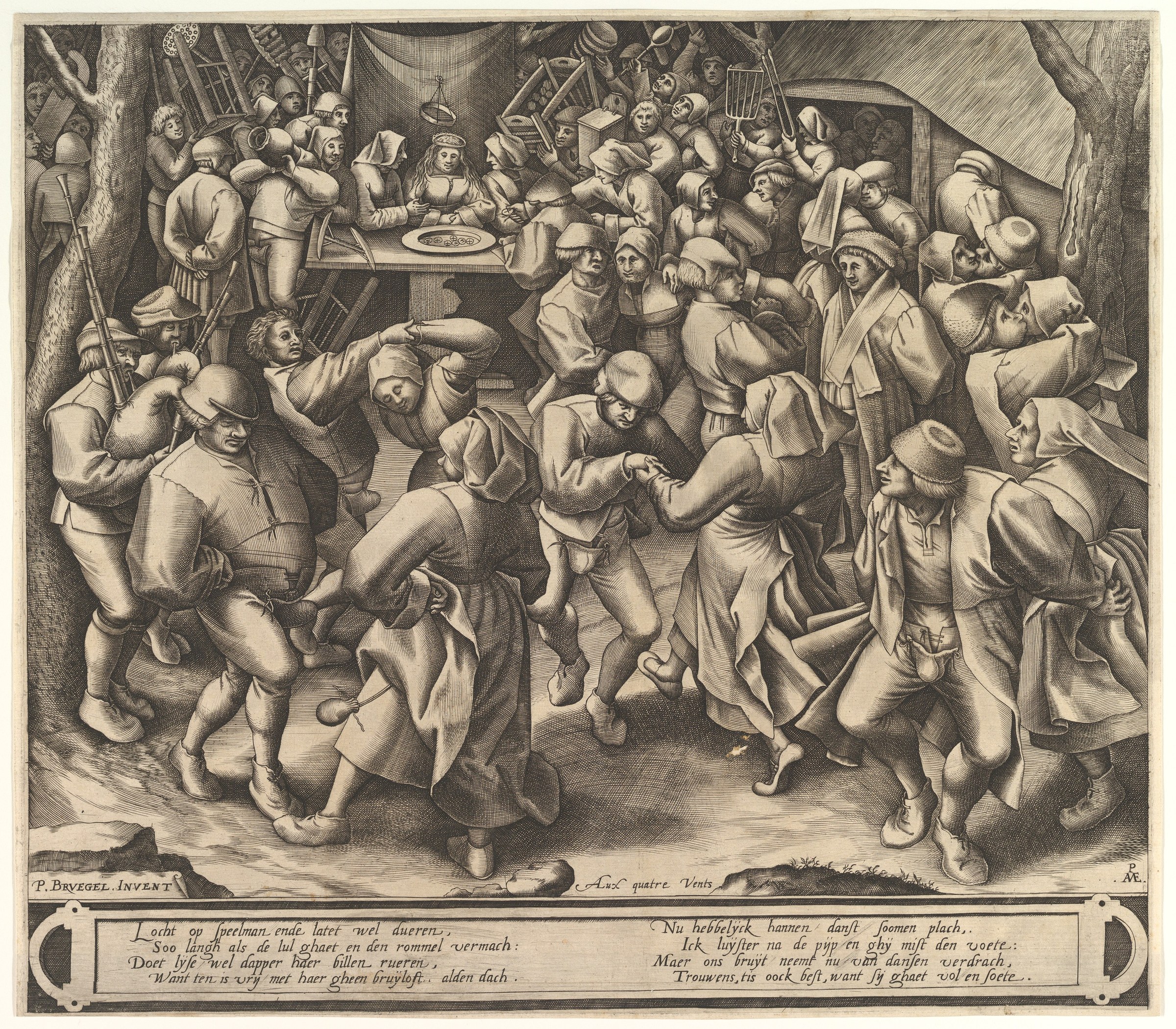
This engraving is one of the most detailed surviving visual documents of how peasants actually danced in the 16th century—not how courtly theorists thought they should dance, but how they moved in real social settings. It shows the vernacular, participatory tradition that later became formalized into the folk dances of Europe, and it demonstrates that couple dancing was already established and widespread among ordinary people generations before the rise of ballroom dancing.
What you are looking at
A crowded outdoor festival or village celebration, rendered in detailed engraving with fine cross-hatching. Dozens of figures—men, women, and children in 16th-century dress—fill a clearing beneath trees. At the center, musicians play pipes and drums on a raised platform or table, while in the foreground and throughout the scene, figures dance, embrace, feast, and socialize. A large table laden with food occupies the middle distance, and figures cluster around it. The composition is deliberately chaotic: bodies overlap and interweave; some couples dance while others sit, eat, drink, or gesture in conversation. The mood is boisterous and unrestrained—this is rustic merriment, not courtly decorum. The engraving captures a particular moment of village festivity, likely a wedding celebration given the title, where multiple activities—eating, drinking, music-making, and dancing—occur simultaneously and with equal prominence.
The dancing
The dancers throughout the scene use relaxed, informal postures—many clasp hands or embrace at the waist in pairs, moving with bent knees and swaying hips rather than upright extensions. Several couples are locked in close contact, suggesting paired social dancing of the kind common in folk festivals. The figures show weight distributed low and forward, with torsos flexed rather than held rigid. Arms are bent and engaged; many dancers hold their partners firmly. The footwork is not precisely rendered—this is engraving for narrative content, not technical documentation—but the overall frame suggests the bouncy, grounded movement of village dance rather than the upright carriage of courtly forms.
The dance depicted
This depicts peasant dancing of the 16th-century Low Countries, almost certainly a country wedding celebration. The dances shown are social couple dances of the folk tradition—likely variants of dances known in the period as branle or other popular regional forms, danced by villagers without formal training or courtly refinement. The presence of paired dancers, the close holds, and the informal setting all point to participatory social dancing rather than performed spectacle. The image captures the anarchic energy of folk celebration: dancing is one activity among many (eating, drinking, socializing, music-making), and the overall scene emphasizes the collective, communal nature of the event rather than the skill or form of individual dancers.
How it was made
This is an engraving—a print made by incising lines into a copper plate, wiping ink across the surface, and pressing paper against it. The technique allows for fine detail and tonal variation through cross-hatching and varying line density, visible especially in the rendering of fabric folds, shading, and the differentiation of figures. Engravings were expensive to produce but cheap to reproduce; each impression was a fresh print, making engravings a primary means of circulating images widely across Europe in the 16th and 17th centuries. The catalogue notes this is the first state of three, indicating the plate was reworked after this impression was made—a common practice allowing the artist to refine or modify the composition.
About this work
This is a detailed narrative engraving of a 16th-century peasant wedding celebration in the Low Countries, depicting multiple simultaneous activities centered on social dancing, feasting, and music-making. The work belongs to a tradition of genre scenes documenting rural life and popular custom—a distinctly northern European interest of the period. It is valuable for dance history because it shows how ordinary people danced together in the period: in close pairs, with relaxed informal posture, as part of collective festivity rather than as a formal or codified practice. The engraving circulated widely and influenced later depictions of peasant life and folk custom in northern European art.
How to look at it
Focus on the pairs of dancers: notice how they hold each other, the bent-knee posture, the informal embrace. Compare their movement to the static feasting figures or the musicians on the platform—the artist is showing dancing as energetic, physical, and distinct from formal courtly movement. Look also at the layering of the scene: the way figures overlap and the composition refuses a single focal point. This is not a performance being watched; it is a simultaneous, collective event where dancing, eating, music, and conversation all happen at once. The print's dense hatching and fine detail allow the viewer to linger on particular figures and read individual stories within the larger chaos of celebration.
The artist
Pieter van der Heyden was a prolific Flemish engraver active in the mid-16th century, known for narrative and genre scenes often based on designs by Pieter Bruegel the Elder. Van der Heyden worked as an interpreter and translator of Bruegel's compositions into prints, bringing Bruegel's detailed, densely populated scenes of peasant life and popular custom to a wide northern European audience. The dense, overlapping composition and the subject matter of rural festivity are characteristic of their collaborative practice. Van der Heyden's engravings were widely collected and influential in establishing the visual conventions for depicting peasant life in northern European art.
The period
This engraving was made in the 1570s, a period of intense interest in the documentation and depiction of peasant life and folk custom in the northern Low Countries and Germany. The rise of genre painting and printmaking in this period reflected both humanistic curiosity about human behavior and the visual culture of print, which made such scenes economically viable. In dance history, this was a period of formalization: courtly dance was being codified in theory and practice (Orchésographie by Thoinot Arbeau appeared in 1588), while folk dances remained largely unwritten and learned by participation. This engraving therefore captures a moment when peasant dancing was vibrant and widespread but not yet systematically documented by dance theorists—we see it through the eyes of a visual artist rather than a dance master.
Where it lives
The work is held by the Metropolitan Museum of Art as part of the Drawings and Prints collection. The source information links it to the museum's online collection, where it may be viewed and studied. This is a print—a reproducible artwork made for circulation—rather than a unique object; other impressions of this and later states of the same plate exist in other collections.
Dance in this work
Questions about this work
Who designed this engraving?
The engraving is by Pieter van der Heyden, but it is likely based on a composition by or in the manner of Pieter Bruegel the Elder, with whom van der Heyden frequently collaborated. Van der Heyden's primary role was to translate designs into engraved prints. The signature 'P. Bruegel, Invent' visible on the plate confirms the design origin.
What kind of wedding is this?
This is a village or peasant wedding, probably in the Low Countries, early 16th century. The rough clothing, outdoor setting, and boisterous atmosphere signal rural celebration rather than an urban or courtly event. The presence of hired musicians and the scale of the gathering suggest this is a community-wide festivity.
What are the people dancing?
The specific dance names are not recorded, but the paired, close-hold dancing and the informal style suggest variants of branle or other popular folk dances of the period. These were social dances, learned by participation and not governed by the formal rules that were beginning to be written down for courtly dances at the same time.
Why does the image matter for dance history?
It provides one of the most detailed and vivid visual records of how ordinary people actually danced in the 16th century—not the idealized or codified versions described in dance manuals, but real vernacular movement in a real social setting. It shows that couple dancing was widespread, informal, and central to community celebration.
More dance artwork