49 works in this view — arrow keys or swipe to move between them.
Dance in Art
Dance Hall in Arles
Vincent van Gogh
- Source:
- Wikimedia Commons
- Rights:
- Public domain — free to use, share and adapt.
- Recorded as:
- public_domain
This work documents the public dance hall as a social institution at a moment when such spaces were new and significant sites of urban working-class life and modern courtship. For dance historians, it is one of the rare paintings that treats social dancing not as a courtship ritual or a formal social performance, but as a space of communal pleasure and bodily expression. The technical choices—the visible brushwork, the expressionistic color, the flattened crowding—also show how modern painting could convey the rhythm and energy of dance itself, a shift that influenced dance imagery for decades to come.
What you are looking at
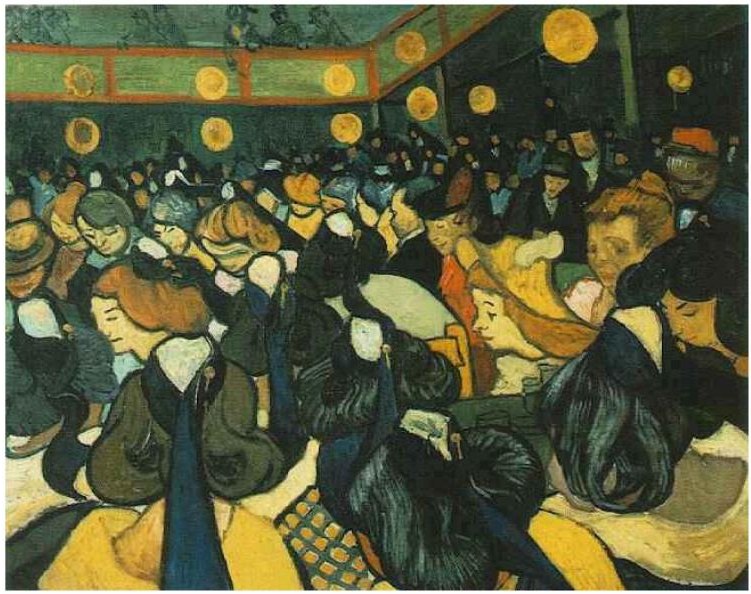
A crowded interior dance hall in warm yellows and deep greens, lit by hanging circular lamps that glow golden against dark walls and ceiling. The floor is packed with figures in late 19th-century dress—women in high-necked blouses, hats, and long skirts in ochre and pale tones; men in dark suits and bowlers. The crowd fills the entire canvas in a compressed, almost claustrophobic arrangement, with faces and bodies overlapping across the foreground and receding into shadow. The perspective flattens the space, making the crowd feel densely packed and animated. Several couples are recognizably dancing—the nearest woman's body is tilted in an active pose, and scattered throughout the scene are pairs in close proximity that suggest movement and partnered motion. The overall effect is of convivial noise and energy, the particular warmth and intimacy of a working-class public dance venue.
The dancing
Most dancers are in close contact or near-partnered stance typical of fin-de-siècle social dancing, though the crowding makes specific holds difficult to discern. Several women are tilted or off-balance in ways that suggest active turning or swaying; their skirts and posture indicate weight shifts and rotational movement. The men are generally upright, some with arms bent or extended in partner-guiding positions. Faces are animated and turned toward partners or toward the viewer, suggesting engagement and pleasure rather than formal technique. The overall impression is of bodies in relaxed, social proximity rather than the rigid frame of formal ballroom.
The dance depicted
This appears to be a depiction of late 19th-century working-class ballroom dancing, most likely the waltz or related salon dances that dominated European dance halls of the 1880s. The close partnering, the crowded public hall setting, and the dress all point to social waltz culture. However, the flattened perspective and expressionistic handling obscure specific footwork and frame details that would confirm a particular style. The scene captures the democratic spirit of the public dance hall rather than the refinement of aristocratic dance—these are ordinary people taking pleasure in movement and music in a space lit and furnished for that purpose.
How it was made
This is an oil painting, recognizable from the visible brushwork, layered color, and the way forms are built from visible strokes rather than line. Van Gogh's characteristic thick, directional brushwork is evident throughout—particularly in the treatment of the lamps as bold yellow circles and in the way the crowd is suggested through repeated marks and overlapping color patches rather than careful individual portraiture. The technique allows van Gogh to convey movement and energy through the paint itself; the dancing crowd is rendered with almost the same rhythmic, energetic mark-making as the swaying bodies would require. This approach was radical for dance imagery, which had often been rendered through line and careful academic drawing.
About this work
This is one of van Gogh's paintings of the dance hall at the Moulin de la Galette or a similar venue in Arles, created during his productive period in southern France in 1888. It documents a specific historical form of public entertainment—the commercial dance hall where working people could pay to dance in a communal space—while treating that mundane subject with the expressive intensity van Gogh gave to all his work. The painting captures both the social reality of the dance (crowding, intimacy, working-class pleasure) and the visual and emotional experience of being in such a space (noise, heat, color, rhythm). It is neither a formal documentation of a dance type nor an allegory, but a direct record of a moment and a place rendered through van Gogh's distinctive visual language.
How to look at it
Notice the artist's choice to fill the entire canvas with the crowd, leaving no space for spectators or empty floor—this immersion is key to the work's effect. Look at how the lamps structure the composition even as the figures obscure the architecture; the golden circles echo and emphasize the warm color of dress and flesh. Pay attention to the way individual faces and bodies are suggested through color and mark-making rather than drawn in detail; van Gogh renders presence and energy rather than narrative or portraiture. The slight tilt and lean of many figures, the way arms extend, the turned heads—these small gestures accumulate to suggest the constant, gentle motion of social dancing, captured mid-flow rather than posed.
The artist
Vincent van Gogh (1853–1890) moved to Arles in February 1888, seeking warmth, color, and a simpler life. He was intensely interested in capturing the life of working people and public spaces, and the local dance halls provided both subject matter and escape from isolation. He painted several versions of dance-hall scenes during his Arles period. Van Gogh's approach to color and brushwork was driven by emotion and symbolism rather than optical accuracy; he chose colors for their emotional effect and applied paint in visible, directional marks that suggest movement and energy. His treatment of social subjects like the dance hall was sympathetic and unsentimental, capturing genuine pleasure and community rather than moralizing about leisure or vice.
The period
The 1880s saw the rapid growth of commercial public dance halls across Europe, responding to urbanization, industrialization, and the emergence of a urban working and lower-middle class with leisure time and disposable income. The waltz remained the dominant partner dance, but music halls and dance venues also featured quadrilles, polkas, and regional variants. These spaces were novel and culturally significant—they were sites of democratic mixing, of relatively unsupervised heterosexual interaction, and of modern entertainment. At the same time, Impressionism and Post-Impressionism were establishing new ways of depicting modern leisure and urban life. Van Gogh's Arles paintings coincide with the end of Impressionism's dominance and the rise of Symbolism and Expressionism, movements that treated emotional and psychological content as more important than optical accuracy. His dance-hall paintings sit at the intersection of documentary interest in modern life and modernist formal experimentation.
Where it lives
The work is attributed to Vincent van Gogh and dated to 1888 based on style and historical record. The source listed is Wikimedia Commons, indicating a digitized version of a work in a public collection, though the specific holding institution is not provided in the catalogue record.
Dance in this work
Questions about this work
Is this a specific dance or dance hall?
The painting appears to depict a dance hall in or near Arles, France, where van Gogh lived in 1888. The Moulin de la Galette was one such venue; van Gogh painted it and similar halls multiple times. The dance is almost certainly the waltz or a variant of salon dancing popular in 1880s France, but the crowding and painterly technique make it difficult to identify a specific style with certainty.
Who are these people?
Van Gogh depicts working-class and lower-middle-class Arlesians—servants, laborers, shopkeepers, and their companions—enjoying an evening of public dancing. These were the people who patronized commercial dance halls in the 1880s, paying a modest fee for music, light, and space to dance. The painting is sympathetic to their pleasure and energy.
Why are the colors so strange?
Van Gogh chose color for emotional and symbolic effect rather than optical accuracy. The warm yellows and greens create intimacy and warmth; the glowing lamps suggest the artificial light and energy of the modern dance hall. The visible, directional brushwork reinforces the sense of movement and vitality. This was a deliberate break from Impressionist practice and a hallmark of Post-Impressionist and Expressionist work.
Does van Gogh judge or critique what he depicts?
No—the tone is affirmative and celebratory. Van Gogh treats the dance hall as a space of genuine pleasure, community, and human connection. Unlike some contemporary critics who saw such venues as morally suspect or symptomatic of modern decline, van Gogh paints them with dignity and warmth.
More dance artwork





