49 works in this view — arrow keys or swipe to move between them.
Dance in Art
La Salle de danse à Arles
Vincent van Gogh
- Source:
- Wikimedia Commons
- Rights:
- Public domain — free to use, share and adapt.
- Recorded as:
- public_domain
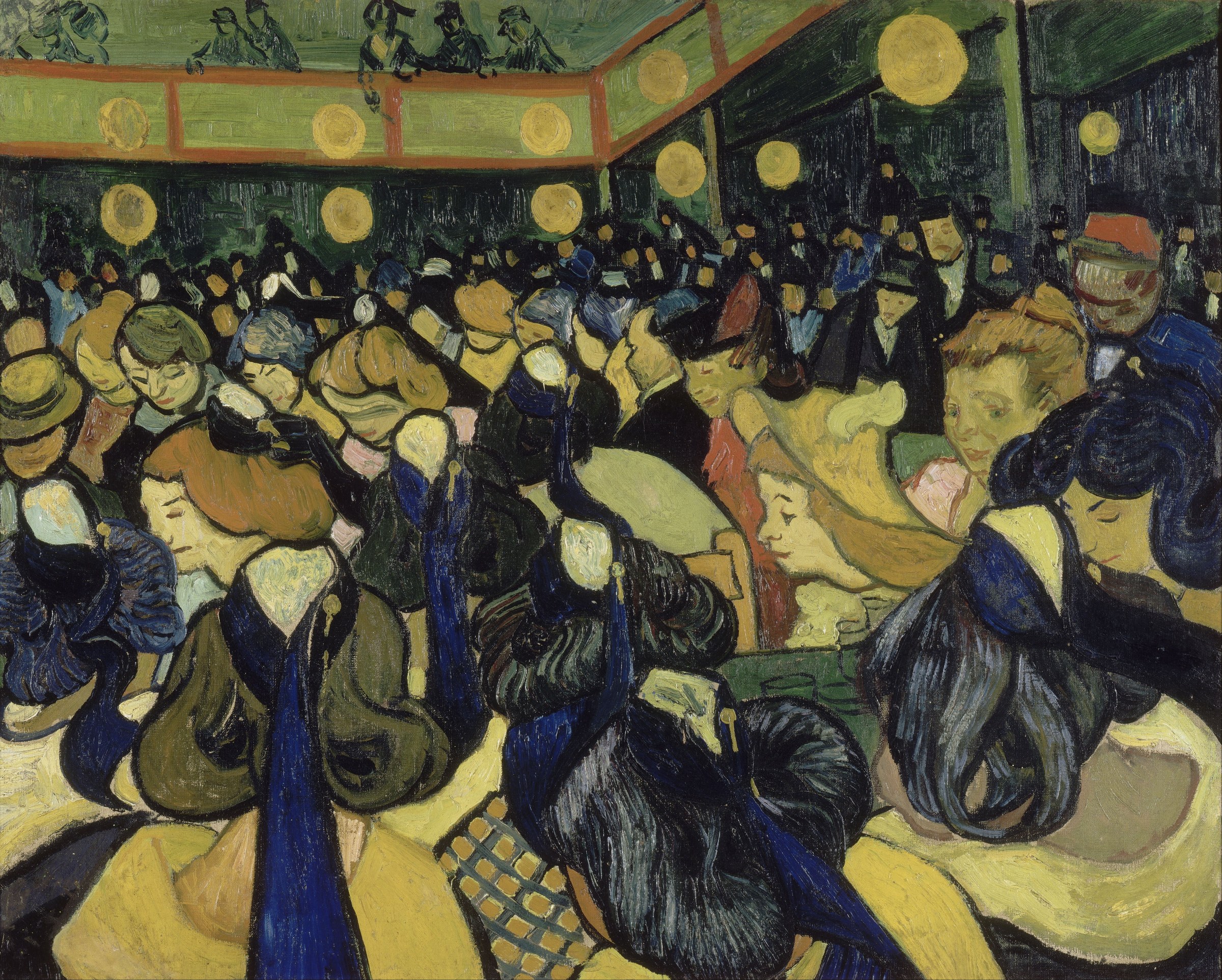
This work documents the waltz as a lived social practice among ordinary people in provincial France, at a moment when ballroom dancing was becoming a mass leisure activity. For art historians, it is also a key example of Post-Impressionist technique—the use of outline, simplified color, and expressionist distortion to convey mood and movement rather than photographic accuracy. The painting shows how dance operated as a subject for artistic innovation, not merely as decoration.
What you are looking at
A crowded dance hall in Arles glows with warm yellow lamplight—at least a dozen hanging globes suspended from the ceiling cast pools of light across the dark interior. The floor is bare wood or tile, rendered in pale yellows and greens. A dense crowd of figures in late-19th-century dress fills the space: men in dark jackets and straw hats, women in long skirts of yellow, blue, brown, and rust, many wearing the pale straw boater hats fashionable in 1888. Several couples are dancing in the central and mid-ground area, while others stand, sit, or cluster in conversation. The architectural space is defined by wooden ceiling beams in reddish-brown and green walls; a darker zone at the back suggests further depth and additional dancers. The composition emphasizes the social density and cheerful informality of the scene—not a formal ballroom, but a public entertainment venue where ordinary people gather. The brushwork is energetic and gestural throughout, with strong outlines defining forms against the warm and cool color blocks.
The dancing
Dancers are depicted in closed holds and facing each other at various positions across the floor. Most visible are couples in what appears to be a waltz position—one figure seen from behind in the right foreground with arms raised and bent, suggesting a turn or rotation; another couple in the left-center shows two figures in profile engaged in a rotation, the woman's skirt flaring. The bodies are rendered with sinuous lines; weight appears to shift between the partners. No pointe shoes or balletic frame is evident; the posture and clothing point toward social ballroom dancing of the period. The dancers' faces are shown in profile or three-quarter view, often with eyes downcast or focused on their partner, a convention of the period that registers intimacy and concentration.
The dance depicted
This is a representation of late-19th-century social ballroom dancing, most likely waltz, the dominant couple dance of 1880s Arles and France generally. The painting captures a public dance hall (likely a guinguette or dancehall open to working and middle-class patrons), where the waltz was the ordinary recreation of the town. The closed-hold positions, the spinning and turning visible in several couples, and the three-quarter time structure implicit in the composition all align with waltz practice. The scene is not theatrical or professional; these are amateurs in a social setting, which tells us about the democratization of ballroom dancing by the 1880s—it was no longer confined to courts or elite assemblies.
How it was made
This is an oil painting, identifiable by the layered, gestural brushwork, the luminosity of the color (particularly the glowing yellows of the hanging lamps), and the way forms are built up from dark underpaintings into lighter tones. The artist has used bold outlines in dark blue-black to define and separate figures from the background and from each other—a technique sometimes called cloisonnism, borrowed from stained glass and Japanese prints. This outline method allows the painting to read clearly even at a distance and even in the crowded composition; each figure remains distinct. The thick, visible brushwork and simplified color planes suggest post-impressionist technique, which was emerging in the late 1880s and allowed artists to capture movement and emotion with greater directness than academic realism permitted.
About this work
This is an oil painting of a public dance hall in Arles, France, depicting a crowded, convivial evening of social ballroom dancing, probably waltz, under gas or oil lamps. The work belongs to the late-19th-century documentary tradition of painting modern social life—the cafés, cabarets, and dance halls where ordinary people spent their leisure time. It is also a work of formal experiment, using bold outlines and warm-cool color contrasts to organize a complex, crowded scene into a legible and emotionally vivid composition. The painting is both a record of a specific local dance culture and a formal study in how to depict movement, light, and collective social pleasure.
How to look at it
Notice how the artist uses the hanging lamps as compositional anchors: their round yellow shapes create a rhythm across the ceiling and draw the eye into depth. The dark outlines separating each figure allow the eye to track individual dancers even in the crowded composition—without them, the scene would dissolve into an undifferentiated mass. Watch how the women's skirts are rendered with bold brushstrokes that suggest the turning and swaying of the dance; the artist has exaggerated the movement to convey energy rather than to document it precisely. The color temperature shifts from warm yellows and oranges around the lamps to cooler blues and greens in the shadowed areas, creating a sense of enclosed, intimate space despite the crowd.
The artist
Vincent van Gogh (1853–1890) spent ten weeks in Arles in the autumn and winter of 1888, a period of intense productivity and experimental work. He arrived after years of study and struggle in Brussels, Antwerp, and Paris, seeking a place of solitude and renewal and hoping to establish an artist community. In Arles he painted landscapes, portraits, still lifes, and scenes of local life. The Night Café and the Dance Hall paintings date from this period and represent his interest in capturing the social and psychological atmosphere of public spaces where working-class and middle-class people gathered. Van Gogh used bold color, thick paint, and expressive outline in these works to convey emotion and movement rather than description. His letters from Arles describe his intentions to paint the vibrant, colorful, modern life around him.
The period
In the 1880s, the waltz had become the dominant social dance across Europe, having displaced the quadrille as the primary couple dance of middle and working-class ballrooms. Public dance halls (guinguettes in France) were spaces of commercial entertainment and social mixing—places where gender, class, and generational boundaries were negotiated and sometimes crossed through the intimacy of the dance. The period also saw the rise of Impressionism and Post-Impressionism; artists were increasingly interested in depicting modern leisure, light, and crowd scenes. The use of vivid color, bold outline, and simplified form became a means of capturing the sensory intensity and psychological energy of modern urban and small-town life. Van Gogh's work participates in this broader movement to make avant-garde formal technique serve the documentation of everyday pleasure and social life.
Where it lives
The work is held in a public collection (specific location not recorded in the source metadata). It is known from Wikimedia Commons, where it circulates as an image file without attribution of reproduction rights or holding location.
Dance in this work
Questions about this work
Is this a real dance hall in Arles, or imagined?
Van Gogh painted what he saw, but the work is not a topographic record. He visited actual cafés and dance halls in Arles and drew sketches and paintings from observation; however, the composition and color are his interpretive response, not a literal transcription. The painting captures the spirit and atmosphere of the place more than its exact appearance.
Why are the figures outlined so heavily in dark lines?
Van Gogh borrowed this technique from Japanese woodblock prints and medieval stained glass, which he greatly admired. The bold outline serves several purposes: it separates figures from the crowded background so each dancer remains legible; it gives the work an almost graphic, poster-like quality; and it conveys energy and emotional intensity rather than naturalistic observation. This technique became a hallmark of Post-Impressionist and early modern art.
What is the dance they are dancing?
Based on the closed positions, the turning and spinning visible in the couples, and the setting and period, this is almost certainly the waltz, which was the dominant social couple dance of France in the 1880s. The painting does not show footwork detail, but the body positions and the three-quarter-time structure suggested by the composition are consistent with waltz technique.
Why did Van Gogh paint dance halls?
Van Gogh was interested in modern social life and the places where ordinary people gathered for pleasure and community. Dance halls, cafés, and cabarets were the leisure spaces of the late-19th-century city and small town. He saw them as rich subjects for exploring color, light, psychology, and movement—and as a way to paint the dignity and vitality of working and middle-class life, which was central to his artistic mission.
More dance artwork





