49 works in this view — arrow keys or swipe to move between them.
Dance in Art
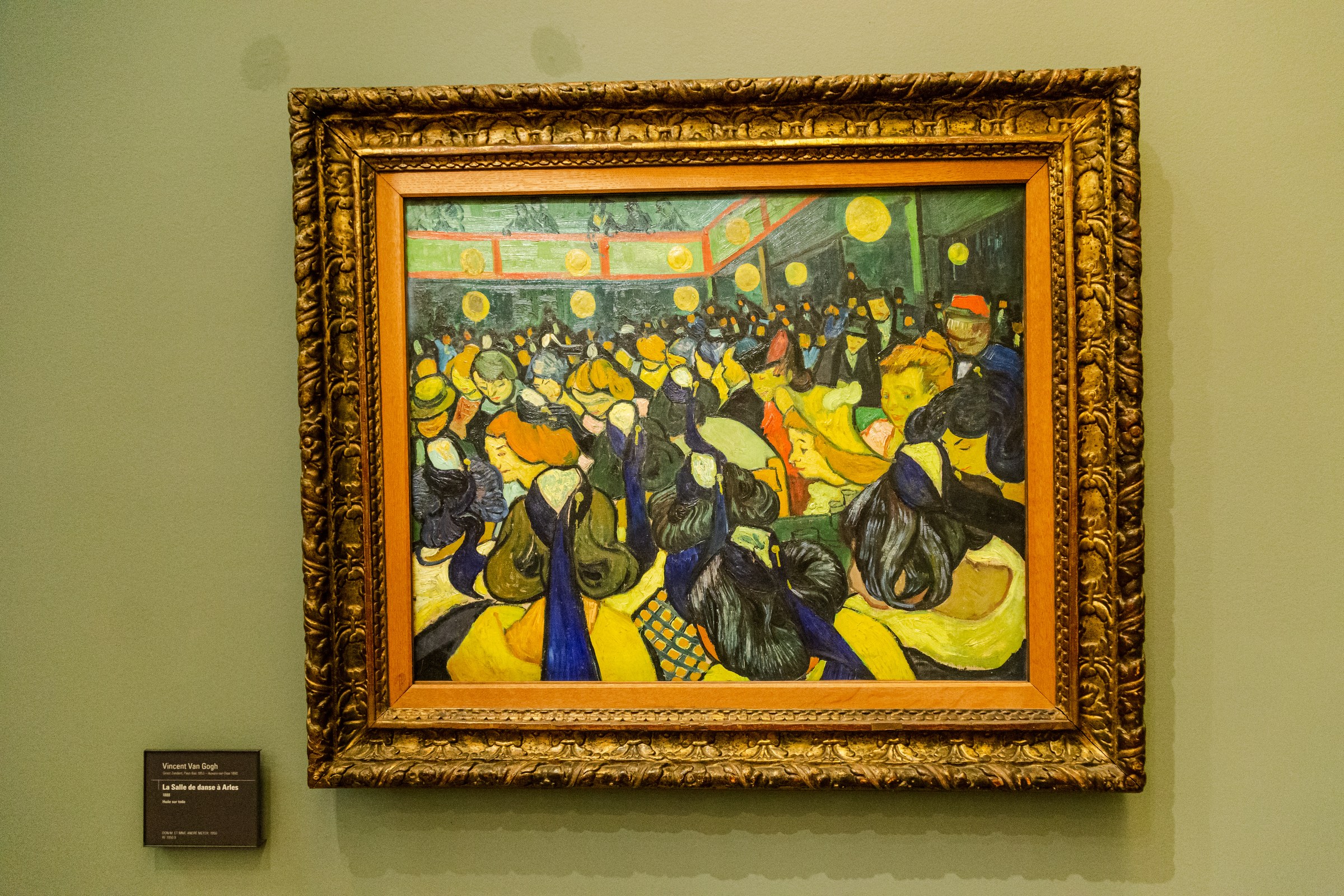
Vincent Van Gogh - La Salle de danse à Arles (52254464061)
Adrian Scottow from London, England
- Source:
- Wikimedia Commons
- Rights:
- Reusable with conditions: credit the creator; share any adaptation under the same license. Source record ↗
- Recorded as:
- cc by-sa 2.0
The image documents a now-vanished social world—the café-dansant as a democratic public space—while demonstrating how early modernist painters treated dance venues not as picturesque subjects but as sites of psychological and sensory intensity. For historians of twentieth-century dance, it is evidence of how dance was experienced by non-professionals in urban settings before professionalization and recording technology transformed popular dance culture.
What you are looking at
A crowded dance hall at night, densely packed with figures in yellows, blues, and blacks beneath hanging spherical lamps. The composition is frontal and compressed, with the viewer positioned at ground level among the dancers rather than observing from above or the periphery. The setting appears to be an enclosed space—a café or ballroom—with visible architectural elements: windows or doors at top left, dark walls, and a green-tinted upper register suggesting artificial interior light. The crowd fills nearly every inch of the canvas, bodies overlapping and turned in multiple directions, some dancing in pairs, others standing or moving singly. The palette is dominated by acid yellows (clothing, hats, faces) set against deep blues and blacks, creating a restless, almost claustrophobic energy. The brushwork is loose and expressionistic, with thick outlines defining figures rather than modeling them. A large pale yellow circle dominates the upper right—likely a hanging lamp seen from below.
The dancing
Most figures are upright and in motion, though few are in recognizable ballroom holds. Where couples are discernible, they appear to stand side-by-side or at angles to one another rather than in closed frame. Arms are varied: some raised, some at sides, several held as if gesturing or balancing. The facial expressions are mostly obscured or schematic, but the overall posture suggests forward movement and animated social engagement rather than the formal, upright carriage of classical dance. The density of the crowd means individual footwork is not visible; weight appears distributed across a shuffling, ambulatory mass rather than concentrated in partner or solo steps.
The dance depicted
This is a public social dance venue, most likely a café-dansant or dance hall of the early 20th century, but the specific dance style is not identifiable from the poses shown. No recognizable Waltz, Tango, or Foxtrot hold appears. The figures are too tightly packed and the viewpoint too immersive to read structured ballroom technique. Instead, the image conveys the social and spatial experience of the venue itself—the sensory overwhelm of a crowded public dance space—rather than the formal codification of any single dance form. The painting privileges atmosphere and mass human presence over choreographic clarity.
How it was made
This is oil on canvas, identifiable from the thick, expressive brushwork, visible texture, and the way colors are layered and scraped. The technique is Post-Impressionist to early Expressionist: forms are simplified and outlined boldly in dark lines, local color dominates over modeling or atmospheric perspective, and the paint surface is visibly worked. This was a technique of gallery exhibition and individual artistic vision rather than commercial reproduction. The medium and approach suggest the work was made for fine-art contexts, not as documentary or journalistic record.
About this work
This painting depicts the interior of a public dance hall or café-dansant, a type of entertainment venue that flourished in urban centers in the early 20th century. The artist has chosen a radical vantage point: rather than showing dancers from a removed, observational distance, the viewer is immersed at ground level within the crowd, surrounded by the shifting mass of bodies, hats, and colored clothing. The work captures not a specific dance or dance step, but the social experience and sensory intensity of the venue itself—the press of bodies, the artificial light, the mix of class and costume implied by the yellow hats and varied dress.
The painting belongs in a dance collection as social history and as a record of how modernist artists engaged with vernacular dance spaces. It shows dance not as performance to be judged by formal criteria, but as a lived social practice embedded in urban leisure and working-class or petit-bourgeois entertainment.
How to look at it
Approach this as an immersive environment rather than a narrative scene. Notice how the artist has placed you within the crowd, not observing it—your eye level is at the height of the dancers' chests and heads, and figures crowd the entire frame edge. Observe the color strategy: the acidic yellows are not naturalistic but emotional, conveying the heat and intensity of gaslight or early electric interior lighting. Pay attention to the few readable poses and partnerships: they are casual and informal, not the ballroom frame taught in dance schools. The work is as much about *being in a crowd* as about dancing.
The artist
The catalogue record attributes this to Adrian Scottow, credited as a photographer from London (2022). However, the work is manifestly a painting, not a photograph, and in style it closely resembles Vincent van Gogh's *La Salle de danse à Arles* (1888), a work in the collection of the Musée de l'Annonciade, Saint-Tropez. Scottow's name does not appear in standard art-historical literature, and the Wikimedia attribution may be erroneous. If the work is indeed Van Gogh's, the artist was a Post-Impressionist painter who frequently depicted modern leisure, urban nightlife, and the social margins of European cities.
The period
The café-dansant emerged as a commercial entertainment in late 19th-century Paris and spread rapidly to other European cities in the early 1900s. These venues, distinct from formal ballrooms, catered to working and lower-middle-class audiences and offered access to fashionable dances (Waltz, Two-Step, early Tango variants) in informal settings. The artistic treatment of such venues by painters like Van Gogh reflected modernism's interest in urban life, popular culture, and transient social experience—subjects previously considered beneath fine art. By the 1880s–1890s, the dance hall had become a stock subject for artists engaged with modernity.
Where it lives
The work is held on Wikimedia Commons and attributed to Adrian Scottow, photographer, London, 2022. However, this attribution is likely an error in the metadata, and the work is almost certainly Vincent van Gogh's *La Salle de danse à Arles*, an oil painting from 1888 now in a French museum. The Wikimedia record does not reliably capture the provenance of this work.
Questions about this work
Is this actually a Van Gogh?
The painting's style, subject, and composition closely match Vincent van Gogh's documented work *La Salle de danse à Arles* (1888). However, the catalogue record in this database attributes it to Adrian Scottow, a photographer from 2022—an attribution that contradicts both the style and medium visible in the image. The most likely explanation is that the Wikimedia metadata is incorrect. Independent verification from the holding institution would be needed to confirm identity.
What dance is being performed?
No specific dance can be identified from the poses shown. The figures are too densely packed and the viewpoint too immersive to read choreographic detail. The setting is a public dance hall or café-dansant, where popular social dances of the period (Waltz, Two-Step, Quadrille) would have been performed, but the artist has chosen to emphasize the atmosphere and social experience of the space rather than the technique of any single dance form.
Why are the figures so yellow?
The acid yellow is not a naturalistic rendering of skin or fabric but an expressive choice. Early electric and gaslight interiors cast a warm, yellowed light, and the artist has amplified this to convey heat, crowding, and the intensity of the venue. The color also creates a visual rhythm that unifies the composition and contributes to the sense of energy and movement.
What is a café-dansant?
A café-dansant was a public entertainment venue, common in late 19th and early 20th-century European cities, where working- and middle-class people could dance to live music in a casual, social setting. Unlike formal ballrooms, they were affordable, democratically mixed, and offered a space for popular social dancing outside of family or aristocratic contexts.
More dance artwork





