49 works in this view — arrow keys or swipe to move between them.
Dance in Art
By Carlos Barretta stk 001494 (8023785583)
Zé Carlos Barretta from São Paulo, Brasil
- Source:
- Wikimedia Commons
- Rights:
- Reusable with conditions: credit the creator. Source record ↗
- Recorded as:
- cc by 2.0
Van Gogh's painting is one of modernism's foundational documents of how social dancing and music shaped 19th-century leisure culture, and how artists understood dance not as a spectacle to be represented but as an immersive, psychologically charged environment. For dance historians, it offers crucial visual evidence of the informal, non-theatrical contexts in which ordinary people encountered music and movement in the 1880s. The work influenced generations of artists' engagement with dance and social spaces, making it essential to understanding how modernist aesthetics intersected with the lived experience of dance.
What you are looking at
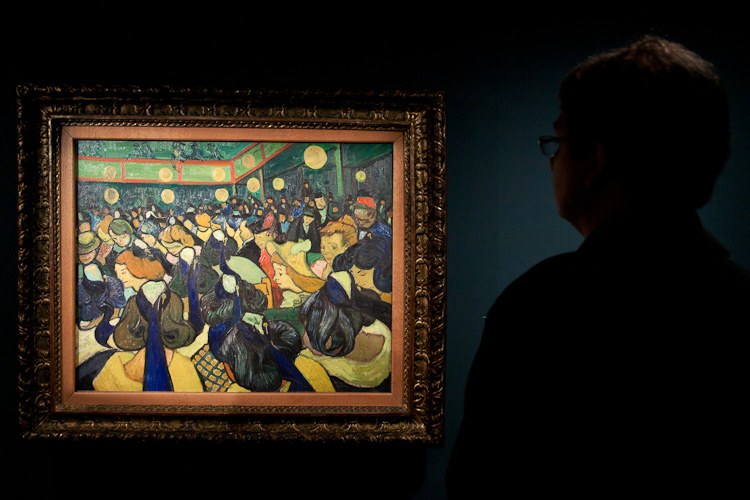
This photograph documents a museum visitor viewing Vincent van Gogh's *The Night Café* (also known as *The Dance Hall at Arles*), exhibited at São Paulo's CCBB (Centro Cultural Banco do Brasil) as part of an Impressionist exhibition. The painting hangs in a substantial gilt frame against a deep teal wall, dramatically lit from the left. The visitor—a man in dark clothing and glasses, shown in silhouette—stands in profile at right, gazing at the work. The painting itself depicts an interior scene alive with movement: figures in late 19th-century dress occupy a lamp-lit space rendered in van Gogh's characteristic thick brushwork and vivid yellows, greens, and blues. Multiple seated and standing figures populate the composition, their forms somewhat abstracted by the artist's expressive technique. The theatrical lighting of both the museum presentation and the painted scene creates a compelling dialogue between the viewer in the present moment and the historical artwork before them.
The dancing
Within the painted work, numerous figures occupy the interior space in various postures of leisure and social engagement. Some sit at tables; others stand or move through the room. The figures are rendered with loose, gestural brushwork that suggests movement and energy rather than precise anatomical detail. Van Gogh's approach dissolves individual bodies into a broader rhythmic composition of color and form, with warm yellows and oranges of clothing and furnishings set against cooler blues and greens of the walls and shadows. The contemporary photograph captures the modern viewer in a static, contemplative stance—a striking contrast to the kinetic scene he observes.
The dance depicted
Van Gogh's painting documents the interior of a café-dancing establishment in Arles, a venue where social dancing and entertainment occurred in the 1880s. The composition suggests the social dances of the period—likely quadrilles, waltzes, or other ballroom dances that formed the backdrop of such establishments—though the artist's expressionistic technique prioritizes the atmosphere and psychological intensity of the scene over precise choreographic documentation. The painting captures not the technical execution of dance but the sensory experience of a space saturated with music, movement, and social interaction. This is a dance environment rather than a dance instruction, and van Gogh's interest lies in the cumulative effect of bodies in motion within a specific social and architectural space.
How it was made
This is a photograph of a painting on display. The original work is van Gogh's oil on canvas from 1888, here documented by photojournalist Zé Carlos Barretta during a 2012 exhibition. The photograph reveals the painting's substantial gilt frame and the museum's dramatic theatrical lighting—a modern curatorial choice that enhances the nocturnal atmosphere van Gogh created. The photographic medium captures both the historical artwork and the contemporary act of viewing, creating an unintentional dialogue between late-19th-century café culture and 21st-century museum practice. The vivid color saturation and tonal range visible in the photograph suggest digital documentation.
About this work
This photograph documents van Gogh's *The Night Café* (1888), one of the artist's most significant paintings of social and leisure activity, during its exhibition at a São Paulo cultural institution. The work depicts the interior of a dance hall or café-dancing establishment in Arles, rendered in van Gogh's mature expressionist style with violent color contrasts and energetic brushwork that convey the psychological intensity of the space. The photograph captures both the historical artwork and the contemporary viewer's engagement with it, creating a layered meditation on how we encounter modernism and social history in museum settings.
For historians of 19th-century dance and social culture, the painting is a vital document of how café-dancing establishments functioned as spaces of leisure, music, and informal social interaction in provincial France. Van Gogh's compositional choices—the steep perspective, the acid color palette, the restless energy of the brushwork—transform what might have been a straightforward genre scene into an expression of the café's psychological and social atmosphere. The work demonstrates how dance and music inhabited spaces beyond the formal ballroom or concert hall, and how artists engaged with dance culture as part of their broader investigation of modern life.
How to look at it
Attend first to the composition's spatial construction: van Gogh uses extreme perspective and a tilted floor to create psychological disorientation rather than comfortable depth. The acid yellows and greens vibrate against blues and purples, creating visual tension that mirrors the social energy of the space. Notice how van Gogh dissolves individual dancers and seated figures into a broader rhythmic pattern of color and brushstroke—he is less interested in documenting specific dances or movements than in conveying the immersive, slightly unsettling atmosphere of the space. The isolated pool table at center and the gas lamps overhead anchor the composition while the surrounding figures blur into gestural marks, suggesting movement without freezing it.
The artist
Vincent van Gogh (1853–1890) created this painting during his 14-month residence in Arles in southern France, a period of intense productivity and psychological turbulence. Van Gogh was fascinated by contemporary leisure culture and the social spaces of modern life—cafés, dance halls, and public gardens—which he documented with the same intensity he brought to portraiture and landscape. His expressionist technique, with its bold color and energetic brushwork, was perfectly suited to capturing not the precise movements of dancers but the sensory and emotional atmosphere of spaces where dance and music occurred. This work exemplifies his conviction that color and form could convey psychological and social truths that strict representation could not.
The period
The 1880s saw the rise of modern café culture and commercialized leisure in French cities and towns. Café-dancing establishments were not theaters but social venues where local people gathered for drinks, conversation, and informal dancing—often to live music or mechanical devices. This democratization of dance, outside aristocratic ballrooms and professional stages, fascinated late-19th-century artists and writers as a subject of modern social life. Simultaneously, post-Impressionist artists like van Gogh were moving away from Impressionism's optical naturalism toward more expressive, psychologically intense engagements with color and form. Van Gogh's painting sits at the intersection of these developments: a modern subject rendered through aggressively modern technique.
Where it lives
This photograph was taken by photojournalist Zé Carlos Barretta and published by Folhapress (São Paulo's major newspaper agency) on 7–8 August 2012, during the exhibition *Impressionistas* at the CCBB. The image is held in Wikimedia Commons and represents a moment of contemporary engagement with modernist art history in a major Brazilian cultural institution.
Dance in this work
Questions about this work
Is van Gogh depicting a specific dance?
Not a specific dance technique or form. The painting documents a café-dancing establishment where social dances like quadrilles and waltzes would have been performed, but van Gogh's expressionist technique prioritizes the overall atmosphere—the light, color, social energy, and psychological intensity—over choreographic precision. He is painting the experience of the space, not the execution of steps.
Why does the painting look so unsettling?
Van Gogh deliberately created psychological disorientation through distorted perspective, clashing colors, and restless brushwork. The space tilts and vibrates; the yellows and greens are almost acidic. These formal choices convey van Gogh's sense of the café as a space of loneliness, alienation, and social intensity—not a simple record of entertainment.
What was a café-dancing establishment in 1880s France?
A commercial venue where people gathered for drinks, food, conversation, and informal social dancing—not a theater or formal ballroom. Music was often provided by small ensembles or mechanical devices. These establishments were part of the emerging modern leisure culture of industrial Europe and fascinated artists as subjects of contemporary social life.
More dance artwork





