49 works in this view — arrow keys or swipe to move between them.
Dance in Art
José Clemente Orozco, La cantina
José Clemente Orozco
- Source:
- Wikimedia Commons
- Rights:
- Public domain — free to use, share and adapt.
- Recorded as:
- public_domain
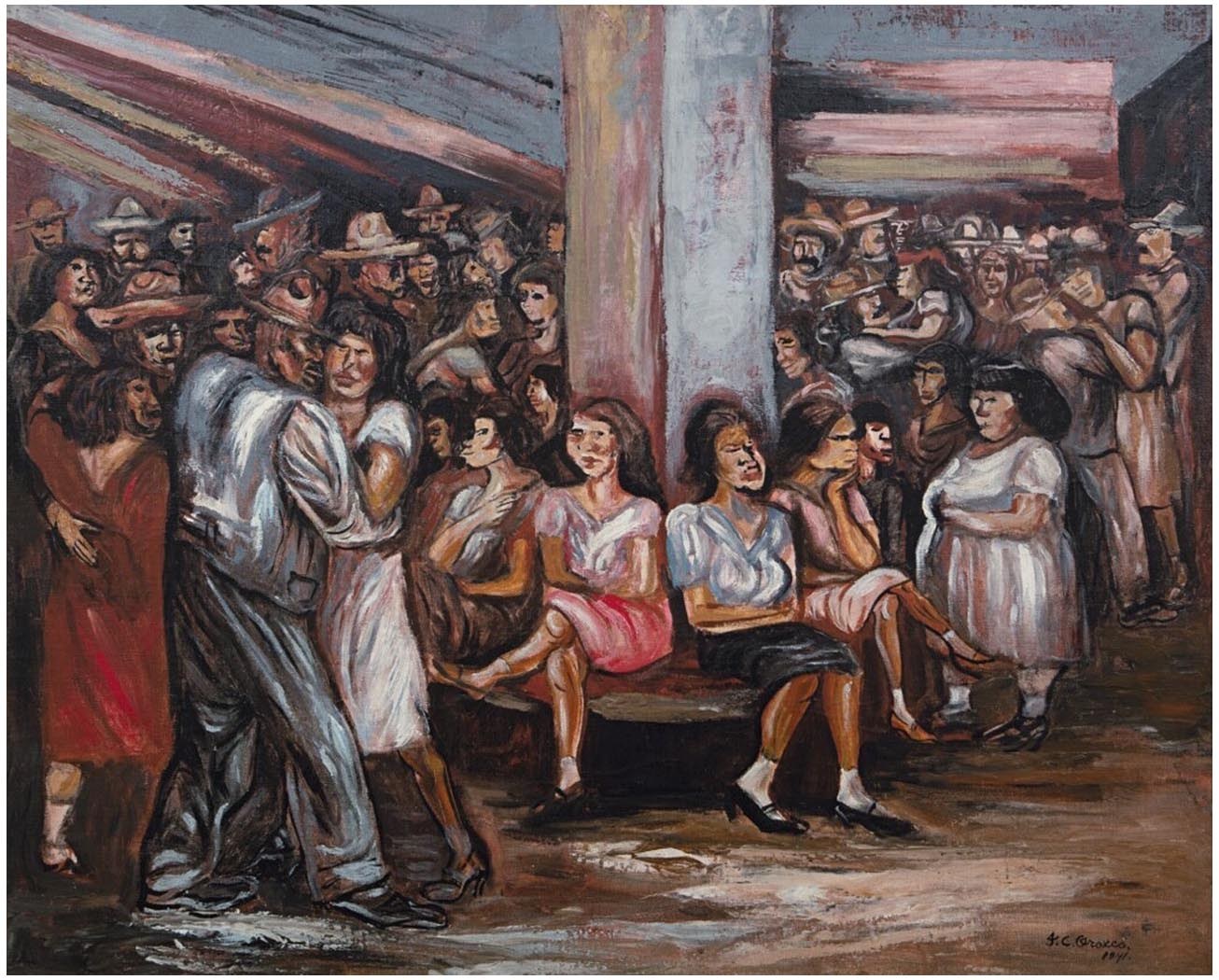
The work documents the cantina as a site of social dancing in early-twentieth-century Mexico—a space where working people danced without choreography, costume, or audience, and where dance was woven into the fabric of communal life rather than separated as performance. For dancers and historians, it preserves a vision of how dance functioned socially before and outside the concert stage, and demonstrates how major artists of the period saw dance as central to portraying authentic popular culture.
What you are looking at
A crowded cantina or dance hall, rendered in Orozco's characteristic expressionist style with warm earth tones and dramatic shadow. The composition is divided by a strong vertical pillar, creating two densely populated zones. On the left, figures in cowboy hats crowd around a central couple; on the right, more figures cluster in animated conversation and movement. The figures wear simple clothing—work shirts, light dresses, hats typical of rural or working-class Mexico. The floor is earthen, the walls bare and weathered. The lighting is theatrical, with warm tones suggesting lamplight or firelight. The moment captures not a formal performance but the press and energy of a public gathering where dance and social interaction blur—bodies are turned toward one another, some leaning, some standing with weight shifted, creating the sense of music and motion without depicting a structured choreography.
The dancing
The bodies are loosely grouped rather than paired in formal holds. Several figures lean inward toward the center of their groups, suggesting attention to music or a performer. Arms are raised and gestural rather than positioned in ballroom frames; one figure in light clothing on the left has an arm extended as if reaching or dancing. Posture is relaxed and forward-tilted, with heads angled in conversation or attention. The density of figures—at least twenty visible, with bodies overlapping—suggests the crush of a crowded social space where individual dancing dissolves into collective movement and proximity.
The dance depicted
This is not a depiction of structured dance but of the social context in which dance occurs: a cantina or pulquería, the working-class drinking establishments where son jarocho, jarabe, and other popular Mexican forms were danced. The painting captures the milieu rather than the technique. The figures' postures and the crowd's energy suggest social dancing—the informal, improvised movement of people dancing with partners or in groups in a public space—rather than performance dance. The work documents how dance functioned as spontaneous social interaction among working people, not as a staged spectacle.
How it was made
Oil on canvas, applied in Orozco's mature expressionist manner. The paint is worked with strong brushwork, building form through color and gesture rather than fine detail. Warm ochres, umbers, and reds dominate; the figures are suggested through rapid, confident strokes that convey movement and energy without anatomical precision. This technique—loose, gestural, prioritizing emotional and social truth over likeness—was well suited to Orozco's project of dignifying working-class Mexican life and creating monumental art accessible to a broad public. The style also allowed him to compress many figures into a unified compositional field without becoming cluttered.
About this work
José Clemente Orozco (1883–1949) was a Mexican muralist and painter who, alongside Diego Rivera and David Alfaro Siqueiros, shaped twentieth-century art through a commitment to social realism and indigenous Mexican themes. Orozco's work celebrated Mexican popular culture and the dignity of working people—campesinos, factory workers, cantina-goers—treating them as worthy subjects for monumental art. La cantina belongs to his body of work documenting Mexican social life: not performance spectacles, but the everyday contexts in which people gathered, danced, drank, and existed together. The painting exemplifies how modernist art in Mexico was inseparable from questions of class, labor, and national identity.
How to look at it
Attend to the composition's division by the pillar: it creates two overlapping worlds of the same gathering, suggesting the multiplicity and simultaneity of social dancing—many couples or groups engaged in their own interactions within the same space. Notice how Orozco has abandoned linear perspective and anatomical detail in favor of compressed, overlapping forms and warm, expressive color; this choice prioritizes the emotional and social content (the warmth, the crowding, the aliveness of the gathering) over photographic accuracy. The painting treats the cantina not as a stage but as a living social space where dance is one expression among many of human togetherness.
The artist
José Clemente Orozco (1883–1949) was a leading figure of the Mexican muralism movement, which sought to create public art celebrating Mexican history, labor, and indigenous culture. After early work as a caricaturist and illustrator, Orozco turned to monumental mural painting in the 1920s, creating works for schools, government buildings, and public spaces. Though best known for his large murals, Orozco also painted smaller works on canvas that explored themes of Mexican social life with the same commitment to expressive form and social content. His style combined European modernism—cubism, expressionism—with Mexican themes and a commitment to clarity and public accessibility. By 1950, when La cantina was painted, Orozco was in his late sixties, refining a vision of Mexican identity through art.
The period
The painting dates to 1950, near the end of Orozco's life and well into the Mexican post-revolutionary period. By this time, the initial fervor of the muralist movement had evolved; Orozco continued to work in an expressionist idiom but was no longer creating the large public commissions that had defined the 1920s and 1930s. In dance, Mexico in 1950 had seen the rise of folklórico performance—the codification and stage presentation of regional Mexican dances—yet Orozco's vision here remains rooted in the social dancing he had observed decades earlier, in the cantinas and plazas of working-class Mexico. The painting thus looks backward, preserving a vision of dance as embedded in everyday social life rather than extracted and presented as national spectacle.
Where it lives
The work is recorded as an oil painting dated 1950, currently held in a private collection or institution not specified in the catalogue record. It is known through reproduction on Wikimedia Commons, where it is accessible as a digital image.
Dance in this work
Questions about this work
Is this a real cantina or imagined?
Orozco drew on real cantinas and pulquerías he had observed throughout his career in Mexico, particularly in rural and working-class neighborhoods. However, the painting is not a documentary record of a specific place or moment; it is an expressionist interpretation designed to capture the social and emotional truth of cantina culture rather than factual detail.
What kind of dance would have happened in a cantina like this?
Working-class cantinas in Mexico hosted son jarocho, jarabe tapatío, corridos, and other popular regional forms, often danced in couples or small groups to live musicians. The dancing was improvised, social, and participatory rather than choreographed or performance-oriented.
Why is Orozco painting a cantina instead of a concert stage?
Orozco's project was to dignify Mexican popular and working-class culture, presenting campesinos and urban workers as subjects worthy of serious artistic attention. By painting social dancing in a cantina rather than professional performers, he asserted that authentic Mexican dance and culture lived in everyday spaces, not in concert halls.
More dance artwork





