49 works in this view — arrow keys or swipe to move between them.
Dance in Art
Peasant Wedding Dancelabel QS:Lja,"農民の婚宴"label QS:Lde,"Bauernhochzeit"label QS:Len,"Peasant Wedding Dance"label QS:Lit,"matrimonio di contadini all'apertopittura"label QS:Lfr,"Danse de noces en plein air"label QS:Lnl,"Dansende boeren op een bruiloftsfeest in de open lucht"
Pieter Brueghel the Younger / After Pieter Brueghel the Elder
- Source:
- Wikimedia Commons
- Rights:
- Public domain — free to use, share and adapt.
- Recorded as:
- public_domain
The image is a rare visual record of how ordinary people actually danced in early modern northern Europe, unmediated by courtly convention or written instruction. It shows that peasant dance valued speed, noise, and bodily release over the geometric precision prized in ballroom dancing—a cultural divide still visible in how we classify and teach dance today.
What you are looking at
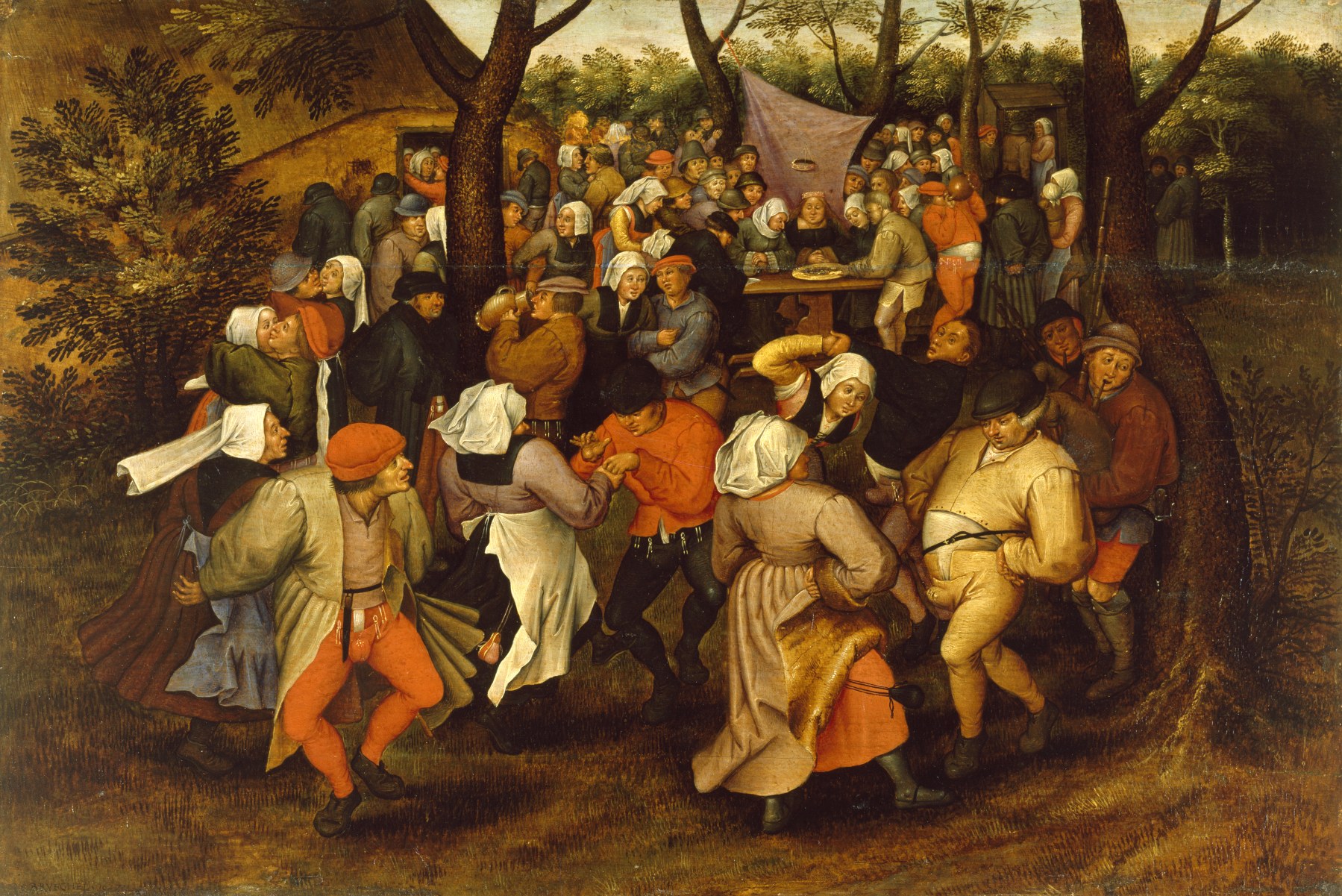
A crowded outdoor wedding celebration unfolds in a wooded clearing during daylight. More than fifty figures populate the scene, dressed in early 17th-century Flemish peasant garments—men in short breeches, doublets, and caps of rust and ochre; women in white linen caps and earth-toned skirts. In the background, a table laden with food stands beneath draped cloth, with figures gathered to eat and drink. To the left, a crude structure (perhaps a barn) marks the settlement. The foreground is dominated by several pairs dancing vigorously in the center of the clearing, while onlookers form a loose perimeter. The lighting is warm and naturalistic, suggesting midday celebration. On the ground, traces of red cloth or fabric appear beneath the dancers' feet.
The dancing
Five or six figures dance in close, energetic pairs and groups at the composition's center. The dancers are squat and broad-shouldered, with bent knees and forward-leaning postures; their bodies convey emphatic, angular movement rather than the upright carriage of courtly dancing. One woman in the immediate foreground dances with arms gesturing outward, her skirts swirling. A piper—the sole musician visible—stands among the dancers, playing bagpipes. The dancers' weight shifts heavily, and their feet appear to pound the ground. There is no ballroom formality: the groupings are loose, the frames vary moment to moment, and the overall impression is of vigorous social dancing in which the body's energy and noise matter more than technique.
The dance depicted
This is a peasant reel or group dance of the sort that would have accompanied a wedding feast, likely danced to bagpipe music (visible in the image). The dance appears to be a communal, open-formation country dance rather than a courtly or theatrical form. The bent postures, heavy footfalls, and casual pairing suggest a vernacular folk tradition—the kind danced at rural celebrations across northern Europe. The image conveys that the dance was exuberant, physically demanding, and valued for its social and celebratory function rather than aesthetic refinement. The presence of the piper, the outdoor setting, and the mingling of ages and dress suggest this was participatory entertainment open to much of the community.
How it was made
This appears to be an oil painting, likely tempera or mixed media on panel, as evidenced by the warm, finely detailed palette and the even distribution of pigment across the composition. The technique allows for precise rendering of costume, landscape, and atmospheric effects (the trees receding into golden distance, the dappled light). The high finish and compositional complexity suggest this was made for a wealthy patron, not a print or popular broadside. The painting's finish and detail imply that such peasant scenes were valued collectible objects for urban elites—a form of social ethnography painted for display in a burgher's or nobleman's collection.
About this work
This is a peasant wedding dance scene of the type made famous in Flemish art in the 1560s and copied repeatedly into the early 17th century. The work documents the kind of communal, unscripted dancing that accompanied rural wedding celebrations, with its emphasis on physical vigor and social participation rather than courtly refinement. The painting circulated as a collectible image of peasant life, appealing to urban patrons interested in ethnographic spectacle and the picturesque roughness of village customs. It captures a moment of social license—the wedding day when hierarchies relaxed and peasants danced freely before returning to labor.
How to look at it
Focus on the dancers' bent knees, forward tilt, and the heavy planting of their feet—postures that convey effort and drive rather than the lifted lightness of courtly form. Note the piper at the center: the music drives the action. Observe that the dancers do not form neat pairs in closed holds but cluster and shift, with some figures turning inward and others reaching outward. The artist has captured not a composed moment but a sustained, boisterous motion—the instant chosen is one of peak energy and noise. The crowds watching are not orderly spectators but integrated into the scene, some clapping, some eating, some waiting their turn to join.
The artist
Pieter Bruegel the Younger (c. 1564–1637) inherited his father's subject matter and his workshop's production model. Pieter the Elder (c. 1525–1569) had pioneered the peasant scene as high art and had painted a famous Peasant Wedding (now in Vienna) around 1566–1567. The son spent his career elaborating and recopying his father's compositions, filling market demand among Antwerp merchants and nobles for images of peasant life. When the Elder's paintings entered imperial collections (like Rudolf II's in Prague), the Younger worked from engravings and memory to recreate them. The practice was not considered plagiarism but a form of artistic dynasty and workshop continuity.
The period
The image dates to a moment when peasant scenes had become fashionable collectible subjects among the Antwerp elite, a taste that would persist through the 17th century. Bruegel's scenes coincided with the rise of landscape and genre painting as categories worthy of wealthy patronage. In dance history, the early 1600s saw the consolidation of courtly ballet in Italy and France, with the Medici court and the French court beginning to commission elaborate allegorical dances. Peasant dancing, by contrast, remained uncodified—celebrated by urban artists and audiences as colorful, vigorous, and authentically "natural," yet never transcribed or taught in the way that court dances were. This painting thus occupies the widening gap between trained courtly dance and untrained communal dance.
Where it lives
The work is recorded via Wikimedia Commons and is attributed to Pieter Bruegel the Younger or his workshop; the specific current holding is not documented in the source record. The image is descended from or closely related to the Elder's Peasant Wedding paintings of the 1560s, of which multiple versions and copies exist in museum collections across Europe.
Dance in this work
Questions about this work
Did peasants really dance like this?
The painting is based on observation of actual village celebrations, but it is also a stylized representation made for urban patrons. Bruegel the Elder painted from life and memory, but he exaggerated the energy and rusticity to appeal to wealthy collectors who saw peasant culture as picturesque and exotic. The dance itself—vigorous, communal, led by a piper—was real, but the composition and framing are artistic choices.
What instrument is that?
The musician in the center plays bagpipes, a wind instrument common in northern European folk traditions. Bagpipes appear in many Bruegel scenes and were a standard accompaniment for dancing at village celebrations. The high, continuous drone and the rhythmic chanter would have made the music audible across the clearing and would have driven the dancers' footfalls.
Why is there a woman under a crown?
The figure near the center-left seated beneath an improvised crown is the bride, honored as "queen for a day" during the wedding celebration. The crown—likely made of branches, cloth, or flowers—was a festive marker of her temporary status. The gifts of coins being offered to her were a way for neighbors to contribute to the new couple's livelihood.
Is this painting by Bruegel the Elder or the Younger?
The attribution is to the Younger, working in the early 1600s, but the composition closely follows a painting by the Elder from around 1566. When the Elder's original entered the imperial collection in Prague, the Younger recreated it from engravings and possibly from memory, a common practice in the workshop tradition. Both versions are considered important records of the same subject.
More dance artwork





