49 works in this view — arrow keys or swipe to move between them.
Dance in Art
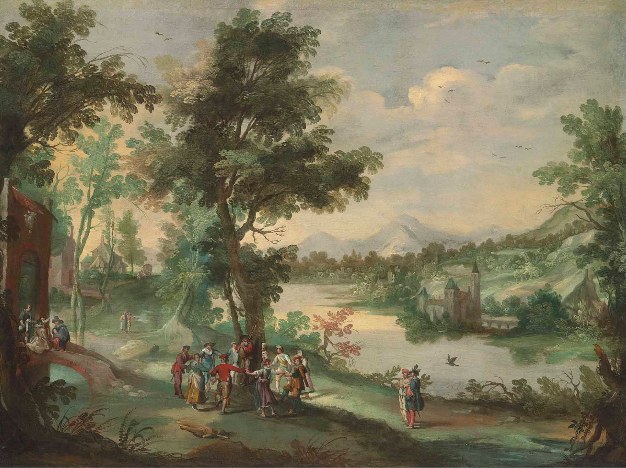
Extensive wooded landscape, with villagers dancing and making music beside a riverlabel QS:Len,"Extensive wooded landscape, with villagers dancing and making music beside a river"
Lucas de Wael
- Source:
- Wikimedia Commons
- Rights:
- Public domain — free to use, share and adapt.
- Recorded as:
- public_domain
This work is one of few surviving images that document village and folk dance of the period in its actual social context, rather than through the filtered lens of court aesthetics or written description. It shows that dancing was not a specialized skill or courtly ornament but a fundamental social practice embedded in community life, requiring no costume, no formal space, and no hierarchy of performers and audience. For dancers and historians, it demonstrates the longevity of paired social dancing and the continuous tradition of music-making outdoors in celebration.
What you are looking at
A Flemish landscape painter has composed a wide panoramic view dominated by a meandering river that curves through the middle distance, reflecting the luminous sky. On the left bank, gathered in a clearing beneath towering trees, a village community—perhaps thirty figures—forms loose clusters around musicians and dancers. The foreground shows the most active group: some figures stand in conversation, others gesture toward the river, and at least two couples appear to be dancing. The middle distance holds more onlookers. Beyond the river, the landscape opens into a misty vista with distant mountains or hills; on the far bank, further figures can be seen, maintaining the sense of a whole community at leisure. The light is diffuse and golden, suggesting late afternoon or early evening. The painting fills the entire composition with careful atmospheric perspective: the trees frame and close the space, the river organizes the view, and the clouds above mirror the movement on the ground below.
The dancing
The dancers occupy the left foreground and middle ground in small groups rather than formal lines. The nearest couple shows a man and woman in close proximity, their bodies angled toward each other in what appears to be a courtship dance or social pair dance; the woman's skirts spread generously, the man's posture attentive. Other figures nearby stand with arms raised or extended—some in gestural speech, others in positions suggestive of music-making or calling. The overall posture is relaxed and social rather than formally structured: bodies lean, weight shifts, arms move in varied directions. The composition suggests simultaneous action in different registers—intimate pairs, wider circles of onlookers, seated or standing musicians—rather than synchronized group choreography.
The dance depicted
This appears to document a rural or village festival dance, likely from the Low Countries in the early 17th century. The mixed-gender pairing, informal grouping, and riverside setting are consistent with Northern European folk or country dance of the period. The presence of musicians (identifiable by posture and likely instruments, though not clearly rendered) and the casual gathering suggest a social occasion—a revel, holiday, or seasonal celebration—rather than courtly entertainment. The painting does not depict a specific named dance that can be identified with certainty, but the conventions—paired dancers in public space, mixed company, music and merriment—align with the vernacular social dances documented in Flemish and Dutch painting of this era, often called 'kermis' (fair) or village celebration scenes. The informality and outdoor setting distinguish this from the indoor court dances of the same period.
How it was made
The work appears to be oil on panel or canvas, executed in the Flemish landscape tradition with careful atmospheric recession and naturalistic color. The technique allows a panoramic composition in which landscape and figures occupy equal visual weight—a hallmark of Northern Renaissance and early Baroque practice. The painter has used warm ochres and greens in the foreground, cooler blues and grays in the distance, creating spatial depth through color as well as scale and overlap. The loose brushwork in the foliage and sky contrasts with more precise rendering of figures in the immediate foreground, suggesting the artist's priority: the human activity and gesture are sharp where we see them, while the landscape recedes into atmospheric softness. This technique was well suited to the workshop production of modest-scale narrative landscapes for prosperous merchant or gentry patrons.
About this work
This is a village dance scene set in a river landscape, painted by a Flemish master in the early 17th century. It belongs to a significant tradition of Northern European art documenting popular festivity and social gathering—subjects that fascinated painters from Pieter Bruegel onward. The work sits at the intersection of three traditions: landscape painting, genre (everyday life) painting, and the documentation of dance and music as markers of community and seasonal celebration. For a reader interested in dance history, it offers rare visual evidence of how ordinary people danced together in early modern Europe, outside the court and away from the formality of named dances. The painting does not name or codify the dance; instead, it captures the social fact of dancing—the gathering, the pairing, the music, the leisure.
How to look at it
The viewer should trace the movement of figures from left to right and foreground to distance: the nearest couple establishes the dance gesture, while the other figures extend and elaborate it across space and time. Notice the painter's choice to render the dancers in profile or three-quarter view—allowing the dress, posture, and gesture to read clearly—and to set them against the horizontal plane of the river and the vertical frames of trees. The loose grouping is intentional: it suggests the informal, ad-hoc quality of village celebration rather than the ordered lines of courtly dance. The painting asks you to read social activity and human relationship (who stands with whom, how bodies orient) as much as formal choreography.
The artist
Lucas de Wael (also Wahl; 1591–after 1627) was a Flemish painter active in Antwerp and later in Italy. He is known for landscape and genre scenes, particularly river landscapes with numerous small figures engaged in daily or festive activities. His work sits at the crossroads of the Flemish landscape tradition (descending from Bruegel and Coninxloo) and the emerging taste for scenes of popular life and leisure. De Wael spent time in Italy, where his work was influenced by the loose, atmospheric style developing in Northern Italian landscape painting. He typically worked at a modest scale, producing works for a merchant or educated gentry audience rather than princely patrons.
The period
In the early 17th century, village celebration and folk dance were subjects of increasing artistic interest in the Low Countries. Pieter Bruegel the Elder had established the tradition of rendering kermis (fair) and village festival scenes decades earlier; by de Wael's time, such subjects were well established in the repertoire. Simultaneously, dancing was becoming a subject of courtly and literary attention—dance manuals documented named dances, court painters showed formal courtship dances—but the vernacular tradition of paired social dancing in village settings remained largely undocumented except in paintings like this. This work was made in a period when rural and popular subjects were gaining respect as worthy of serious artistic attention, a shift that would accelerate through the 17th century.
Where it lives
The work is catalogued on Wikimedia Commons and is held in a collection not specified in the source record. It is typical of the modest-scale, landscape-dominant panel paintings produced for circulation among Flemish and Dutch merchant collectors in the early 17th century.
Dance in this work
Questions about this work
Can you identify the specific dance being performed?
No, the painting does not depict a formal named dance recognizable from pose or costume. It shows village or folk dancing—social, paired, and informal—consistent with Northern European custom of the period, but without the specificity of a minuet, volta, or galliard. The value of the image lies in showing how ordinary people danced socially, not in preserving a choreographic record.
What role did music play in village dancing at this time?
Musicians are present in the scene (identifiable by posture and position) and appear integral to the celebration. In villages, dancing and music-making were typically inseparable; traveling musicians or local players would provide pipes, drums, or strings. The music established rhythm and invited participation, turning a gathering into a festival.
Does the dress tell us anything about the dancers' status?
The figures wear the simple wool and linen of rural or urban working people—no silks, no jewels, no courtly ornament. The women's full skirts and simple bodices, and the men's hose and jerkins, are consistent with documented clothing of the period for non-elite populations. The painting thus documents dancing by ordinary people in ordinary dress.
Why was this scene worth painting?
By the early 17th century, scenes of popular leisure and celebration had become fashionable as subjects for painting among prosperous non-aristocratic patrons. They offered a glimpse of rural or village life idealized as natural, festive, and harmonious—a kind of anti-courtly fantasy. They also document real social practice: communities genuinely did gather to dance and make music at fairs, holidays, and seasonal celebrations.
More dance artwork





