49 works in this view — arrow keys or swipe to move between them.
Dance in Art
A Tavern Interior with Drinking and Dancing Peasants
Mattheus van Helmont
- Source:
- Wikimedia Commons
- Rights:
- Public domain — free to use, share and adapt.
- Recorded as:
- public_domain
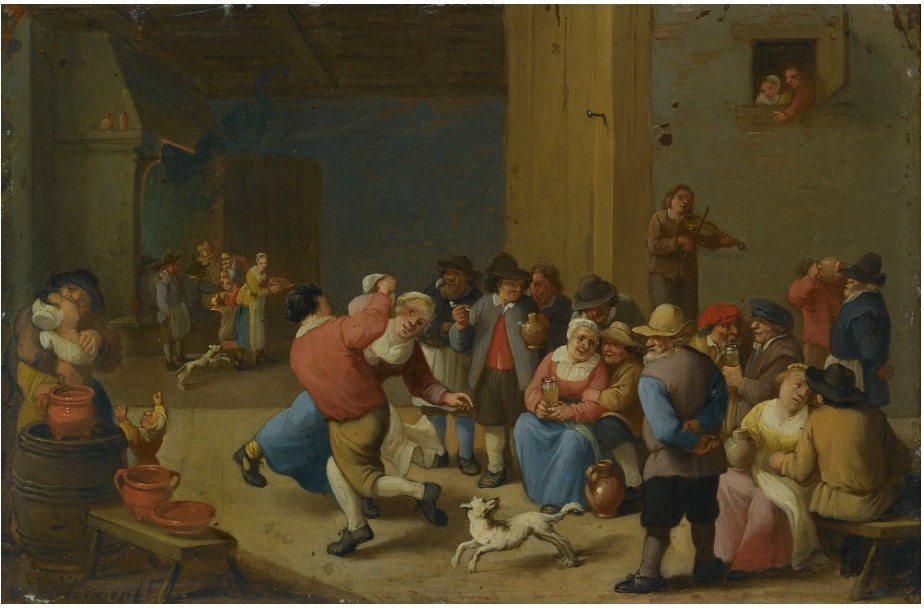
This work is among the few surviving visual records of how ordinary people actually danced in early modern Europe, unconstrained by courtly convention or professional training. For historians of folk dance and social practice, it provides rare evidence of popular movement vocabulary, the role of music and drink in dancing, and the communal contexts in which non-elite people moved. The painting also demonstrates how thoroughly dance was embedded in tavern life and village gathering—not a separate art form but inseparable from eating, drinking, and socialising.
What you are looking at
A crowded tavern or village interior, rendered in warm earth tones with deep shadows, shows a boisterous gathering of peasants in the mid-17th century. The composition is dense and layered: in the foreground, a man in a red doublet and blue breeches executes a vigorous dance step, his body bent forward with one leg extended, while a small dog occupies the immediate ground beside him. To his left, seated figures watch and drink from vessels; to his right, a woman in a blue skirt sits watching. The middle distance is packed with standing onlookers in various states of engagement—some clapping, some drinking, some conversing. A violinist stands elevated on the right side, his instrument raised, providing music. The background recedes into shadow, with more figures barely visible in the gloom. Light enters from above, catching the surfaces of clay vessels, white linen, and the flushed faces of the revellers. The scene captures a moment of uninhibited village festivity, with the dancing figure as the focal point amid collective participation.
The dancing
The primary dancer—a stout man in the foreground—displays an exaggerated forward lean with one leg extended in a vigorous kicking or stamping motion, his arms positioned for balance. His body weight is clearly shifted, suggesting explosive movement rather than refinement. The surrounding figures are mostly stationary observers: seated women with hands folded or raised to their mouths, standing men holding drinking vessels, and one musician actively playing. The contrast between the dancer's uncontrolled energy and the relative stillness of the crowd suggests this is a solo, improvisational display rather than a structured group dance. No couples hold formal positions; instead, spectating and drinking dominate the composition.
The dance depicted
This appears to be a depiction of peasant or folk dancing from the Low Countries in the 17th century—likely a tavern jig or village revel rather than a courtly dance. The costume, setting, and bodily deportment place this squarely within folk-regional tradition, possibly representing a country dance or village celebration. The artist has captured the rough, unrestrained quality of popular dancing, in sharp contrast to the refined ballet or court dances of the same period. The presence of the violin suggests a fiddle-driven tradition. This is not a recognisable named form but rather a window into how ordinary people danced without instruction—with emphasis on stamping, vigorous movement, and communal participation rather than technique.
How it was made
The painting employs oil on panel, a medium well-suited to the warm, glowing interior light and the rich browns and ochres of the tavern setting. The artist has built up layers of glazing to create atmospheric depth, with foreground figures rendered in precise detail and background figures dissolving into shadow. This technique was typical of Netherlandish genre painting, allowing the artist to capture both the specificity of individual faces and clothing and the overall mood of convivial excess. The work would have been intended for a collector's cabinet rather than a public or religious space, suggesting an audience interested in the picturesque and humorous documentation of lower-class life.
About this work
This is a Netherlandish genre painting capturing an interior moment of popular festivity and dance in the mid-17th century. The work belongs to a well-established tradition of tavern and village scenes in Northern European art, offering a rare direct record of how non-elite people danced, dressed, and socialised outside courtly contexts. The painting documents the violence and exuberance of folk dancing, the centrality of alcohol and music to celebration, and the participatory rather than spectatorial nature of communal revelry. For dance historians, the image is valuable precisely because it shows the body in motion without the filter of courtly refinement or choreographic instruction—the unmediated physicality of peasant dancing as it was actually practised.
How to look at it
Attend to the dancer's body: the forward lean, the extended leg, the absence of a partner, and the raw force of the movement. Note how the artist has frozen him mid-stride, capturing dynamism and imbalance rather than a composed pose. Look also at the faces in the crowd—some engaged and joyful, others distracted—and at the musician, whose raised violin is the source of all this motion. The tavern setting itself is crucial: notice the clay vessels, the darkness, the crowding, the way bodies are packed together. This is not a dance floor but a room where dancing erupts from drinking and socialising. The painting asks you to see dancing not as a separate art but as eruption, spontaneity, and collective energy.
The artist
Mattheus van Helmont (documented early–mid-17th century) was a Flemish painter specialising in genre scenes of everyday and festive life. He worked in the tradition of Pieter Bruegel and other Netherlandish artists who found rich subject matter in village celebrations, tavern gatherings, and the customs of rural and urban common folk. Van Helmont's work sits within a broader pattern of Northern European art treating lower-class life as both comic and worthy of detailed observation. Such paintings often carried moralising undertones—excess, disorder, and sensuality as warnings—but also served as a form of documentary realism.
The period
In the mid-17th century, the formal courtly dances of the Renaissance (pavane, galliard) were being systematised and refined in the courts of France and Italy, while folk and tavern dancing remained largely unrecorded and largely disdained by the educated elite. This painting captures the vast gulf between the two worlds: the improvised, physically exuberant, drink-fuelled dancing of working people had no place in the ordered, geometric world of court ballet. The image is also evidence of the violin's increasing role as a folk and tavern instrument in this period, challenging the earlier association of stringed instruments with courtly sophistication. Van Helmont's work dates to a moment when genre painting itself was establishing itself as a legitimate subject, influenced by the economic rise of the merchant class and growing interest in depicting daily life.
Where it lives
The work is recorded on Wikimedia Commons as a Netherlandish oil painting from 1645. Its current location and collection are not established in the catalogue record. The painting exists as a digital image available for study and reference.
Dance in this work
Questions about this work
Is this a real dance or is the artist making it up?
The movement is exaggerated and comic, but the basic vocabulary—stamping, vigorous leg extension, the use of the body's weight for force rather than elegance—reflects actual popular dancing from the period. The artist is documenting a real social practice, though with some caricature. The setting and behaviour are recognisable from other Netherlandish tavern scenes and from written descriptions of village celebrations.
What is the difference between this and court dancing?
Court dances like the pavane or galliard were geometric, controlled, and codified, with partners in set positions and measured steps. Peasant dancing as shown here is solo, improvisational, vigorous, and rooted in the body's weight and strength rather than its refinement. There is no instruction, no symmetry, no formal hold. The musician responds to the dancers rather than dancers following a predetermined sequence.
Why is the dog in the painting?
The dog is part of the genre painter's interest in capturing the totality of a scene—all its figures, animals, and objects. It may also carry symbolic weight, as dogs in such scenes sometimes suggest disorder or transgression. Its presence adds to the sense of a crowded, lively, uncontrolled social space.
How do we know this is 1645 and not earlier?
The costume, especially the man's breeches and doublet, the women's white linen caps, and the style of the violin are consistent with mid-17th-century dress in the Low Countries. The painting style itself—the handling of light, the palette, the composition—aligns with Flemish genre painting of the 1640s–1650s. The exact date depends on stylistic analysis and any documentation associated with the work.
More dance artwork





