49 works in this view — arrow keys or swipe to move between them.
Dance in Art
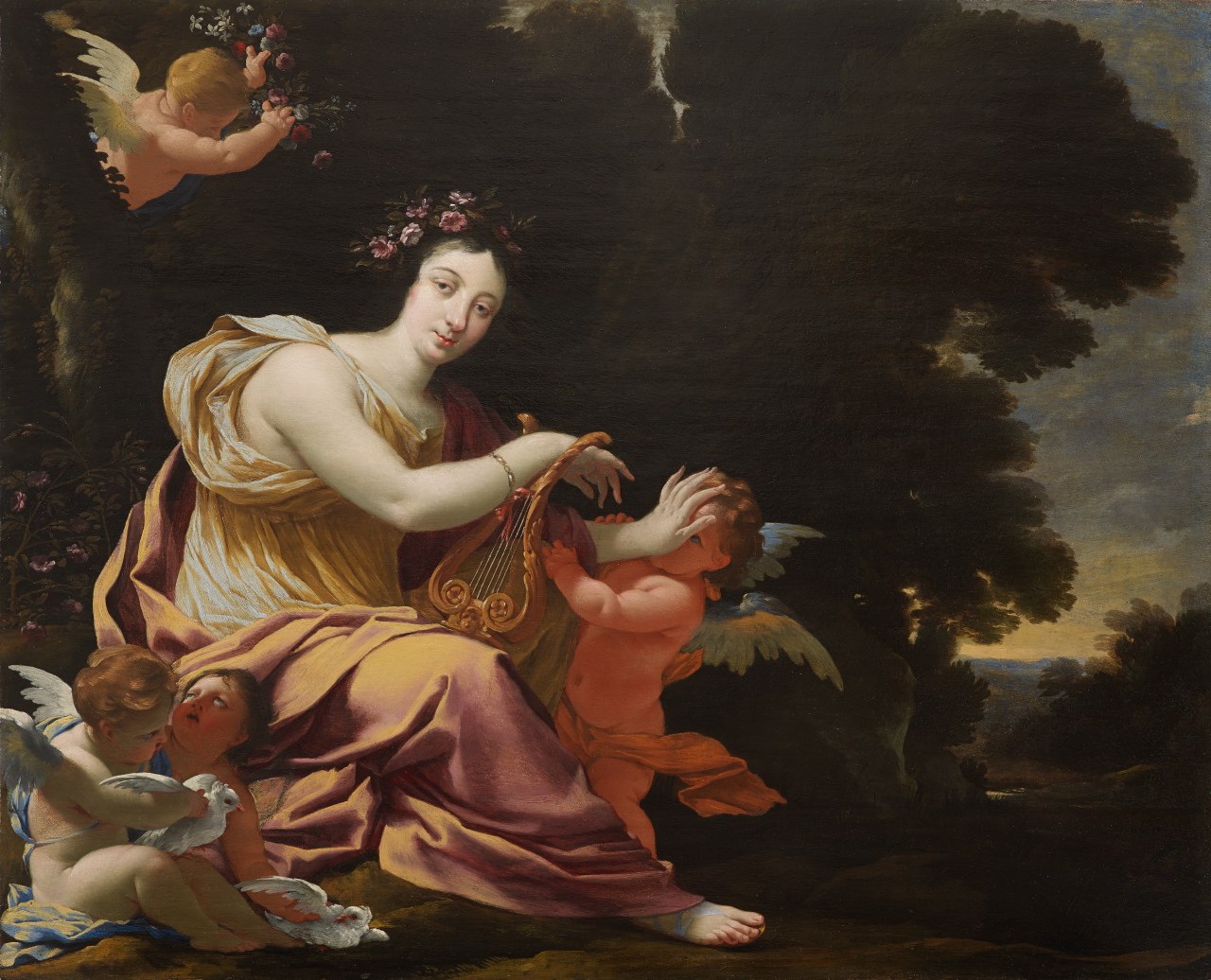
Terpsichore, Muse of Dance and Light Poetry
Michel Dorigny
- Source:
- Wikimedia Commons
- Rights:
- Public domain — free to use, share and adapt.
- Recorded as:
- public_domain
This work is essential to understanding how dance was conceptualized in seventeenth-century European high culture. Rather than showing dancers or choreography, it reveals that educated patrons and artists thought of dance as an abstract art allied with music and poetry, deserving of allegorical representation and classical mythology. The painting documents the intellectual and aesthetic status of dance among the European elite during the period when court ballet was reaching its height.
What you are looking at
A woman wearing classical dress—a golden-yellow draped garment and deep crimson mantle—sits in a three-quarter pose against a dark landscape, her body angled toward the viewer. She wears a floral crown and gazes downward with a serene expression. Her left hand rests on a golden stringed instrument (a lyre or similar), while her right hand gestures gently downward. Three putti surround her: one above left holding a garland of flowers, one to her right in orange-red drapery offering roses or similar blooms, and one lower left with folded fabric. The setting is a wooded park with dark foliage massed in the background and a break of pale sky suggesting classical landscape conventions. The painting employs golden and warm tones for the figures against deep browns and greens, creating theatrical atmospheric depth.
The dancing
The central woman is seated rather than standing or actively dancing, positioned in a contemplative classical pose. Her body exhibits the graceful, elongated proportions favored in seventeenth-century academic art. The gesture of her right hand—opened, fingers extended downward—suggests benediction, musical direction, or the flowing movement of dance rather than a static pose. Her left arm cradles the instrument naturally. The three attendant putti are posed in active, playful attitudes: the upper one bends forward in effort, the right-hand one leans in offering, the lower one reclines. The composition emphasizes verticality and the elegant tilt of the seated figure's torso.
The dance depicted
This is an allegorical representation of Terpsichore, the Muse of Dance in classical mythology, rather than a depiction of actual dance practice. The woman embodies the concept and inspiration of dance and lyric poetry through her attributes (the lyre, the floral crown, the graceful pose) and her setting among classical references. No specific dance style is being performed or demonstrated; instead, the work illustrates Renaissance-Baroque convention of representing abstract virtues and arts through idealized female figures. The putti emphasize the divine or elevated nature of the muse's domain. The image tells us that seventeenth-century viewers understood dance as an art worthy of allegorical veneration, paired with music and poetry, and associated with grace, beauty, and divine inspiration.
How it was made
This is an oil painting on canvas, recognizable from the layered glazing, tonal modeling, and the soft atmospheric perspective achieved in the background. The technique allows for the subtle rendering of fabrics (the translucent golden drapery, the deep crimson), the luminous flesh tones, and the careful atmospheric effects. The composition and finish suggest this is a finished easel painting intended for a patron of means, not a preparatory sketch or print. The size and subject matter (classical allegory) indicate it was made for a collector's cabinet or private gallery, placing it within the academic tradition of history painting—the highest genre of the period.
About this work
This is a formal allegorical portrait of Terpsichore, the classical muse of dance and lyric poetry, painted in the mid-seventeenth century by Michel Dorigny, a French painter trained in the academic tradition. The work belongs to a long Renaissance and Baroque tradition of representing abstract concepts through idealized female figures attended by putti. It is neither a record of actual dance practice nor a scene of dancers in motion, but rather a celebration of Dance as an art form worthy of elevation to the realm of divine inspiration and classical learning. The painting exemplifies how dance was understood by educated European audiences of the period—not primarily as a physical activity to be studied, but as an abstract virtue and poetic principle.
How to look at it
Attend first to the contemplative, inward-turning pose of the central figure—she is not performing or demonstrating but embodying an idea. The gaze downward and the gentle downward gesture of the right hand suggest a melancholic, graceful reverie rather than active motion. The lyre is the key attribute identifying her as Terpsichore and linking her to music and poetry; in seventeenth-century thought, dance could not be separated from musical accompaniment and verse. The three putti add liveliness and playfulness, suggesting that while Dance is a serious, learned art, it is also joyful and associated with beauty and youth. The warm golden and crimson tones against the dark landscape create an almost ethereal quality, marking this as a vision or allegory rather than a scene from observed life.
The artist
Michel Dorigny (c. 1617–1665) was a French painter and engraver trained in the academic tradition, likely under Simon Vouet or within his circle. He worked in the classical, history-painting mode that dominated French court painting in the mid-seventeenth century, specializing in allegorical and mythological subjects. Dorigny was active during the reign of Louis XIV, when French academic painting was establishing itself as a dominant force in European art and when the French court ballet was becoming a model for Europe. His work exemplifies the formal, learned approach to classical allegory that prevailed among painters of his generation.
The period
In the 1640s, when this painting was made, dance occupied an unusual position in European culture. At court—especially the French court under Louis XIV—ballet was becoming increasingly formalized and codified, moving from social dance toward theatrical spectacle and technical display. Simultaneously, in academic art and literature, dance was being elevated to the status of a liberal art, paired with music and rhetoric as part of classical learning. This painting sits at that intersection: it treats dance as worthy of the highest mode of painting (history painting / allegory) while making no reference to the actual court ballet practice happening in the same period and in the same circles. The allegorical muse tradition allowed artists to honor dance as a concept while remaining detached from its physical, social, or courtly manifestations.
Where it lives
The work is recorded as sourced from Wikimedia Commons. The catalogue record does not indicate a current holding collection, medium, or exhibition history. The image quality and documentation suggest it is part of a public or open-access art collection, but the specific institution and accession details are not recorded here.
Questions about this work
Is this a scene of actual dance?
No. This is an allegorical representation of Terpsichore, the classical muse of dance, not a depiction of dancers in performance or practice. The woman embodies the concept and inspiration of dance through her attributes and pose, not through active choreography or movement.
What is the instrument she is holding?
A lyre (or similar stringed instrument), which is a classical attribute of Terpsichore and signals the inseparable connection between dance and music in seventeenth-century thought. Dance, music, and poetry were understood as sister arts in the academic tradition.
Why does she look so still and contemplative?
This is characteristic of allegorical representation in Renaissance and Baroque art. Virtues and abstract concepts were shown in poses of grace and repose rather than in active demonstration. The downward gaze and gentle gesture suggest inspiration, creativity, and the melancholic grandeur associated with the muses.
What do the three putti represent?
The attendant putti reinforce the divine and elevated nature of dance as an art. They are common in allegories and mythological scenes, suggesting joy, beauty, and the playful aspects of the muse's domain. Their active poses contrast with and enliven the seated figure.
More dance artwork





