49 works in this view — arrow keys or swipe to move between them.
Dance in Art
La danse
Gustave Jean Jacquet
- Source:
- Wikimedia Commons
- Rights:
- Public domain — free to use, share and adapt.
- Recorded as:
- public_domain
For historians of ballroom culture and courtship ritual, this painting is an unusually accomplished depiction of the social world in which ballroom dancing took place—the dress, the setting, the gender relations, the moment of pause and display. For art historians, it exemplifies the persistence of aristocratic leisure painting in the later 19th century, even as Impressionism and realism were redefining the concerns of high art.
What you are looking at
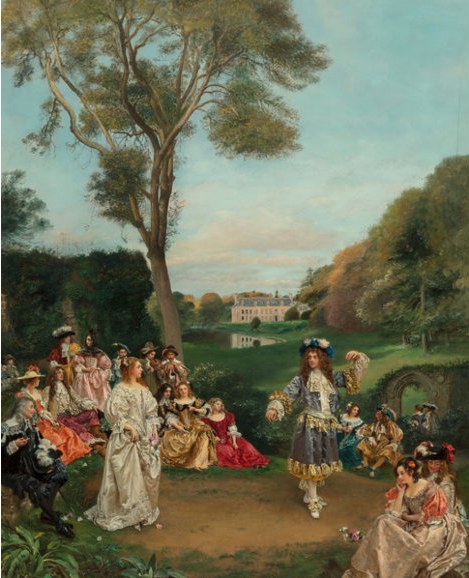
A formal outdoor garden party or ball, set in the grounds of a neoclassical château visible across a lake in the middle distance. The foreground is dominated by elegantly dressed figures in 1870s costume arranged in loose groups on a terrace of pale earth. On the left, a cluster of women in white and pastel silks with full skirts converse and gesture; a man in formal coat and breeches stands among them. On the right, a separate group includes a woman in a red or rose-colored dress and several other figures in lighter costume. The composition is anchored by a monumental pale tree with spreading limbs in the center-left, whose trunk and branches frame the scene. Dappled light falls across the terrace, creating a sense of afternoon leisure. The overall mood is one of refined courtship and social performance—no energetic dancing is visible, but the figures are arranged as if pausing in the midst of social movement and mutual regard.
The dancing
The bodies are arranged in a promenade or processional mode rather than in closed dance holds. The women's arms are exposed and held at varying heights—some gesturing expressively, others at rest. The men stand upright in formal dress with hand positions suited to social address rather than to partnered movement. Weight appears distributed for standing and casual walking rather than for the sustained tension of ballroom positions. The overall frame is vertical and presentational, with figures oriented toward conversation and social interaction rather than toward the mechanics of dancing.
The dance depicted
This scene depicts aristocratic social dancing or a dance party of the Gilded Age, most likely a ball or garden fête. The painting does not freeze a moment of active dancing but rather captures the social ritual that surrounds dance—the promenade, the conversation, the courtship display. The figures are dressed for and presumably in the process of participating in formal ball-room dances (quadrilles, waltzes, or similar salon dances), but the artist has chosen to show the preliminary or interstitial moment rather than the dance itself. The painting is thus more about the social context and courtship performance of ballroom culture than about the technical execution of any particular dance.
How it was made
This is an oil painting (or possibly large format gouache or watercolor, though the finish suggests oil). The technique allows for subtle modeling of light across silk fabrics and landscape, and for the kind of soft atmospheric depth that situates the château and lake in convincing recession. The scale and finish suggest this is a salon painting intended for exhibition and private collection—a work aimed at the leisured classes who recognized the social world it depicted. The medium's permanence and prestige mark this as a work of considerable ambition, not a sketch or study.
About this work
Jacquet's *La danse* is a society portrait of the ballroom world of the Second Empire or early Third Republic, depicting not the moment of dance itself but the social ceremony of the ball. The painting captures the elaborate costume, the formal garden setting, and the courtship performance that framed ballroom culture for the European elite. It belongs to a tradition of Rococo and Romantic paintings that staged aristocratic leisure as a subject worthy of artistic attention—a tradition that continued even as the social world it depicted was beginning to shift. The work is valuable less as documentation of actual dance technique than as evidence of how the educated classes understood and valued dance as social theater.
How to look at it
Attend first to the moment the painter chose: not the middle of a dance step, but the pause, the promenade, the moment of social address. Notice how the tree frames and stabilizes the composition while the figures remain in loose, almost scattered arrangement. Look at the fabrics—the painter has devoted considerable skill to the play of light on silk, lace, and the shine of hair and jewelry, suggesting that the visual pleasure of appearance was central to the ballroom experience. The painting asks you to see the ball as a theater of social and erotic display rather than as an athletic or technical performance.
The artist
Gustave Jean Jacquet (1846–1909) was a French academic painter who specialized in historical and genre scenes of aristocratic leisure and salon life. He trained within the official academic system and exhibited regularly at the Salon. His work belongs to the tradition of society painting that had flourished in the 18th century and continued throughout the 19th, depicting the leisure world of the wealthy. Jacquet's paintings are marked by careful attention to costume, setting, and the social psychology of courtship and display, though his work remained largely within conservative academic conventions.
The period
In the 1870s, when this painting was made, academic painters were still defending the importance of historical and narrative painting against the rising challenge of Impressionism. The subject of aristocratic leisure was itself becoming retrospective—the painting may nostalgically evoke an earlier era even if it claims to depict contemporary society. Ballroom dancing in this period was still central to elite courtship and social life, though the venues and the surrounding culture were gradually changing. The garden setting and classical building in the distance may suggest an idealized or historical version of the ball rather than a contemporary 1870s scene.
Where it lives
The work is known from Wikimedia Commons. No collection, accession number, or exhibition history is recorded in the available catalogue entry.
Dance in this work
Questions about this work
Is anyone actually dancing in this painting?
Not visibly. The artist has chosen to depict the social ritual and leisure of the ball rather than the moment of dance itself. The figures are arranged as if in conversation or promenade, the intervals that punctuated ballroom events. This choice is itself informative—it suggests that for audiences of the time, the social performance and courtship display mattered as much as the actual steps.
What dances would these people have danced?
In the 1870s, the ballroom repertoire in wealthy European households would have included the waltz, the quadrille (in various forms), and the polka. These were formal partner dances or set dances, performed in strict rhythm and with prescribed figures. The clothing—the women's full skirts and tight bodices, the men's formal coats—was designed for these dances and the slow promenade between them.
Why paint a ball scene without showing dancing?
This reflects a broader tradition in aristocratic portraiture: the idea that leisure, taste, and social position could be displayed through setting, costume, and the arrangement of figures in refined conversation. For the audience that bought such paintings, the ball was significant as a space of courtship and status display, not primarily as a venue for the technical execution of dance steps.
Is this a specific event, or a type scene?
Almost certainly a type scene—an idealized or generalized depiction of ballroom society rather than a portrait of a particular occasion. The title *La danse* (The Dance) suggests universality rather than specificity. The classical building, the formal gardens, and the scattered arrangement of figures all contribute to a timeless, theatrical mood.
More dance artwork





