49 works in this view — arrow keys or swipe to move between them.
Dance in Art
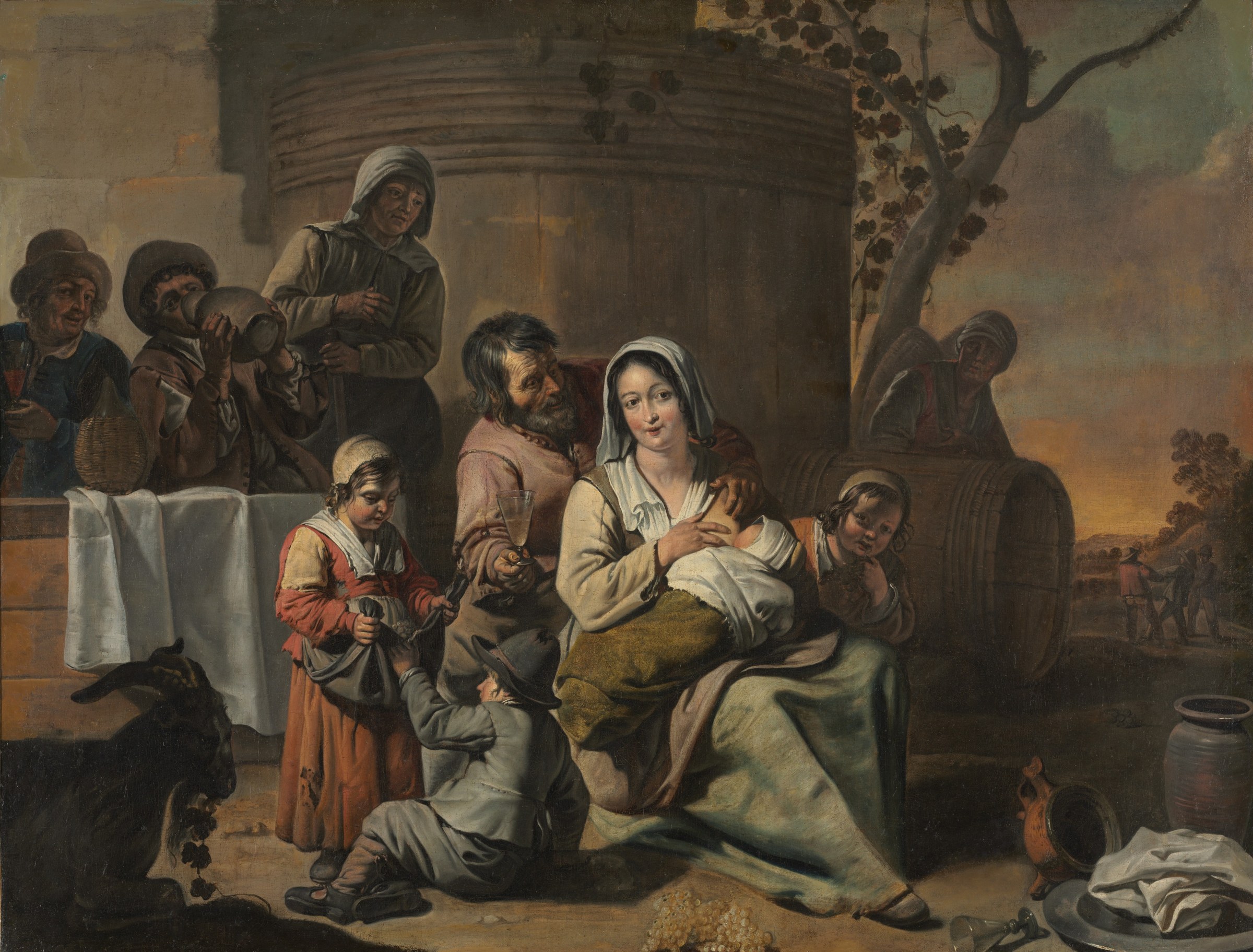
Circle of Le Nain - Vintage Scene and Peasant Children Dancing (painting pair), 1650s
Le Nain Brothers
- Source:
- Wikimedia Commons
- Rights:
- Public domain — free to use, share and adapt.
- Recorded as:
- public_domain
The Le Nain paintings are among the only extensive visual records of actual rural clothing, domestic interiors, and social customs in 17th-century France, created with ethnographic precision and respect. For historians of dance and social life, these works capture the visual context in which folk dancing and communal gathering took place, even when not depicting movement itself.
What you are looking at
A woman sits centrally in a rural interior, cradling an infant while a small child in red stands beside her. Around them cluster five or six other figures—peasants of various ages, some standing, some seated on the ground. The setting is a modest stone dwelling with a large barrel or vat visible in the background and climbing vines on the right wall; a white cloth drapes over what may be a table on the left. The light is warm and golden, concentrated on the central group. The figures are dressed in simple, worn clothing typical of rural French life in the mid-17th century: linen shifts, dark woolen garments, and white head coverings. The mood is contemplative rather than festive, with the gathered figures attending to or observing the mother and children in an intimate domestic scene.
The dancing
The central woman is seated in a relaxed posture, her body angled slightly as she supports the swaddled infant with both arms in a secure hold. The standing child beside her has one arm around her shoulder in a gesture of affection or dependency. The surrounding adults are stationary, posed as onlookers or attendants rather than participants in coordinated movement. No figures are in a dance hold or frame; bodies are vertical and at rest, suggesting a social gathering rather than active dancing.
The dance depicted
The catalogue title references 'peasant children dancing,' but no dance is visibly in progress in this image. The figures are static and arranged in a familial or communal gathering—a birth scene or presentation of an infant, perhaps—rather than executing steps or participating in a structured dance. The title may reflect a broader series or pair of paintings, or it may project a narrative meaning onto a quiet domestic moment. Without visible movement or the codified postures of any recognized dance form, the claim of dance cannot be substantiated from the visual evidence alone.
How it was made
The work appears to be an oil painting, executed with the muted earthy palette and warm light characteristic of 17th-century Dutch and Flemish realism. The technique favors soft transitions between figures and background, and careful attention to texture—fabric, skin, and architectural surfaces. This would have been a work for private or modest church collection rather than a grand commission, scaled and composed for intimate viewing in a domestic or modest institutional space.
About this work
This painting presents a scene of rural French or Flemish domestic life in the 1650s, attributed to the circle of the Le Nain brothers, whose reputation rested on their sympathetic and detailed representation of peasant and working-class interiors. The image records a quiet moment of family and community life—the arrival or presentation of an infant, witnessed by neighbors or relations. It is not a dance scene in the conventional sense, though the catalogue record invokes dancing, and belongs in the archive as a historical document of how rural people gathered, dressed, and marked significant moments in their lives. The work exemplifies a major thread in mid-century French painting: the elevation of peasant life as a subject worthy of serious artistic attention and compositional care.
How to look at it
Look first at the posture and arrangement of the figures: who is active, who is still, who is attending to whom. The central woman and children occupy a stable geometric position, and the surrounding figures are oriented toward them, suggesting hierarchy and attention rather than participation in a shared movement. Notice the light: it falls warmly on skin and fabric, creating a mood of intimacy and inwardness. The artist has chosen a quiet moment of gathering rather than a moment of visible action, which tells us that the meaning of the scene lies in presence and relationship rather than in spectacle.
The artist
The Le Nain brothers—Antoine, Louis, and Mathieu—were French painters active in Paris in the mid-17th century, celebrated for their uncommonly sympathetic and detailed representations of peasant life and rural labor. Unlike some of their contemporaries, they did not condescend to their subjects or load scenes with moral commentary; instead, they recorded dress, gesture, and domestic arrangement with the attention usually reserved for aristocratic portraiture. Their work was admired in their lifetime and has been rediscovered repeatedly as a model of social realism. The attribution and dating of individual works remains uncertain, as the brothers often collaborated and few pictures are signed or reliably documented.
The period
The mid-17th century saw a growing market for genre scenes of rural and working-class life in France and the Low Countries, driven partly by curiosity about peasant customs and partly by a newly confident merchant and minor-noble class eager to collect images of lower social orders. Dance and courtship scenes were popular in this market, but so were scenes of labor, eating, drinking, and family life. The Le Nain brothers' work coincided with a moment when peasant festivities—particularly dancing—were being documented in text and image as a subject of ethnographic and moral interest. The painting's ambiguous title may reflect this context: a work primarily recording a domestic or birth scene might be catalogued or remembered as a 'peasant scene,' and any gathering of rural figures could acquire the label of 'dancing' through association with popular understanding of peasant sociability.
Where it lives
The work is recorded in the catalogue of the Cleveland Museum of Art (accession 1958.175) and identified as a painting pair with another Le Nain interior scene. The source is Wikimedia Commons. Neither the medium (oil, canvas size) nor the current location beyond Cleveland are confirmed in the record provided.
Questions about this work
Is this actually a dance scene?
No visible dance is depicted. The catalogue title invokes 'peasant children dancing,' but the figures in the painting are stationary and posed in a domestic or social gathering, most likely centered on an infant. The title may reflect a broader series or a historical association of peasant scenes with festive dancing, but the image itself shows a quiet moment of family and community witness rather than movement.
What is happening in the scene?
A woman sits holding a swaddled infant while a small child in bright red stands beside her. Around them gather five or six other figures—adults of various ages dressed in simple rural clothing—who stand or sit as onlookers. The setting is a modest stone room with a large barrel, a table covered with white cloth, and climbing ivy visible through an opening. The mood suggests a domestic occasion—a birth, presentation, or gathering of family and neighbors.
Who were the Le Nain brothers?
Three French painters active in Paris in the mid-17th century, known for unusually respectful and detailed images of peasant life and labor. They often collaborated and few of their works are securely attributed or dated. They were admired in their time and remain important as among the earliest serious painters of rural and working-class subjects in European art.
What can we learn about dance from this painting?
Though this particular work does not depict dancing, the Le Nain paintings collectively record the clothing, domestic spaces, and social contexts in which rural people gathered and danced. The simple linen and wool garments, the modest interior, and the casual grouping of community members visible here show the material world of 17th-century peasant life, including the settings where dance and festivity would have occurred.
More dance artwork





