49 works in this view — arrow keys or swipe to move between them.
Dance in Art
Spanish: Paisaje con la boda de Isaac y Rebeca The Marriage of Isaac and Rebeccalabel QS:Len,"The Marriage of Isaac and Rebecca"label QS:Lde,"Landschaft mit der Vermählung von Isaac und Rebekka"Alternative title(s): The Mill
Claude Lorrain
- Source:
- Wikimedia Commons
- Rights:
- Public domain — free to use, share and adapt.
- Recorded as:
- public_domain
For historians of dance imagery, this work documents how Baroque painters conceived of wedding celebration and social festivity in an idealized classical world. The gathering depicted here—the crowd, the landscape of abundance, the river—establishes the visual vocabulary through which artists of the period represented occasions of ceremony and communal joy, even when dance itself is not the explicit subject.
What you are looking at
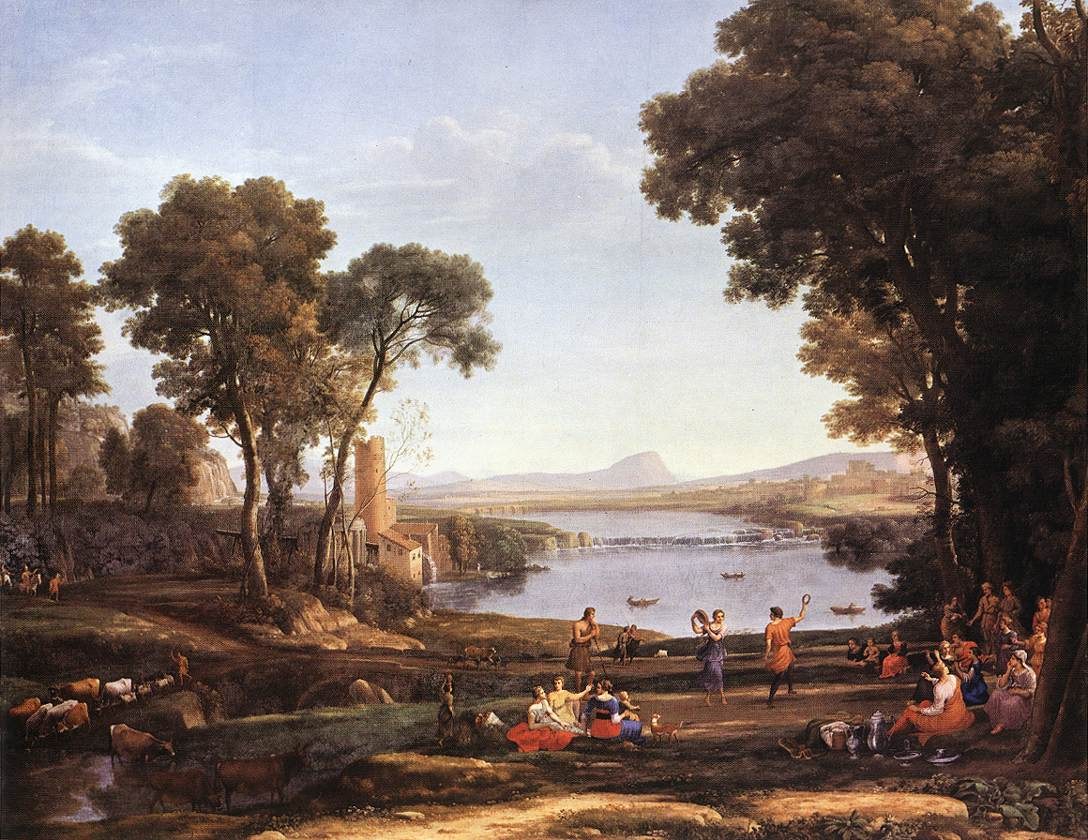
A sunlit river valley unfolds in the middle distance, framed by ancient trees whose massive trunks and spreading canopies create a natural colonnade on either side of the composition. The foreground is occupied by a large gathering of figures in classical dress—men, women, and children scattered across grassy ground in animated conversation and movement. Some stand in clusters; others recline or crouch on the earth. The figures wear draped garments in warm ochres, reds, and blues. To the left, a fortified structure with crenellations suggests a walled settlement. The river beyond is dotted with small boats. In the far distance, mountains and towns suggest a vast cultivated landscape bathed in luminous, hazy light—the hallmark of Claude Lorrain's atmospheric perspective. The scene reads as a moment of social gathering, celebration, or significant arrival rather than fixed tableau.
The dancing
The figures display no coordinated formation or closed holds characteristic of European court dance. Instead, they occupy the space in loose, naturalistic groupings typical of Baroque pastoral imagery. Some stand with weight shifted conversationally; others bend or sit, suggesting ease and informal assembly rather than choreographed movement. A few figures in the middle ground appear to gesture or motion—one woman with arm raised—but these are gestures of everyday animation, not dance vocabulary. The distribution across the foreground and middle ground creates spatial depth and narrative diffusion rather than focus on a single dancing body or pair.
The dance depicted
The catalogue record identifies this as depicting the biblical marriage of Isaac and Rebecca, anchored by an inscription on the tree stump in the composition's centre (now visible only in this version with the inscription; a variant without it is titled *The Mill*). The assembled crowd most likely represents the wedding feast or celebration surrounding this union. However, the image does not depict formal choreographed dance. Instead, it presents the social gathering and festivities that would have surrounded such an event in classical or idealised antiquity—the kind of leisure, abundance, and social concordance that Baroque artists associated with Arcadian or biblical pastoral. The work illustrates the occasion rather than the dance.
How it was made
Oil on canvas, executed with the refined technique for which Claude Lorrain became renowned. The painting demonstrates mastery of atmospheric perspective: colours and detail diminish with distance, and a warm luminous haze—achieved through subtle layering of glazes—unifies the composition and draws the eye toward the river and distant landscape. The foreground figures, though numerous, are rendered with economy; their faces and individual gestures are subordinate to their roles in the overall spatial composition. This technique—prioritising light, air, and landform over narrative detail—was central to Claude's method and made his works highly prized by European collectors and influential on landscape painting for two centuries.
About this work
This is Claude Lorrain's *Landscape with the Marriage of Isaac and Rebecca*, a painting that uses biblical narrative as a framework for an Arcadian landscape composition. The work belongs to a large body of paintings in which Claude merged classical subject matter with imaginative landscape, creating scenes of idealized antiquity suffused with golden light and atmospheric depth. Within a gallery of dance in art, it appears as an example of how festive or ceremonial occasions—moments rich in social significance—were represented in the visual culture of the seventeenth century. The painting is not primarily about dance as a performed art; rather, it shows the social and ceremonial context in which dance and celebration would have occurred.
How to look at it
Attend first to the composition's spatial structure: how the massive trees frame the receding landscape, guiding the eye toward the distant mountains and luminous sky. The human figures are scattered within this landscape rather than foregrounded; they are part of the scene's fabric rather than its focus. This subordination of the narrative (the wedding) to the landscape (the Arcadian valley) was Claude's characteristic inversion of Renaissance hierarchy—the setting becomes more significant than the story it contains. Notice also the play of light: warm and golden in the foreground, cooler and hazier in the distance, unifying the entire composition in a kind of perpetual late afternoon. The gathering of figures, when examined closely, shows no synchronized movement; instead, the animation comes from their distribution across space and the subtle variations in their gestures and groupings.
The artist
Claude Lorrain (1600–1682) was a French Baroque painter who spent most of his career in Rome and became the most influential landscape painter of his era. He specialised in imagined classical and biblical scenes set within vast, luminous landscapes, often populated with small figures engaged in narrative moments—harbours, mills, arcadian gatherings, sacred histories. His meticulous observation of light and atmosphere, combined with his ability to create deep spatial recession, made his works intensely sought after by collectors and imitators. He kept a record book (the *Liber Veritatis*) of his compositions to guard against forgeries, evidence of his market success and reputation.
The period
In the mid-seventeenth century, when this painting was made, landscape painting was undergoing a profound elevation in status. Claude was instrumental in establishing landscape—rather than history painting or portraiture—as a vehicle for artistic ambition and philosophical meditation. At the same time, wedding celebrations and civic gatherings in baroque courts and aristocratic households were increasingly elaborate, incorporating dancing, music, theatre, and spectacle. This painting captures the ideal of such occasions as moments of social harmony and natural abundance, rendered through a classical or biblical lens. The work also reflects the Counter-Reformation interest in biblical narrative and the pastoral tradition's association of landscape with timeless human values.
Where it lives
The work is held in a major collection (not specified in the record provided). This is one of Claude's variations on the theme; another version without the identifying inscription is in the Palazzo Doria Pamphilij in Rome. Such variations were not uncommon in Claude's practice and reflect both the high demand for his work and his interest in exploring compositional possibilities.
Questions about this work
Is anyone actually dancing in this painting?
No. The painting depicts a festive gathering—a wedding celebration in an idealized landscape—but the figures are not performing choreographed dance. They stand, converse, gesture, and recline in the attitudes of a social assembly. The work illustrates the occasion for dance and celebration rather than dance itself.
How do I know this is the Marriage of Isaac and Rebecca?
Claude inscribed the identification on a tree stump in the composition's centre. The inscription is difficult to read in reproductions, but the catalogue record and art historical tradition confirm it. A variant of this composition without the inscription exists and is titled *The Mill*, showing that Claude valued the landscape design independent of the narrative.
Why is this painting so much about landscape rather than people?
Claude believed landscape could be a vehicle for profound artistic expression, equal to history painting. By making the luminous valley, the river, and the distant mountains the true subject, he invited viewers to read the human gathering as part of a larger harmony between civilization and nature. This was a revolutionary reordering of artistic priorities in the seventeenth century.
What would a wedding celebration in this period actually have involved?
Baroque wedding celebrations in aristocratic and court circles were elaborate affairs involving feasting, music, dancing, and sometimes theatrical performances. This painting captures the idealized social abundance and concord such occasions represented, though it does not depict the specific entertainments. Dance would typically have followed the feast and been a central feature of the evening's festivities.
More dance artwork





