49 works in this view — arrow keys or swipe to move between them.
Dance in Art
Venus Feast
Peter Paul Rubens
- Source:
- Wikimedia Commons
- Rights:
- Public domain — free to use, share and adapt.
- Recorded as:
- public_domain
Though not itself a dance scene, the painting documents the mythological and sensual framework within which Baroque court dance and masque were performed and understood. It shows us the visual culture of abundance and pleasure that dances were created to embody and celebrate. Understanding these Baroque feast paintings helps explain the aesthetic choices in contemporary choreography and spectacle.
What you are looking at
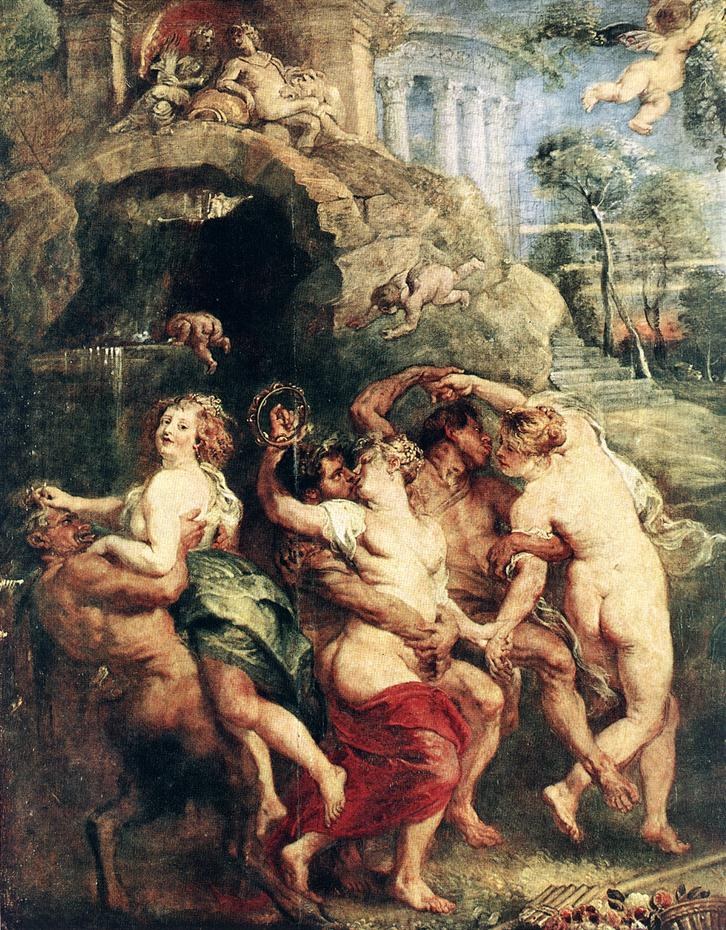
A crowded outdoor scene of revelry and sensuality in a classical setting. A mature, rotund male figure—identifiable as a satyr or Bacchus by his reddish-brown coloring and animal vitality—reclines on a stone platform or altar at the center-left, attended by multiple nude and partially draped female figures (nymphs or attendants) who lean toward him, touch him, and offer him fruit and wine. The figures are arranged in an interlocking composition of flesh tones against darker stone architecture; columns and a classical portico are visible in the background, with a landscape and flying putti (cherubs) in the upper right. The light is warm and golden, emphasizing the fleshy abundance of the bodies. A dog occupies the lower foreground. The overall mood is one of unrestrained abundance and physical pleasure, with the female figures' bodies arranged to display their forms rather than to show coherent action.
The dancing
The bodies are arranged in a loose, sensual embrace rather than in a coordinated dance. The central male figure reclines passively while the female attendants bend, lean, and reach toward him in attitudes of service and seduction. Their postures are elongated and sinuous, with arms raised and extended, bodies pressed close. There is no synchronized movement, no partnership frame, no footwork visible—instead, the composition emphasizes proximity, touch, and the interplay of gazes. The arrangement suggests a tableau of desire rather than a structured dance.
The dance depicted
This is not a depiction of dance in any formal or technical sense, though it uses the conventions of erotic pageantry familiar from court masques and festival imagery of the Renaissance and Baroque periods. The scene borrows from the visual language of bacchanalia and the feasts of mythological figures—a context in which music, dancing, and sensual display were conventionally combined. However, the image freezes a moment of static devotion and consumption rather than showing movement or rhythm. The title *Venus Feast* (or a variant) suggests a scene of mythological celebration where dance might occur, but the actual bodies do not depict dancing.
How it was made
This is an oil painting on canvas, executed in Rubens's characteristic thick, luminous style. The artist applied paint loosely in places (particularly the flesh) and more carefully in the architectural and landscape details. The technique allowed for the rich modeling of skin tones and the sensual play of light across fleshy forms—effects impossible in line-based media. The finish is polished and substantial, suggesting a work made for a wealthy patron's collection rather than a preparatory sketch or print. The painting's circulation would have been limited to aristocratic and courtly audiences.
About this work
This is a Baroque allegorical scene depicting a mythological feast, probably a satyr or Bacchus surrounded by nymphs or attendants in a classical setting. The work belongs to a long tradition of Baroque sensual imagery celebrating abundance, fertility, and erotic pleasure through the bodies of mythological figures. Though the title and subject matter invoke a festive occasion (where dance would be expected), the actual composition is static and tableaulike, organized around the male figure's passive enjoyment rather than around movement or music. The work exemplifies the Baroque visual celebration of the body and the close association between mythological revels, sensuality, and the visual display of female forms.
For a dance gallery, this image matters primarily as a representation of the *aesthetic and cultural context* in which dance occurred—the feasts, masques, and courtly celebrations where dance was one element of a larger sensory experience of music, spectacle, wine, food, and erotic display. The painting records not dance itself but the environment and values that framed it.
How to look at it
Attend to the composition's center of gravity: the reclining male figure is passive and central, while the female figures are arranged around him in attitudes of service and desire. Notice how the artist has used overlapping bodies, varied skin tones, and directional gazes to create a sense of movement even though no one is actually dancing or in motion. The painting freezes a moment of indulgence and display. Compare the careful rendering of flesh tones and textures with the more schematic treatment of the architecture and landscape—an indication of where Rubens and his audience valued visual attention. The work is a feast for the eye in the same way the scene depicts a feast for the body.
The artist
Peter Paul Rubens (1577–1640) was the most celebrated Baroque painter in Northern Europe, known for his dynamic compositions, warm color, and celebration of full-figured female bodies. He ran a large workshop in Antwerp and received commissions from European royalty and the church. His mythological and allegorical scenes were designed for princely collections and embodied the Baroque taste for sensuality, movement (even in static compositions), and rich color. Many of his works depict feasts, bacchanalia, and mythological revels—genres that allowed him to explore the interplay of multiple bodies, drapery, and erotic themes.
The period
This painting dates to the 1630s, late in Rubens's career, when the Baroque visual language was fully mature. The 1630s saw the height of court masque culture in England and France, where elaborate spectacles combining dance, music, theater, and visual display were staged for royalty. In painting, mythological feasts and bacchanals were fashionable subjects among wealthy collectors, embodying the pleasures of sensory experience and the classical past. The emphasis on the body and on abundance reflected broader Baroque aesthetics but also the economic and political aspirations of the courtly patrons who bought these works.
Where it lives
The source is listed as Wikimedia Commons, indicating a digitized image of a work held in a public collection. The exact current location and accession number are not provided in the record.
Questions about this work
Is this actually a dance scene?
No, though it depicts a mythological feast—a context in which dance would occur. The figures are arranged in a static tableau of sensual attendance rather than in coordinated movement. The work is valuable to dance history not as a depiction of dance technique or movement, but as evidence of the luxurious, erotic aesthetic context in which court dance and masque were performed.
Who or what is the central figure?
The reddish-brown male figure is almost certainly a satyr or the god Bacchus, indicating a scene of mythological revelry. He is the object of the attendants' devotion and desire. The title *Venus Feast* suggests the scene may also invoke Venus (goddess of love and beauty) as the organizing principle, though the image itself centers the male figure's pleasure.
Why would a painter choose this subject?
Mythological feasts and bacchanals allowed Baroque painters to explore multiple intertwined bodies, rich colors, and erotic themes in a way that was sanctioned by classical and allegorical tradition. Wealthy patrons—especially aristocrats and royalty—collected such paintings as expressions of their own cultured taste and as celebrations of sensory pleasure and abundance.
What does this tell us about dance in Rubens's time?
While the painting is not a dance scene, it reveals the visual and sensual culture surrounding dance. Court dances and masques occurred within feasts and celebrations like the one depicted here. The painting's celebration of the body, of pleasure, and of spectacle reflects the values that shaped choreography and performance in the Baroque period.
More dance artwork





