49 works in this view — arrow keys or swipe to move between them.
Dance in Art
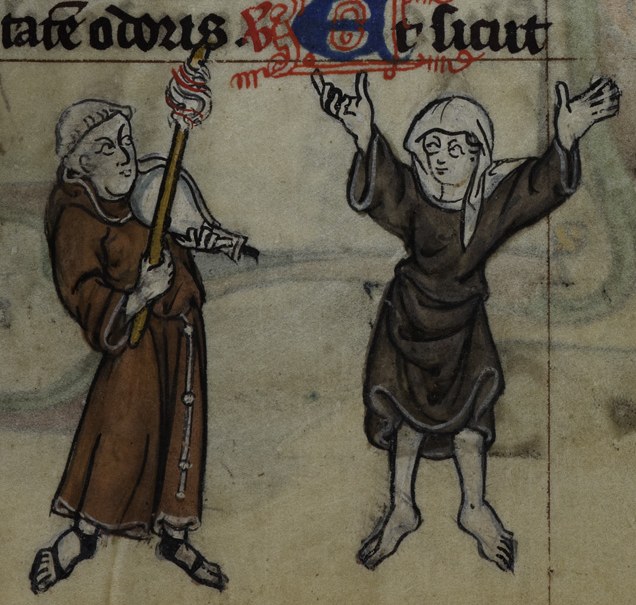
Maastricht Book of Hours, BL Stowe MS17 f038r (detail)
Unknown miniaturist from Liège-Maastricht area, ca. 1300-1325
- Source:
- Wikimedia Commons
- Rights:
- Public domain — free to use, share and adapt.
- Recorded as:
- public_domain
Medieval visual records of actual dance are scarce, and most surviving evidence comes from formal courtly contexts or religious texts. This drollerie is precious because it shows informal, exuberant movement—the kind of dancing people actually did in everyday life—drawn with the immediacy and humor of a marginal sketch. It is also evidence, rare for the period, of women (possibly religious women) as active participants in music and dance, and of the church's ambivalent tolerance for such pleasures within monastic or aristocratic walls.
What you are looking at
A medieval manuscript illumination shows two figures in a moment of music and dance. On the left stands a figure in a brown robe with white coif, holding an ornate staff topped with a knotted finial—likely a nun or religious figure—who looks toward a companion. The figure on the right wears a dark garment and is captured mid-movement with both arms raised high, palms open, in an expansive gesture. The composition is set against the plain parchment background typical of manuscript drolleries—the marginal, often whimsical illustrations that appear throughout medieval books of hours. The red and blue illuminated initial above frames the scene. The drawing style is characteristic of early 14th-century Liège-Maastricht work: outlined figures with minimal modeling, lively linear quality, and the kind of spontaneous energy these drolleries were known for.
The dancing
Two figures occupy the composition: the left figure stands relatively still, grounded and frontal, while the right figure abandons formal posture entirely. The dancing figure's arms rise in an open, exuberant frame—not a closed partnered hold but an expression of joy or abandon, with the weight shifted and the body animated in a way that suggests active, joyful movement rather than courtly restraint. The contrast between the stillness of the musician and the energy of the dancer is the work's central dynamic.
The dance depicted
This is documentary evidence of early social dancing in a religious context, most likely a moment of recreation or entertainment within monastic or aristocratic life. The figure on the right performs what appears to be a simple, celebratory social dance—not a formal courtly measure but an informal, exuberant movement to music. The raised arms and open posture suggest freedom of expression rather than technical precision. This type of informal dancing to instrumental music was common in medieval secular and semi-secular settings, though its appearance here in a book of hours—a devotional text—marks it as a drollerie: a deliberately incongruous, often humorous marginal scene that offered relief from sacred text. The identity of the musicians and dancers (possibly a nun and monk, or possibly secular performers in religious dress) remains ambiguous but deepens the work's interest as evidence of how medieval society imagined religious women and men in moments of leisure.
How it was made
This is a detail from an illuminated manuscript—hand-drawn and hand-colored on vellum. The technique is ink drawing with watercolor or gouache, executed with the linear precision and economy typical of manuscript illustration. The drolleries in books of hours were often sketched more freely and swiftly than the main miniatures, allowing artists greater expressiveness and humor. The fact that this is a manuscript means it circulated among the wealthy—likely an aristocratic woman in the Liège-Maastricht region—and offers insight into what educated, high-status patrons found entertaining enough to commission in the margins of their sacred books.
About this work
This medieval manuscript illumination preserves a fleeting moment of informal social dance and music-making in the early 14th century. The work appears as a marginal drollerie in the Maastricht Book of Hours, a luxury devotional manuscript commissioned for an aristocratic patron. It is simultaneously a record of how people actually moved and gestured, a window onto the role of music and dance in medieval recreation, and an example of the kind of secular humor and observation that medieval artists embedded in the sacred texts of the wealthy. The work matters because it captures dance at an unguarded moment—not performance, not courtly display, but the body in spontaneous joy, a rare documentary trace from a period when such moments were rarely recorded.
How to look at it
Attend first to the contrast between the two figures: the musician's vertical, almost formal stance versus the dancer's explosive, upward-reaching gesture. Notice the precision of the ink line and the economy of detail—the artist conveys movement and emotion through posture and gesture rather than anatomical detail. The raised arms of the dancer are the key: they are not constrained or technically formal, but open and high, suggesting a moment of unselfconscious joy or celebration. The drollerie format itself invites a different kind of looking than the formal miniatures of the book would: this is meant to be intimate, quick, perhaps even funny—a private joke between the artist and the owner of the manuscript.
The artist
The artist is unknown, identified only by the style and provenance of the Maastricht Book of Hours, which scholars attribute to the Liège-Maastricht scribal and artistic tradition of the early 14th century. This was a region of sophisticated manuscript production, known for ambitious narratives and lively marginal imagery. The drolleries in this manuscript are among its most valued features—evidence of an artist or workshop comfortable with observation, humor, and the freedom to treat margins as space for social commentary and visual wit.
The period
The early 14th century saw the flourishing of manuscript culture among the European aristocracy, particularly in the Lowlands and France. The book of hours—a personal devotional text—became a status object for wealthy women and men, and the margins of these books became a canvas for artists to explore secular themes, social observation, and humor. Dance itself in this period was undergoing shifts: courtly dances were becoming more codified and performative, while social dancing in non-court contexts remained informal, participatory, and tied to music and celebration. The appearance of dance in a sacred text's margins reflects the medieval acceptance of such pleasures as part of aristocratic life, even if moralists sometimes condemned them.
Where it lives
The Maastricht Book of Hours is held in the British Library (Stowe MS 17). It was commissioned in the early 14th century for an aristocratic patron, likely a woman, in the Liège-Maastricht region. The manuscript was owned in the 18th century by the 1st Duke of Buckingham and Chandos, acquired by Lord Ashburham in 1849, and purchased by the British Library in 1883 as part of the Stowe collection. This folium (f38r) appears in the section of the manuscript that contains the Little Office of Our Lady (Hours of the Virgin), though the drollery itself has no liturgical relation to the text it accompanies.
Dance in this work
Questions about this work
Is this definitely a nun dancing?
The figure on the left wears a white coif and brown robe consistent with medieval religious dress, and is likely a nun or religious woman. The figure on the right, also in religious dress, may also be a religious figure or a secular performer wearing such costume. The catalogue description suggests the interpretation, but the image allows for ambiguity: it could be a nun dancing with a monk, or secular performers dressed as such. What matters is that both are engaged in informal, joyful movement.
What kind of music is being played?
The staff the left figure holds is an ornate processional staff, not an instrument. No visible instrument is drawn. The music is implied rather than shown, which was common in medieval drolleries. The gesture and posture of the dancer, however, suggest instrumental music—likely a pipe, drum, or stringed instrument commonly used for dance in the period.
Why is a secular scene in a prayer book?
Drolleries—whimsical, often secular, sometimes irreverent marginal illustrations—were a standard feature of luxury medieval manuscripts, especially books of hours. They offered visual relief, humor, and social observation alongside sacred text. They may also have been markers of the owner's wit and sophistication. The presence of such scenes reflects medieval attitudes: leisure, music, and dance were acceptable pleasures for the aristocracy, and depicting them in a devotional book did not constitute sacrilege.
How do we know this dates to the early 14th century?
The style, technique, and paleography of the Maastricht Book of Hours, combined with its regional characteristics and the history of its commission, are documented in scholarly study. The work is dated to 1300–1325 based on script, illumination style, and known artistic production in the Liège-Maastricht region during that period.
More dance artwork





