49 works in this view — arrow keys or swipe to move between them.
Dance in Art
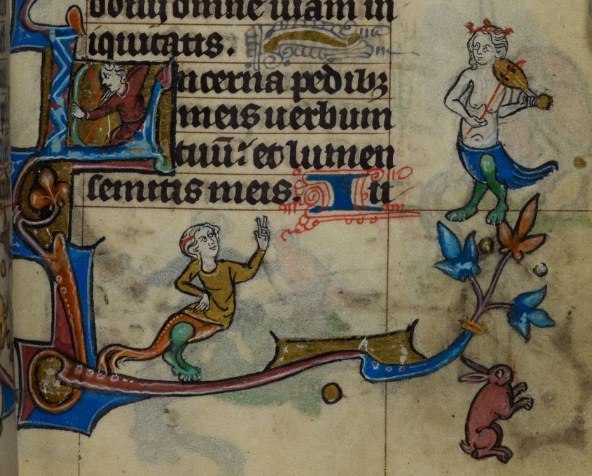
Maastricht Book of Hours, BL Stowe MS17 f103r (detail)
Unknown miniaturist from Liège-Maastricht area, ca. 1300-1325
- Source:
- Wikimedia Commons
- Rights:
- Public domain — free to use, share and adapt.
- Recorded as:
- public_domain
This is one of the earliest extant depictions of popular dancing and entertainment in Northern European visual culture, capturing the bodily language of vernacular movement distinct from courtly or liturgical forms. It provides rare documentary evidence of how medieval artists perceived the relationship between musician and dancer, and how entertainers were coded in elite visual culture—often as marginal, hybrid, or monstrous figures, reflecting anxieties about the body, pleasure, and low social status. For historians of dance practice, it opens a window onto performance contexts and kinetic habits that left no other trace.
What you are looking at
A marginal drollery from a Book of Hours illuminated manuscript, painted in the early 14th century. Two hybrid creatures occupy the lower left and right margins of the folio, framing the text above. The left figure is a human-headed creature with a fish or serpent tail, seated or crouching and playing a stringed musical instrument (a lute or similar). The right figure, a male hybrid with the upper body of a man and lower body suggesting animal or fantastical form, dances or gestures in response to the music. Both figures are rendered in warm ochres and flesh tones against the aged parchment. At the bottom right, a small rabbit or hare sits independently. The overall composition is playful and whimsical, typical of the marginal commentary and social satire common to 14th-century manuscripts—these figures bear no relation to the liturgical text of the Hours of the Virgin above them.
The dancing
The dancing male figure on the right adopts an open, celebratory posture with limbs extended in an attitude of movement or abandon. His stance is frontal and energetic, lacking the formal structure of courtly dance; his body appears to lift or sway. The musician on the left is seated or kneeling, inclined toward the instrument, creating a clear relationship of call-and-response between the two. Neither figure demonstrates the controlled frame or precise footwork of trained dance; instead, both suggest playful, spontaneous movement—the kind of vernacular gesturing that might accompany folk music or entertainment.
The dance depicted
This drollery depicts not formal or courtly dance but popular or festive movement—the kind of joyful response to music-making that would have been familiar in medieval taverns, fairs, or festive gatherings. The male figure's open posture and apparent weightlessness suggest dancing done for pleasure rather than ceremony. The presence of a musician and a dancer together, depicted as hybrid or monstrous creatures in the margin, may be a form of social or moral satire, mocking the frivolity of secular entertainment or the lowly status of entertainers. The image captures a moment of musical-kinetic exchange rather than any identifiable step pattern or named dance form.
How it was made
This is a detail from an illuminated manuscript—ink and pigment on vellum, painted by hand. The technique allows for fine linear detail in the figures and minute characterisation of gesture, while the cost and labour of hand-painting restrict such elaborate marginal scenes to elite patrons. The survival of the Maastricht Book of Hours suggests it belonged to an aristocratic household in the Liège-Maastricht region, yet the marginal drolleries—often crude, satirical, or vulgar by contrast with the formal religious text—reveal a taste for humorous commentary on secular life. Such margins are characteristic of early 14th-century Flemish and Northern European manuscript practice.
About this work
A marginal drollery from the Maastricht Book of Hours, ca. 1300–1325, depicting two hybrid creatures—one playing a stringed instrument, the other dancing in response—set apart from the liturgical text of the Hours of the Virgin. The image belongs to a rich tradition of medieval manuscript marginal art, in which secular, satirical, or whimsical scenes comment obliquely on the sacred text above. It is one of the earliest surviving visual records of popular entertainment and musical-kinetic response in Northern Europe.
The work matters to dance historians as evidence of how medieval artists understood and portrayed non-courtly, unschooled movement—the bodily response to music-making in everyday or festive contexts. It also documents the status and representation of entertainers (musicians and dancers) as subjects fit for satire or moral commentary in the eyes of elite patrons. The drollery records a social and performative world largely absent from surviving choreographic texts or formal portraiture.
How to look at it
Attend to the open, unschooled quality of the dancer's posture: this is not the upright, measured bearing of a courtly dancer, but an exuberant, almost weightless response to sound. Notice the musician's inclined focus on the instrument and the dancer's directional response toward it—the two figures are locked in a moment of call-and-response. The decision to render both as hybrid or monstrous creatures (rather than humans) is significant: it marks them as 'other,' outside the normal social order, and likely reflects the satirical intent of the marginal scene. The rabbit at bottom right may be a further emblem of folly or appetite, common in medieval visual culture.
The artist
The manuscript was produced by an unknown miniaturist or workshop active in the Liège-Maastricht region in the first quarter of the 14th century. The style is characteristic of early Netherlandish manuscript illumination, marked by delicate figural work, rich colour, and a taste for marginal drolleries and social satire. The artist's training, patrons, and individual name remain unrecorded, as is typical for manuscript craftspeople of this period, who worked within guild systems and workshop traditions rather than as named individual creators.
The period
In the early 14th century, the art of manuscript illumination was at a peak of refinement in the Low Countries and Northern France. The book of hours—a private devotional text with a calendar, psalms, and the Hours of the Virgin—was a luxury commodity for the nobility and merchant class, and such manuscripts often featured elaborate marginal commentary. These margins frequently depicted scenes of hunting, labour, courtship, or moral satire that stood in ironic relation to the sacred text. Meanwhile, in the lived world of performance, secular entertainment—music, dance, and acrobatics—was provided by minstrels, jongleurs, and other travelling performers, who occupied an ambiguous social status between valued skill and moral suspicion. The drollery records this cultural tension.
Where it lives
This detail is from the Maastricht Book of Hours (British Library, Stowe MS 17, folio 103r), an illuminated manuscript of the early 14th century held in the British Library as part of the Stowe collection. The manuscript was acquired by the British Library in 1883 from the collection of Lord Ashburton, to whom it had passed in the 19th century from the 1st Duke of Buckingham and Chandos. The full manuscript is a devotional luxury object commissioned for an aristocratic patron in the Liège-Maastricht region.
Dance in this work
Questions about this work
What are these hybrid creatures and why are they depicted in the margin?
Medieval manuscript margins often contained drolleries—playful, satirical, or moralizing scenes with no connection to the text above. These hybrid creatures (human-headed with animal or fantastical lower bodies) were common in such marginal art and typically encoded social satire. Their depiction as 'monstrous' or 'other' may reflect anxiety about secular entertainment, the lower status of performers, or more simply, the pleasure medieval artists and patrons took in the grotesque and absurd. No single explanation fits all marginal drolleries; their meaning was often deliberately ambiguous or open to multiple readings.
Is this a 'real' dance or just playful invented movement?
It appears to be neither a named, formal dance nor purely invented fantasy. Instead, it captures the bodily language of spontaneous, joyful response to music—the kind of movement that would have accompanied entertainment at fairs, feasts, or taverns. Medieval visual artists rarely depicted named courtly dances in such unselfconscious, open-postured ways; this suggests the artist was recording popular, vernacular movement rather than codified performance. The lack of formal frame or precise footwork distinguishes it sharply from courtly dance imagery.
What does this tell us about medieval entertainment?
The image is evidence that music and dance were paired forms of secular entertainment by the early 14th century, and that they attracted elite interest (this patron commissioned a luxury manuscript) alongside moral or social suspicion (the satirical marginal framing). It suggests entertainers were mobile, skilled, and present at aristocratic venues, yet coded as socially marginal or worthy of mockery. It also shows that artists and patrons took pleasure in documenting the unschooled, exuberant bodily responses of common people—a perspective largely absent from formal or courtly art.
More dance artwork





