49 works in this view — arrow keys or swipe to move between them.
Dance in Art
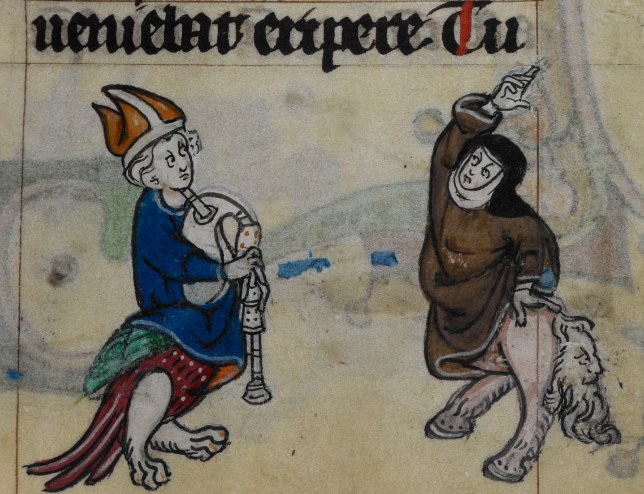
Maastricht Book of Hours, BL Stowe MS17 f049r (detail)
Unknown miniaturist from Liège-Maastricht area, ca. 1300-1325
- Source:
- Wikimedia Commons
- Rights:
- Public domain — free to use, share and adapt.
- Recorded as:
- public_domain
Medieval manuscripts rarely show the body in active movement; when they do, it is usually in margin drolleries where transgression is permitted. This image captures the medieval anxiety about music as an irresistible force that unmakes rational order and decorum. For historians of dance and embodiment, it is evidence that the period understood music and movement as intimately, almost involuntarily linked—a fundamental principle that would govern theatrical and social dance for centuries after.
What you are looking at
A marginal drollery from a 14th-century manuscript depicts two fantastical hybrid creatures in a moment of musical performance and dance. On the left, a bird-headed figure wearing a bishop's mitre and blue clerical robes plays bagpipes with evident enthusiasm, the instrument angled upward. To the right, a lion-headed creature dressed in brown monastic habit dances in response, its body twisted mid-motion with one leg extended and arms gesturing expressively. The beasts stand on a blank ground with minimal architectural or natural setting; the pale vellum background emphasises their grotesqueness. The figures are rendered in the manuscript's characteristic style with delicate ink outlines and applied colour wash—ochre and rust for the lion, blue and green for the bishop, naturalistic flesh tones for their human limbs and faces. This is a margin annotation utterly divorced from the religious text above it, exemplifying the unsanctioned visual humour that scribes embedded in sacred manuscripts.
The dancing
The lion-dancer's posture suggests active movement: the body leans forward with weight shifting, one leg bent and the other extended, the torso rotated to face the bagpiper. The arms are raised and angled, one higher than the other, in a gesture of response or abandon rather than formal dance frame. The bishop-musician stands more stationary, anchored by the bulk of his instrument and robes, but his head is angled toward his dancing companion. Neither figure adopts a partnered dance hold; the relationship is performer-and-audience, musician-and-responder.
The dance depicted
This is not identifiable as any specific historical dance form. The image depicts an improvised or fantastical response to music rather than a codified dance. The scenario invokes the medieval trope of animals or hybrid creatures driven to movement by irresistible sound—a motif of moral transgression and loss of rational control common in marginal drolleries. The lion's gestures suggest something closer to capering or joyful flailing than to the courtly or ceremonial dances documented in the period. What matters is the implicit claim: that music compels the body, and that permission to move visibly is granted to the grotesque and the marginal.
How it was made
This is a detail of an illuminated manuscript leaf, executed in ink and pigment on vellum in the early 14th century. The technique—fine-lined figure drawing with applied watercolour wash—allowed the miniaturist to work at small scale with precision and delicate modulation of colour. The margin location and the complete absence of textual function indicate this was decorative or narrative excess rather than an illustration serving the liturgical content. The survival of this manuscript in the British Library collection speaks to the value placed on its animal studies and decorative inventiveness, despite (or because of) the irreverence of its margin drolleries.
About this work
This folio from the Maastricht Book of Hours shows the explosive visual culture of 14th-century manuscript margins, where scribes and illuminators annexed blank space to depict scenes the holy text would never authorize. The bishop-and-lion scene is a fantasy, yet it documents a real belief about music and movement: that sound triggers bodily response, and that this response is comic, transgressive, and morally ambiguous when enacted by creatures outside the rational human hierarchy. The work belongs in a dance history not because it depicts an actual dance, but because it reveals how medieval culture imagined the body's surrender to rhythm—and who was permitted or condemned for exhibiting that surrender.
How to look at it
Attend to the diagonal line of energy from the bagpiper's raised instrument through the lion's extended leg and raised arms. The artist has frozen the moment of maximum response—not the start of the dance, but its climax of abandon. The comic grotesqueness of the hybrid bodies is essential: a human dancer responding to music would be morally neutral or virtuous, but a beast compelled to move is inherently funny and slightly obscene. The marginal placement is part of the meaning; this scene has no right to exist in the liturgical page, yet it persists in the white space where the eye finds it.
The artist
The miniaturist is unknown, as is common for manuscript illuminators of the period. The Maastricht Book of Hours is attributed to the Liège-Maastricht region on stylistic grounds, a region known for sophisticated manuscript production. The manuscript is especially celebrated for its animal studies and the vivacity of its margin illustrations, suggesting that the artist or the scriptorium's atelier valued naturalistic observation and visual wit alongside devotional content.
The period
Early 14th-century Europe was experiencing the rise of an urban literate culture; Books of Hours were luxury objects for the aristocratic laity, particularly women, blending prayer with visual pleasure. In the same period, court dances such as the estampie and carole were documented and transmitted through written instruction, yet the vast majority of people experienced dance as a village or communal act, often associated with music and transgression. The scholarly and clerical class that produced manuscripts inhabited a culture deeply anxious about the body, music, and the loss of rational control—concerns that margin drolleries could safely lampoon.
Where it lives
This is a detail from BL Stowe MS 17, folio 49r, held in the British Library as part of the Stowe collection. The manuscript was acquired by the British Library in 1883 from the Stowe collection; its earlier provenance includes ownership by the 1st Duke of Buckingham and Chandos in the 18th century.
Questions about this work
Is this a real dance or a fantasy?
It is a fantasy. No historical dance matches this figure's posture or context. The drollery depicts an imaginary scenario—a beast moved to dancing by irresistible music—that was a common margin motif in medieval manuscripts. It tells us what the culture believed about music and the body, not what anyone actually danced.
Why would a religious manuscript include this?
Margins of manuscripts, especially Books of Hours, were considered less sacred space than the text block. Scribes and illuminators used margins for visual relief, humour, and the expression of ideas that would not fit the formal religious programme. Drolleries—grotesque or comic figures—were a standard outlet for irreverence and social commentary that was otherwise suppressed.
What is the bishop playing?
Bagpipes. The instrument is clearly shown with the chanter reed and the inflated pipe. In medieval art, bagpipes were often paired with dance and were associated with lower-class entertainment and rusticity, despite their later aristocratic use in some regions. The combination of episcopal dress and a 'common' instrument underscores the drollery's inversion of social hierarchy.
More dance artwork





