49 works in this view — arrow keys or swipe to move between them.
Dance in Art
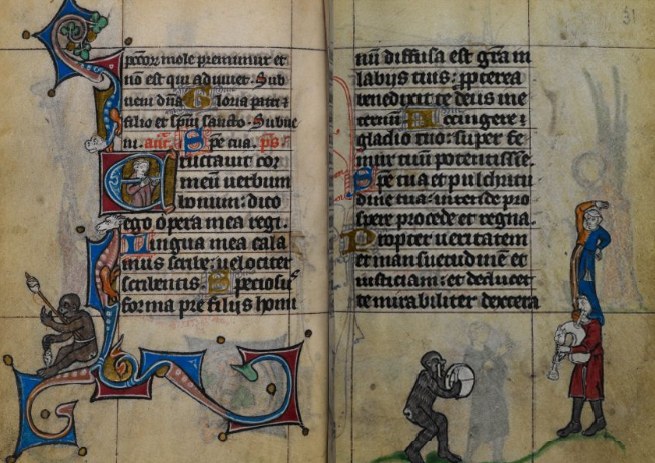
Maastricht Book of Hours, BL Stowe MS17 f030v-f031r
Unknown miniaturist from Liège-Maastricht area, ca. 1300-1325
- Source:
- Wikimedia Commons
- Rights:
- Public domain — free to use, share and adapt.
- Recorded as:
- public_domain
The image is rare evidence of medieval acrobatic performance and the working partnership between musician and performer that sustained popular entertainment. It shows that even in the margins of sacred manuscripts, artists recorded the bodily skills and street spectacles of ordinary entertainers—a reminder that dance history includes not only court dances but the skilled physicality of jongleurs and minstrels whose names we do not know.
What you are looking at
Two facing pages from an illuminated manuscript show a densely decorated medieval interior. The left page features an ornate historiated initial (a large decorated letter) in blue and gold, with drolleries—grotesque marginal figures—scattered below, including what appears to be a monkey or hybrid creature. The right page contains similar marginal decorations. The text is written in black Gothic script in two columns on each page, with gold leaf and colored pigments throughout. On the lower margin of the left page, a musician plays bagpipes while a dancer stands upright on his shoulders; the dancer's weight appears to be balanced on the piper's head and upper body. On the right page margin, a standing figure in red and brown dress faces toward the left. The pages are yellowed with age, and the vellum shows the wear and foxing typical of medieval manuscripts over seven centuries old.
The dancing
The primary dancer is depicted in a vertical, upright stance balanced on the bagpiper's shoulders—a feat of acrobatic skill rather than balletic grace. The dancer's body is nearly perpendicular to the ground, arms held at the sides or slightly out for balance. The bagpiper below bends slightly under the weight, his instrument visible across his body. The second figure on the right page stands in profile or three-quarter view, legs straight, wearing a long fitted gown; the posture and stillness suggest either a stationary moment or a walking figure rather than active dance movement.
The dance depicted
This manuscript captures a moment of acrobatic performance rather than courtly or ceremonial dance. The image documents shoulder-standing or human-stacking, a form of street performance and popular entertainment in medieval Europe—the kind of spectacular, body-defying feat that would have been performed by jongleurs, minstrels, and traveling entertainers at fairs and in noble households. The pairing of bagpiper and acrobat suggests a working performance partnership: the musician provides accompaniment while the performer's body becomes the spectacle. This is folk performance and popular amusement rather than the formal dances (caroles, estampies, or basse dances) that marked courtly occasions.
How it was made
This is an illuminated manuscript on vellum, a luxury object produced for a patron of means. The medium combines text and image in a hierarchical composition: the liturgical text is primary (this is a Book of Hours), and the dancing figures occupy the margins—a traditional space for marginal commentary, humor, and worldly observation. The miniaturist used tempera and gold leaf, with the gold applied after pigment to create luminosity. This technique of embedding secular and comic scenes in the margins of devotional texts was standard practice in 14th-century Flemish and French manuscript production, allowing the artist to blend high religious art with keen observation of daily life and popular entertainment.
About this work
This is a page from a luxury illuminated Book of Hours made for an aristocratic patron in the Liège-Maastricht region in the early 14th century. The manuscript is chiefly known for its lively marginal scenes of animals and hybrid creatures, but this spread includes one of its most striking secular images: a bagpiper supporting an acrobatic dancer on his shoulders. The scene is not a formal dance but a performance—the kind of spectacular entertainment that would have been familiar at medieval fairs, markets, and noble courts. The dancer's feat of balance and the musician's instrument anchor the image in the world of traveling performers and popular spectacle, worlds that existed alongside and often within the official ceremonies of medieval aristocratic life.
The work documents a now-vanished performance tradition and reveals how illuminated manuscripts—even devotional ones—served their elite audiences as windows onto the full spectrum of medieval culture, from prayer to entertainment.
How to look at it
Look first at the left margin where the dancer and piper meet: the artist has captured the exact moment of balance—the acrobat's weight fully transferred onto the musician's shoulders, the piper's posture bent but holding firm. The artist understood the physical cooperation required: the piper cannot play and support the dancer without a stable stance, and the dancer cannot balance without the piper's stillness. Notice also how the artist embedded this secular scene in a sacred text: the drolleries and marginal performers are visual counterpoint to the prayers above, acknowledging that even devotion existed in a world of spectacle and bodily skill.
The artist
The miniaturist is unknown, as is standard for manuscript illumination of this period. The hand has been attributed to the Liège-Maastricht school, a scriptorium region known for rich, idiosyncratic manuscript decoration that blended refined gold work with energetic and sometimes playful marginal imagery. The attention to naturalistic detail in the animals and hybrid creatures—and here, the acrobat's precarious balance—suggests an artist with keen observational skill and a willingness to depict the physical world beyond the devotional text.
The period
The early 14th century was a period of flourishing book production in the Low Countries, where wealthy merchant and aristocratic patrons commissioned devotional manuscripts of increasing elaboration and luxury. The Book of Hours (a prayer book structured around the liturgical day) was the preferred format for such commissions. While the texts were standardized and sacred, the decoration—especially in margins—was personalized and often witty, reflecting the patron's taste and the artist's inventiveness. This was also a period when street performance and popular entertainment were central to medieval urban and courtly life. Jongleurs, minstrels, and acrobats performed at markets, fairs, and in noble households; their skills were valued and their presence documented, even if their names were not.
Where it lives
The manuscript is held in the British Library as part of the Stowe collection (BL Stowe MS 17). It was owned in the 18th century by the 1st Duke of Buckingham and Chandos, sold in 1849 to Lord Ashburham, and acquired by the British Library in 1883 when Ashburham's collection was purchased.
Dance in this work
Questions about this work
Is this a picture of a real dance?
It documents a real performance tradition—acrobatic shoulder-standing by medieval jongleurs and minstrels—but it is not a courtly or ceremonial dance. It is street entertainment, the kind of spectacular bodily feat that traveling performers used to earn their living. The pairing of bagpiper and acrobat shows how music and movement worked together in popular performance.
Why is a performance scene in a prayer book?
Medieval illuminated manuscripts, especially Books of Hours, used marginal decoration (drolleries) as a visual commentary running parallel to the sacred text. These marginal scenes often depicted the secular, comic, or mundane world—animals, hybrids, performers, peasants—creating a conversation between prayer and everyday life. The margins belonged to the patron's world, not the text's sacred space.
Could a medieval acrobat actually do this?
Yes. Medieval jongleurs trained extensively in acrobatics, juggling, and balance work. Shoulder-standing was a documented skill, and the pairing of musician and acrobat was a working partnership. The artist's depiction shows understanding of the physical requirements: the piper's bent stance, the acrobat's upright balance, the cooperation between the two bodies.
What does the rest of the manuscript show?
The manuscript is primarily a Book of Hours—a prayer book structured around the liturgical day. Its full-page miniatures illustrate religious scenes. The margins are filled with animals (real and hybrid), grotesque creatures, and secular scenes like this one. It is known chiefly for the inventiveness and humor of its marginal imagery.
More dance artwork





