49 works in this view — arrow keys or swipe to move between them.
Dance in Art
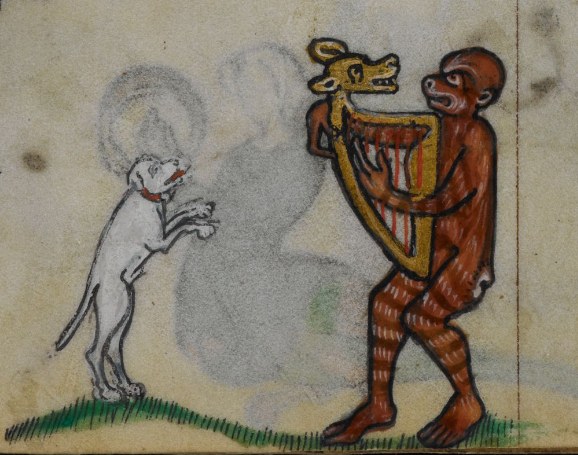
Maastricht Book of Hours, BL Stowe MS17 f245r (detail)
Unknown miniaturist from Liège-Maastricht area, ca. 1300-1325
- Source:
- Wikimedia Commons
- Rights:
- Public domain — free to use, share and adapt.
- Recorded as:
- public_domain
This drollery documents a form of entertainment—the trained animal performance—that was widespread in medieval Europe but left few other visual records. For historians of dance and performance culture, it demonstrates that 'dance' in the medieval period encompassed not only human social and ceremonial forms but also the mimicry and training of animals, and that the visual conventions for depicting motion and entertainment applied across both categories. The image also shows how medieval artists rendered the body in motion and response, and what kinds of poses and gestures they associated with entertainment and musical accompaniment.
What you are looking at
A medieval drollery depicts an animal performance: a brown monkey, rendered with exaggerated muscularity and a grinning face, plays a stringed instrument (a harp or similar) while a small white dog stands on its hind legs before the monkey in an attitude of dance or entertainment. The monkey's posture is dynamic—leaning back slightly, one arm raised toward the instrument, the other supporting it—while the dog faces the musician with front paws raised. Both creatures are set against a neutral background with a simple green ground line at the bottom. The drawing is executed in the characteristic style of a medieval illuminated manuscript, with fine ink outlines and careful colour application: the dog rendered in white with delicate grey shading, the monkey in warm brown with darker definition of musculature and facial features. The figures are small (a detail from a larger page) but crisply rendered, suggesting this marginal scene was given considerable care despite its playful subject.
The dancing
The dog is the principal dancer, balanced on its hind legs with front paws raised to shoulder height or slightly higher, weight shifted upward in an alert, responsive stance. The posture suggests both attentiveness to the music and readiness to move—the body is taut rather than relaxed. The monkey is not a dancer but a musician-entertainer, its body turned to face the dog, one arm actively engaged with the instrument and the other supporting it. The compositional relationship between the two is performer-and-audience rather than partnered dance: the dog responds to the monkey's music, not to physical contact or shared technique. No footwork is visible, and the dog's dance is suggested through the lifted, expectant posture rather than depicted mid-step.
The dance depicted
This is not a representation of a human dance form, but a satirical or entertaining depiction of a trained animal performance—a dog dancing to music supplied by a monkey musician. Such scenes were common in medieval manuscript margins as drolleries: humorous inversions of human social order in which animals mimicked human behaviour. The dog's raised-paw stance and alert posture suggest the kind of trained response a medieval audience would have seen in performances by entertainers with performing animals, a widespread form of street and court entertainment in the 14th century. The image tells us little about any specific human dance style, but much about the culture of animal entertainment and the visual vocabulary medieval artists used to suggest motion and musicianship in non-human subjects.
How it was made
This is a detail from an illuminated manuscript page, executed in the traditional technique of the period: fine ink drawing for outlines and architectural or anatomical definition, with hand-applied pigments (likely tempera) for colour. The manuscript format allowed for extensive marginal decoration and entertaining drolleries at minimal production cost per image, since a single artist or workshop could produce multiple copies through the copying process. The small scale and marginal placement suggest this scene was meant as a visual joke or entertainment for a reader examining the page closely—a reward for careful attention to the manuscript's margins. The quality of execution, particularly in the definition of the monkey's musculature and the precise rendering of the dog's small form, indicates that even apparently trivial scenes received the attention of a skilled hand.
About this work
This is a marginal drollery from the Maastricht Book of Hours, a luxury illuminated manuscript produced in the Liège-Maastricht region in the early 14th century. Books of hours were devotional texts used by aristocratic patrons for private prayer, but their margins—the 'drolleries'—were sites of visual entertainment and satire, filled with imaginative scenes of animals mimicking human behaviour. The image of a dog dancing to a monkey musician belongs to this tradition of inversion and comedy. In the context of a dance gallery, it is valuable not as evidence of a human dance form, but as documentation of the visual culture of animal entertainment in the medieval period, and as a record of how 14th-century artists depicted motion, musicianship, and performance.
How to look at it
Look first at the dog's posture: the raised paws, the upright stance, the directed attention toward the musician. This is the pose of an animal in response to external stimulation—music, a command, or both. The monkey's lean-back posture and engaged arm suggest not a single musical phrase but sustained performance. The artist has chosen to freeze a moment of mutual engagement: the dog is not in mid-leap or mid-step, but in the held, alert position of an animal waiting to respond. This is not a naturalistic depiction of how a dog would move, but a schematized representation of attentiveness and trained compliance. Notice also the careful rendering of the dog's small scale and delicate form, which makes the anthropomorphic pose—the raised paws, the upright bearing—more striking and comic by contrast.
The artist
The artist is unknown, identified only as a miniaturist from the Liège-Maastricht region active in the early 14th century. This region was a major centre of manuscript production in the Low Countries, known for high-quality devotional texts and sophisticated decorative programmes. The hand that executed this drollery demonstrates competent figure drawing, anatomical observation (particularly in the rendering of the monkey), and a keen eye for animal behaviour and comic effect. The willingness to lavish care on marginal scenes suggests either the artist's own pleasure in the work or a patron who valued entertainment and visual wit alongside devotional content.
The period
In the early 14th century, the illuminated manuscript was at the height of its development as a luxury object for aristocratic consumption. The manuscript culture of the period permitted extensive experimentation with marginal decoration and drolleries—scenes that had no narrative or religious function but served to amuse and surprise. Simultaneously, the period saw flourishing traditions of street entertainment and court performance, including acrobats, jongleurs, musicians, and animal trainers. These performers occupied a complex social position, somewhere between respected artists and disreputable vagabonds. The appearance of trained animal performances in manuscript margins suggests both that such entertainments were familiar enough to medieval readers to serve as subjects of humour, and that the act of depicting them—of giving them space in a devotional text—was itself a form of visual transgression and play.
Where it lives
This detail comes from folio 245r of the Maastricht Book of Hours, British Library Stowe MS 17. The full manuscript was produced in the Liège-Maastricht area in the first quarter of the 14th century for an aristocratic patron, possibly a woman. It changed hands several times: it was owned in the 18th century by the 1st Duke of Buckingham and Chandos, sold by him in 1849 to Lord Ashburton, and purchased by the British Library in 1883 as part of the Stowe collection. The manuscript is known particularly for its lively and inventive marginal illustrations of animals and hybrid creatures.
Questions about this work
Is this actually a dance?
It is a trained animal performance, not a dance form as we usually think of it. The dog is responding to music and possibly to training, rather than executing a sequence of steps or participating in a social or ceremonial form. However, it is documented proof that 'performance' and 'dance-like' activity extended beyond human social forms in the medieval period, and that artists were interested in depicting the body in motion and response across both human and animal subjects.
Why would a devotional manuscript have jokes in the margins?
Illuminated manuscripts for wealthy patrons often included extensive marginal decoration and drolleries—visual entertainment and satire that had no connection to the text. These marginalia served multiple functions: they amused the reader, demonstrated the artist's skill and imagination, and created a sense of intimate conversation between artist and patron. The juxtaposition of pious text and playful images was itself a form of medieval humour.
What does this tell us about medieval entertainment?
The appearance of trained animal performances in manuscript margins confirms that such entertainments were familiar, common, and visually interesting to 14th-century aristocratic readers. Trained animals were part of the broader culture of performative entertainment, alongside musicians, acrobats, and dancers. The fact that an artist took time to depict this scene carefully suggests that it was considered worthy of visual attention and memory.
Could this dog have been a real trained animal that the artist saw?
Very possibly. Trained dogs and monkeys were part of medieval street and court entertainment. The artist's careful observation of the dog's small scale, delicate proportions, and alert posture suggests familiarity with real dogs. Whether this scene depicts a specific performance the artist witnessed, or a general type of entertainment, is impossible to say from the image alone.
More dance artwork





