49 works in this view — arrow keys or swipe to move between them.
Dance in Art
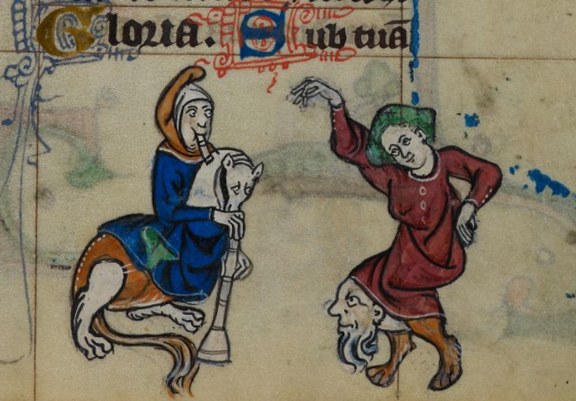
Maastricht Book of Hours, BL Stowe MS17 f115r (detail)
Unknown miniaturist from Liège-Maastricht area, ca. 1300-1325
- Source:
- Wikimedia Commons
- Rights:
- Public domain — free to use, share and adapt.
- Recorded as:
- public_domain
Most surviving evidence for medieval dance comes from courtly treatises and noble imagery; this drollery is among the rare visual records of popular, vernacular movement from a period when most people danced but left no formal documentation. The spontaneous posture and musical pairing offer historians direct observation of how dance and music were integrated in everyday entertainment, centuries before the codification of ballroom forms.
What you are looking at
This manuscript illumination depicts two hybrid creatures engaged in music and dance. The figure on the left, wearing a blue tunic and orange-lined hood, plays a wind instrument—possibly a pipe or flute—while crouching or bending forward. The musician has an exaggerated animal head (goat or ram) for a lower body. To the right, a second creature in a burgundy-red garment dances in response, with an upraised arm and dynamic, flexed posture. This dancer also sports an animal head (appearing feline or leonine) as its lower half. Both figures are rendered in the characteristic style of 14th-century Flemish manuscript illumination, with delicate line work, bright pigments, and expressive gesture. The margin setting and the pair's fantastical form mark this as a drollery—a playful, marginal illustration typical of the period, deliberately unrelated to the sacred text it accompanies.
The dancing
The dancing figure on the right displays an active, energetic posture: one arm raised high, torso tilted, weight shifted onto what appears to be a single leg, suggesting mid-movement. The stance is playful and uninhibited, without the formal positioning of courtly dance. The musician on the left bends deeply, creating a counterpoint in the composition. Neither figure shows the closed holds, symmetrical framing, or measured foot placement of contemporary elite dance; instead, both bodies communicate spontaneity and physical abandon. The doubled heads—one human, one animal—add grotesque humor and emphasize the bodily exuberance.
The dance depicted
This image most likely documents popular or vernacular social dance of the early 14th century, performed to pipe music. The energetic posture, upraised arm, and weight shift of the dancing figure are consistent with folk or recreational dance, not the courtly choreography recorded in contemporary dance treatises. The presence of a musician and dancer in dialogue suggests the casual, improvisational character of tavern or street entertainment. Without surviving choreographic notation from this period and region, we cannot name the specific dance, but the image records attitudes toward the body and music that predate the formal court dances of the 15th century.
How it was made
This is a manuscript illumination—hand-painted on vellum using mineral and organic pigments, with details outlined in iron-gall ink. The technique required great precision with brush and quill to create the fine linework of the figures' faces, folds, and animal features. Manuscript illumination was labor-intensive and expensive, restricting circulation to wealthy patrons (in this case, presumably an aristocratic woman). The bright pigments—lapis blue, vermillion red, gold leaf—would have been costly. The small scale and marginal placement of this drollery allowed the artist relative freedom from strict iconographic rules, explaining the playful, anatomically impossible hybrid forms.
About this work
This early 14th-century Flemish manuscript drollery captures a moment of popular music and dance outside the formal record. The image preserves gestural and postural evidence of how ordinary people moved to music in the medieval Low Countries—energetic, bodily responsive, and playful. It appears in a luxury Book of Hours commissioned for an elite female patron, where such humorous marginalia offered visual relief and entertainment alongside sacred devotion. The work survives now in the British Library as part of the Stowe collection, one of thousands of marginal images that collectively document medieval attitudes toward the body, music, and laughter.
How to look at it
Notice the precise moment the artist chose: not a static pose, but a caught instant of movement—the dancer's arm aloft, weight transferred, torso angled. The musician leans into his playing, creating a visual rhythm between the two figures. This frozen-moment technique conveys the temporal experience of dance better than a frontal, symmetrical arrangement would. Observe also the artist's use of line to suggest fabric movement and bodily strain; the clothing clings and billows in ways that record the force and speed of the motion.
The artist
The miniaturist is unknown, identified only as working in the Liège-Maastricht region in the early 14th century. This was a major center of manuscript production, known for lively, naturalistic marginal imagery and sophisticated figure work. The artist's approach to the drollery—anatomically playful, dynamically composed, and full of observed gesture—is typical of the Flemish school's contribution to late medieval manuscript art.
The period
The early 14th century saw the flourishing of the Book of Hours as a status object for wealthy merchants and nobility, especially women. Alongside formal prayers and miniatures illustrating the Life of the Virgin, manuscripts included increasingly elaborate marginal decoration: drolleries, grotesques, and scenes of daily life. These margins offered artists freedom to depict popular entertainment, labor, animals, and comedy without theological constraint. In the same period, secular dance was shifting: court dances were becoming more formal and choreographed (as recorded in later treatises like the Cervera Processional), while popular dance remained largely undocumented outside such manuscript images.
Where it lives
The manuscript is held in the British Library as part of the Stowe collection (shelfmark BL Stowe MS 17). It was assembled over centuries: made in the Liège-Maastricht region in the early 14th century for a noblewoman, acquired by the 1st Duke of Buckingham and Chandos in the 18th century, sold to Lord Ashburnam in 1849, and purchased by the British Library in 1883 as part of the Stowe library bequest.
Dance in this work
Questions about this work
Why do these dancers have animal heads?
This is a drollery, a type of playful marginal illustration in medieval manuscripts that was deliberately fantastical and unrelated to the sacred text. Hybrid creatures—part human, part beast—were stock figures in these margins, used for humor and entertainment. They allowed the artist to exaggerate bodily movement and to depict popular figures (like a bagpiper or street performer) in a comic, transgressive register that would have been inappropriate in the main text.
What dance is this?
We cannot identify the specific dance from the image alone. No choreographic notation survives from 14th-century popular dance, and manuscript images do not provide enough detail to reconstruct steps or patterns. What the image does show is the energetic, improvisational character of vernacular social dance performed to live music—very different from the measured, formal court dances that would be documented in later dance treatises.
Who would have seen this image?
The manuscript was commissioned for a wealthy patron, likely an aristocratic woman, so the primary audience was elite and private. The drolleries in Books of Hours were viewed during personal devotional practice. However, as manuscripts were sometimes loaned or copied, images like this circulated within courtly and educated circles. The wider public would have seen the actual dances depicted—popular entertainment at fairs, taverns, and streets—rather than the manuscript images.
Why is the musician shown bending forward?
The deep bend conveys physical effort and involvement in the music-making; the player is not distant or formal but actively engaged in producing sound. This posture, along with the dynamic pose of the dancer, communicates the physical exertion and mutual attentiveness of musicians and dancers in real performance contexts.
More dance artwork





