49 works in this view — arrow keys or swipe to move between them.
Dance in Art
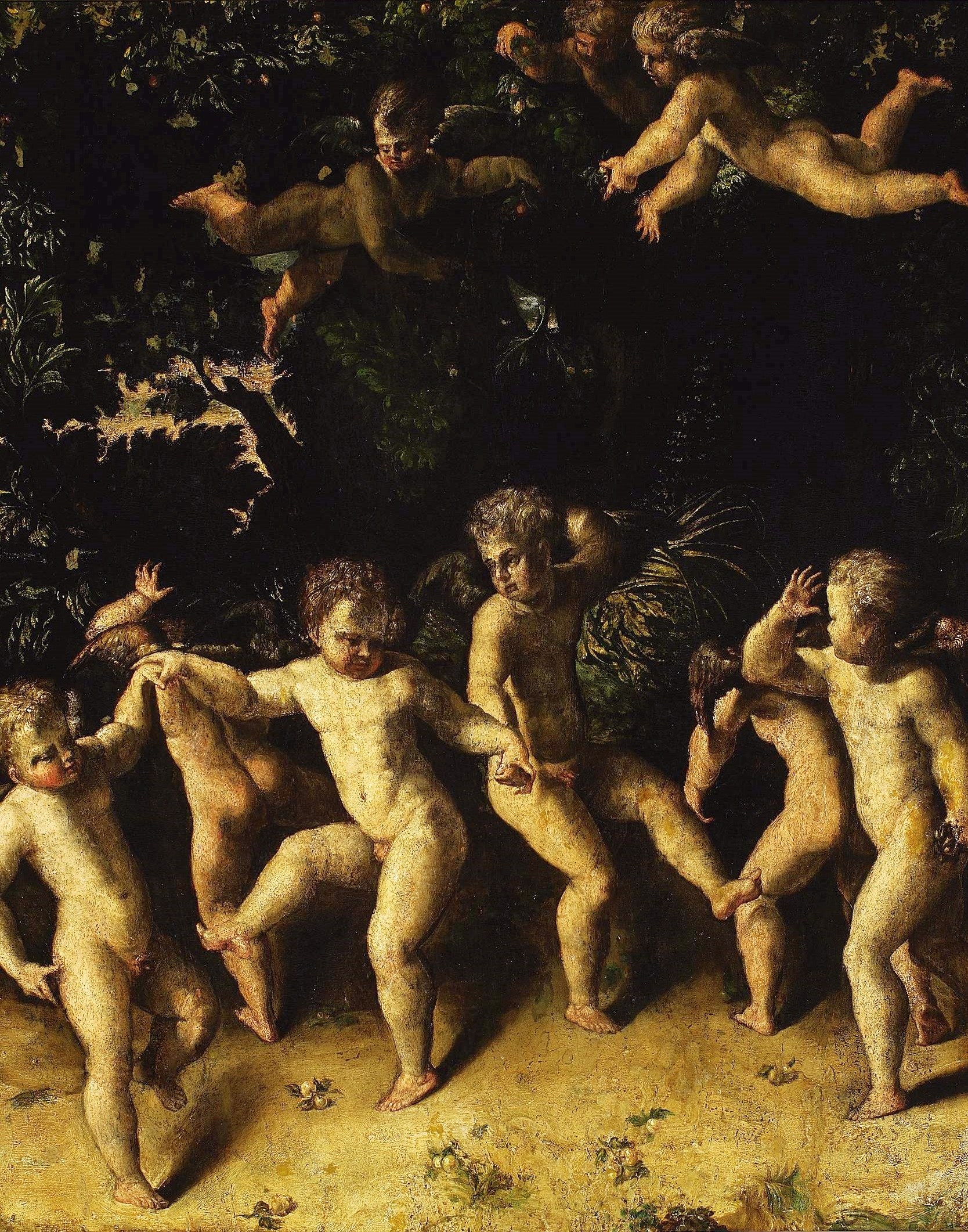
Polish: Taniec amorków The Dance of the Cupids.title QS:P1476,pl:"Taniec amorków "label QS:Lpl,"Taniec amorków "label QS:Lpt,"Dança dos Cupidos"label QS:Len,"The Dance of the Cupids."label QS:Lfr,"Danse des Amours."
Niccolò dell'Abbate
- Source:
- Wikimedia Commons
- Rights:
- Public domain — free to use, share and adapt.
- Recorded as:
- public_domain
The painting demonstrates how Renaissance artists used dance and movement as visual metaphors for philosophical and spiritual concepts, not merely as documentation of social practice. The sophisticated handling of multiple interacting figures in varied postures reveals the degree to which anatomical study and the vocabulary of human movement had become central to artistic training and expression by the mid-16th century.
What you are looking at
A dense composition of putti (cherub-like figures) occupies a woodland clearing rendered in warm golden tones against a dark background. In the foreground, approximately ten to twelve figures of varying sizes engage in an animated group dance, their plump bodies caught in a moment of collective movement across sandy ground scattered with small plants. Above them, three additional putti appear to float or leap through the air among hanging vines and foliage, suggesting either aerial movement or a compositional layering of the scene. The lighting is theatrical, with the figures glowing against shadowed trees and vegetation that frame the composition densely. The overall effect is one of uninhibited, joyful motion—a supernatural or allegorical scene of childlike revelry rather than a naturalistic gathering.
The dancing
The putti are arranged in no formal line or couple structure; instead they cluster and interact, some with arms raised or extended in open gestures, others leaning toward one another. Several figures stand with legs apart in wide stances; at least two appear to be in mid-leap with legs splayed. The bodies are fleshy and rounded, rendered with considerable anatomical articulation in the limbs despite their cherubic proportions. The composition suggests simultaneous individual impulses—turning, reaching, moving in different directions—rather than synchronized group choreography, though the overall effect remains cohesive through the density of the composition and the unified warm lighting.
The dance depicted
This is a Renaissance allegorical image of celestial or divine joy expressed through the bodies of putti, rather than a representation of an actual dance form performed by humans. The subject matter—'The Dance of the Cupids'—belongs to a long tradition of Neoplatonic art celebrating love, desire, and the harmonies of nature. The image does not depict a named dance style or technique but rather an imaginative vision of uninhibited movement as a visual expression of divine or natural festivity. Such scenes were popular in Northern Italian painting of the mid-16th century as expressions of humanist philosophy and classical subject matter.
How it was made
The work is executed in oil on panel, characteristic of Northern Italian Renaissance practice. The technique demonstrates sophisticated use of chiaroscuro (the contrast between dark and luminous areas) to create depth and drama, with the figures emerging from shadow into warm, golden light. The artist's control of figure composition—the overlapping bodies, the varied scales suggesting spatial recession, the anatomically informed rendering of movement—indicates training in classical principles. The dark background and close framing create an intimate, almost magical quality despite the large number of figures; this technique would have been well-suited to a smaller, precious panel intended for a patron's private collection.
About this work
This painting presents a vision of movement as divine play—putti dancing in a woodland clearing as an allegory of love and cosmic harmony. The work belongs to the Renaissance tradition of adapting classical subject matter to contemporary painting, translating the abstract concept of joyful motion into a richly composed image of human (or quasi-human) bodies in animated interaction. The composition demonstrates the artist's mastery of figure arrangement, anatomical knowledge, and the technical effects of light and shadow that were hallmarks of mid-16th-century practice. For dance historians, the work offers not a record of actual choreography or technique, but rather a window into how Renaissance artists understood and represented movement itself as a carrier of meaning—in this case, the expression of divine or natural harmony through uninhibited bodily gesture.
How to look at it
Attend to the variety and simultaneity of movement within the composition: the artist has frozen not a single coordinated action but a moment of collective, exuberant activity in which each figure seems to pursue its own trajectory. Notice the artist's treatment of the bodies themselves—how the plump, rounded forms are nonetheless articulated with anatomical precision in the limbs and how this creates a tension between the childlike and the naturalistic. The spatial arrangement, with figures overlapping, receding, and floating above the ground plane, suggests not a bounded stage or ballroom but rather an unlimited space of play. The warm golden light pooling on the figures against dark vegetation creates an almost dreamlike or supernatural quality, inviting interpretation of the scene as allegorical rather than literal.
The artist
Niccolò dell'Abbate (c. 1509–1571) was a leading Northern Italian Mannerist painter active primarily in Modena and Bologna before moving to the court of France. He was known for historical and allegorical narratives populated with numerous figures in complex spatial arrangements, often set in classical or pastoral settings. His style synthesized Bolognese tradition with Mannerist elegance, and he was particularly skilled at rendering mythological and Neoplatonic subjects for educated patrons. Dell'Abbate's work was influential in spreading Italian Renaissance aesthetics northward, especially during his later career in France.
The period
The mid-16th century saw a flourishing of allegorical and mythological imagery in painting across Italy, driven by Neoplatonic philosophy and the revival of classical texts. Court culture in this period celebrated movement, music, and dance as expressions of cosmic order and divine harmony—ideals articulated in courtly spectacles, poetry, and visual art. The image of putti or cupids in paradise became a popular vehicle for expressing these abstract philosophical concepts. Simultaneously, artists were deepening their study of human anatomy and the vocabulary of gesture, influenced by classical sculpture and contemporary anatomical science. This painting sits at the intersection of those developments—using the bodies of putti to explore movement as both a physical and metaphysical phenomenon.
Where it lives
The work is recorded in Wikimedia Commons; medium, collection, and current location are not recorded in the available catalogue data. The painting is documented as a work by dell'Abbate dated to 1550.
Questions about this work
Is this an actual Renaissance dance?
No. The work is an allegorical or imaginative composition depicting putti (cherubs) rather than a record of a real dance form or social practice. Renaissance artists used dance and movement as visual metaphors for divine joy, love, and cosmic harmony. The subject belongs to a tradition of Neoplatonic art rather than to dance documentation.
Why are there so many figures and why are they arranged this way?
The density and overlapping arrangement serve both compositional and allegorical purposes. Multiple figures amplify the sense of joyful collective motion and abundance, while the lack of formal line or synchronized movement suggests natural, uninhibited expression rather than courtly discipline. The composition also demonstrates the artist's skill in managing complex spatial relationships and anatomical variety within a unified image.
What does this image tell us about Renaissance attitudes toward movement?
The painting reveals that Renaissance artists and patrons understood movement not merely as physical action but as a carrier of meaning—particularly as an expression of joy, harmony, and divine or natural order. The sophisticated anatomical rendering and compositional control suggest that the study of how bodies move had become central to artistic training and to the visual representation of philosophical ideas.
More dance artwork





