49 works in this view — arrow keys or swipe to move between them.
Dance in Art
Renaissance C14A-2 Füllmaurer Mömpelgarder Altar20
Heinrich Füllmaurer
- Source:
- Wikimedia Commons
- Rights:
- Public domain — free to use, share and adapt.
- Recorded as:
- public_domain
This work documents the performative and spatial dimension of Renaissance civic ceremony, showing how formal dress, hierarchical arrangement, and controlled gesture created ceremonial meaning. For dance historians, it offers rare visual evidence of how elite bodies moved in formal religious and civic contexts, and how artists chose to represent collective action and ritual rather than individual virtuosity.
What you are looking at
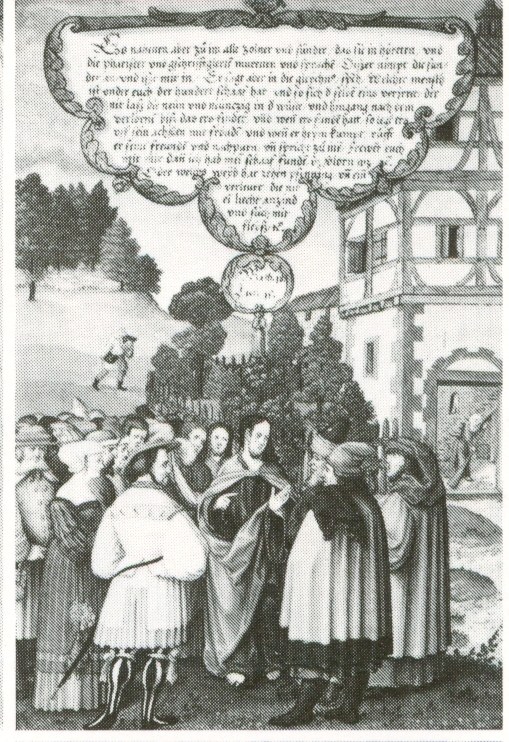
A religious or ceremonial gathering stands in a Renaissance courtyard or town square before a half-timbered building. A large group of figures in long robes and formal dress—women in white headdresses and dark gowns, men in dark cloaks—cluster together in animated conversation or ritual action. The composition is dense and crowded, with figures overlapping and gesturing toward one another. Above the scene floats a decorative scroll or cartouche containing text in German Gothic script, anchored to the figures below. The setting suggests a formal civic or ecclesiastical event: the architecture is orderly and domestic, the dress is uniform and hierarchical, and the arrangement suggests ceremonial procession or gathering rather than spontaneous movement. A few figures gesture with raised arms; others bow or incline their heads. The print technique renders everything in precise line and crosshatching, with strong contrasts between black robes and white linen.
The dancing
The figures stand in tight groups rather than in a coordinated line or formation. Several women in the foreground appear to bow or curtsy toward a central focus—their bodies incline forward from the waist, heads bowed. Men in long cloaks stand upright or gesture with one arm extended in address or blessing. The overall posture is formal and reverent rather than dynamic: weight is distributed vertically, there is no apparent footwork or turning, and the bodies relate to one another through social hierarchy and attention rather than through coupled or partnered contact. The gestures are sparse and controlled, appropriate to a ceremonial rather than recreational context.
The dance depicted
This does not depict dance in the modern sense. The image shows a formal religious or civic ceremony—possibly a blessing, oath-taking, or ecclesiastical gathering. If movement is present, it is ritual genuflection or processional standing rather than choreographed dance. The crowded arrangement, the uniform dress, the presence of what appears to be clergy or officials, and the Germanic inscription all point to a civic or religious occasion in a Renaissance town. No hold, frame, or footwork characteristic of any historical dance form is visible.
How it was made
This is a woodcut or engraving, executed in black line on white ground with fine crosshatching for tone. The technique is typical of 16th-century Northern European religious and civic prints: precise, legible at distance, reproducible, and suited to wide distribution and documentation of civic events. The medium allowed the artist to capture fine detail in the costumes and architecture while maintaining the formal clarity required for a commemorative image. The inscription in the scroll suggests this was made as a record of a specific, named event—the Mömpelgarder Altar—for circulation among the educated public and clergy.
About this work
This is a 1540 woodcut or engraving by Heinrich Füllmaurer documenting a Renaissance ecclesiastical or civic ceremony in a German-speaking town. The work captures a formal gathering of officials, clergy, and lay figures in ceremonial dress, arranged before a domestic or civic building. Although the print is titled an "altar," the composition and text suggest it records an actual event—a blessing, dedication, or formal assembly—rather than depicting a static object. The image is valuable not as a dance record but as evidence of how formal movement, gesture, and spatial arrangement functioned in Renaissance civic ritual. The print preserves both the event itself and the visual conventions used to commemorate it.
How to look at it
Note the careful arrangement of the figures into a hierarchy of attention and proximity: the officials or clergy are centered and often taller or more prominently placed, while the lay figures cluster around them. Observe the restraint of gesture—raised arms and bowed heads are the primary movements—and the way the artist uses the scale and positioning of figures to convey rank and role. The floating text scroll is essential: it names and validates the event depicted below, turning a crowd into a historical record. The precision of the clothing and architecture grounds the scene in a specific time and place, making this a document as much as an image.
The artist
Heinrich Füllmaurer was a 16th-century German woodcut artist and designer active in the Augsburg-Nürnberg region, known for religious, historical, and civic documentation. His prints were part of the widespread Northern European tradition of using woodcut to record and disseminate images of important local events, ceremonies, and religious scenes. The precision and detail of his line work suggest training in the workshop tradition and access to elite patronage.
The period
The 1540s were a period of intense visual documentation of civic and religious life in the German-speaking lands, as woodcut printing allowed events and ceremonies to be recorded and circulated widely. The Reformation was reshaping the role of ceremony and spectacle in urban life, and prints like this served to validate and memorialize official actions. Renaissance ceremonial practice placed great emphasis on formal dress, hierarchical positioning, and controlled gesture—a visual language that was as important as any movement. The print preserves evidence of how Renaissance elites understood collective action and public ritual.
Where it lives
The work is attributed to Füllmaurer and dated 1540 based on style and inscription. It is listed as part of the Mömpelgarder Altar series in Wikimedia Commons. The precise holding collection and current location are not recorded in the catalogue.
Questions about this work
Is this actually a dance?
No. This is a formal religious or civic ceremony, not a choreographed dance. The figures are arranged in ritual formation, and their gestures—bowing, standing, addressing—are ceremonial rather than kinetic. The work is included in the Gallery to illustrate the boundary between formal movement and dance, and to show how Renaissance artists documented collective action in ceremonial contexts.
Why is a ceremony included in a dance gallery?
Formal ceremony shares with dance the shaping of the body in time and space, the use of dress to convey meaning, and the creation of collective spectacle. Understanding how Renaissance elites moved in formal contexts helps illuminate what dance was, by contrast, and how movement was valued differently across ceremonial, civic, and recreational contexts.
What does the German text say?
The inscription appears to name and describe the event (the Mömpelgarder Altar or a related ceremony), but the resolution and Gothic script make a full transcription difficult from this image. A specialist in 16th-century German paleography and local history would be needed for a complete reading.
Who were these people?
Based on the dress and positioning, they appear to be clergy, magistrates, and prominent lay figures from a German Renaissance town. The formal robes and headdresses indicate rank and office. The print was likely commissioned to commemorate a significant civic or religious event and to distribute an image of it among the educated classes.
More dance artwork





