49 works in this view — arrow keys or swipe to move between them.
Dance in Art
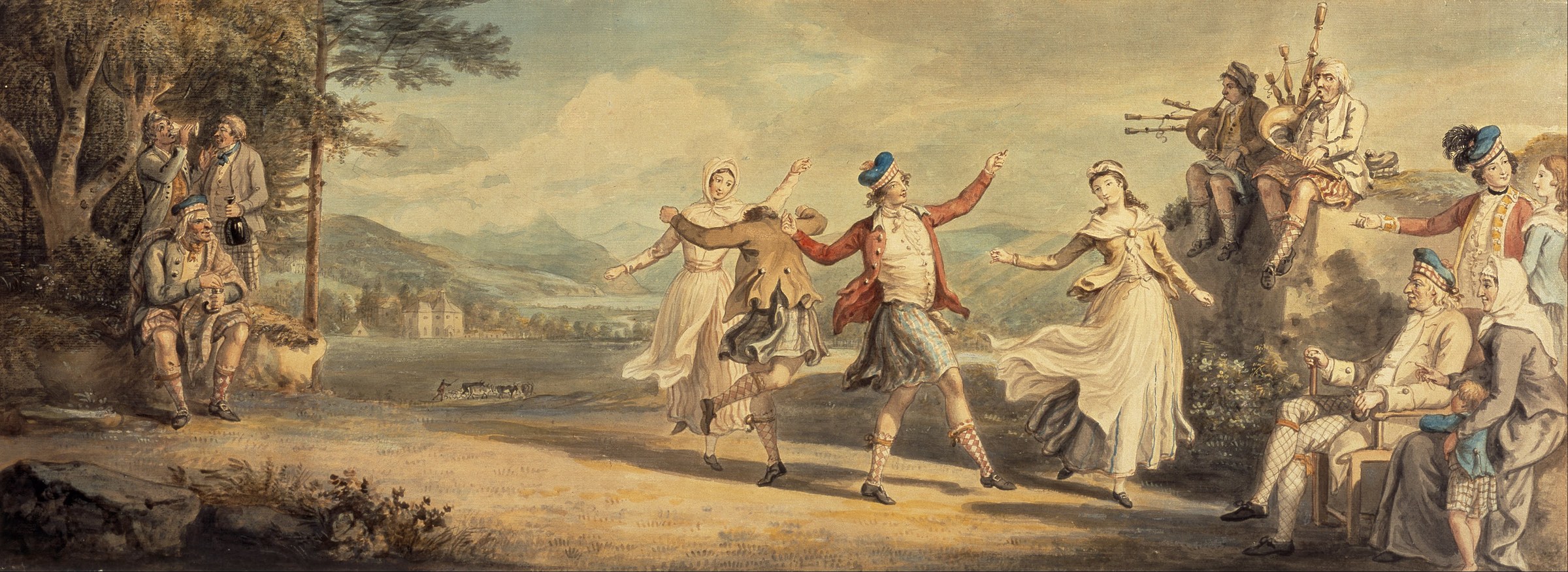
A Highland Dancetitle QS:P1476,en:"A Highland Dance"label QS:Len,"A Highland Dance"
David Allan
- Source:
- Wikimedia Commons
- Rights:
- Public domain — free to use, share and adapt.
- Recorded as:
- public_domain
This is one of the earliest sustained visual records of Highland dancing as a social practice, made while the style itself was being standardized and exported to polite society. It shows the genuine vernacular movement from which later theatrical Highland dance would evolve, and it captures the gender dynamics, costume, and spatial arrangement of an 18th-century reel. For historians of either Highland culture or ballroom dance, it is an unusually detailed and trustworthy visual source.
What you are looking at
A Highland dance unfolds in an expansive landscape before a distant loch and mountains, rendered in the soft golden light of what appears to be late afternoon. The composition is theatrical in its arrangement: two central figures—a man in tartan and a woman in a pale muslin gown with red accents—execute the dance together while flanked by spectators. On the left, seated figures in 18th-century dress observe from beneath a large tree; on the right, standing onlookers in varied costume create a stage-like frame. The figure groupings suggest this is both a vernacular performance and a genteel social occasion, with the landscape itself serving as the ballroom. The artist has captured the moment mid-movement, with the dancers' limbs extended in open, energetic positions against the pastoral Scottish setting.
The dancing
The two central dancers display open, celebratory postures with arms raised and extended, their bodies in balletic alignment despite the folk context. The male dancer wears the belted plaid (tartan kilt) and is captured mid-stride with one leg extended; the female dancer, in a high-waisted Empire gown, mirrors his energy with arms lifted. Their relative positions suggest a social dance structure rather than a couple's closed hold—they appear to be performing alongside each other rather than in contact. The surrounding figures are arranged in informal audience positions: some seated, some standing, some gesturing as if in accompaniment to the music, creating a semi-theatrical tableau.
The dance depicted
This work depicts a Highland reel or strathspey as performed in late 18th-century Scotland, likely at a social gathering. The open arm positions, extended legs, and upright carriage are consistent with Highland dancing of the period, which emphasized high leg lifts and energetic upper-body movement. The presence of musicians (visible at upper right with what appear to be bagpipes and fiddle) confirms the musical context. The mixed social setting—gentry and common folk together—suggests this represents the period when Highland dance was becoming fashionable among the educated classes and was being stylized for polite society, though executed with vernacular energy.
How it was made
This appears to be a hand-colored engraving or aquatint, likely from the late 18th century, based on the soft watercolor palette, the fine line work, and the tonal gradation visible in the landscape and figures. The technique allows for considerable atmospheric detail—the mountains fade into mist, the foreground figures are rendered with precision, and the clothing shows fine pattern work. The medium suggests this was a commercial print, circulated to a broad educated audience interested in Scottish manners and costume, contributing to the Romantic movement's fascination with Highland culture.
About this work
David Allan's 'A Highland Dance' captures a pivotal moment in British cultural history: the transformation of folk dance into fashionable social spectacle. Painted in 1780, it documents Highland dancing not as an ethnographic artifact but as a living, performed event, one that attracted both working people and the gentry. The work sits at the intersection of Romantic interest in Scottish identity and the Georgian ballroom's appetite for novel forms of entertainment. For dance history, it is a primary visual document of how Highland reels were executed—the body mechanics, the costume, the social context—at the precise moment when they were leaving the Highlands and entering the drawing rooms of Edinburgh and London.
How to look at it
Attend to the positioning of the limbs: the raised arms, the extended legs, the upright spine all differ markedly from the closed, lower-energy positions of contemporary European ballroom dance. Notice the tartan-clad male figure and how the artist has rendered the fabric's pattern across his kilt—a detail that confirms the historical specificity of the costume. Observe how the spectators create a frame for the dancers, some seated in shadow, others highlighted, which suggests this is a semi-formal occasion, a performance rather than a casual reel. The artist chose a moment of maximum extension and energy, which flattens the vertical line of the body in a way that emphasizes lift and control rather than fluidity.
The artist
David Allan (1744–1796) was a Scottish painter celebrated for his genre scenes of contemporary life, particularly rural and working-class Scottish subjects. He trained in Rome and brought continental technique to the documentation of Scottish manners, establishing himself as the chronicler of folk life and custom at a moment when such subjects were becoming fashionable among educated patrons. His work sits between ethnographic interest and aesthetic pleasure, recording social practice with sympathy and compositional sophistication.
The period
Allan's painting emerges during the late 18th-century Romantic rediscovery of Scottish culture following the defeat of the Highland uprisings and the gradual integration of the Highlands into Britain. Highland dress, which had been legally prohibited for decades, was being rehabilitated as picturesque and national; Highland dances, similarly, were moving from private social practice into public spectacle and eventually into codified theatrical form. The era saw intense interest in 'national' dances across Europe, and Allan's work documents the precise moment when Highland reels began to be shaped by Lowland taste and aesthetic ideology. In painting, the period favored narrative genre scenes in the manner of Wilkie and Morland, and Allan's composition belongs firmly to this tradition.
Where it lives
The work is recorded in Wikimedia Commons with no holding collection noted. The catalogue record provides no accession information or location. Hand-colored engravings and aquatints by Allan circulated widely in the late 18th century and are held in collections across Britain and America.
Dance in this work
Questions about this work
What is a Highland reel, and how does it differ from ballroom dancing?
A reel is a Scottish circle or line dance performed to fast strathspey or reel music, with high leg lifts and energetic arm movements. It differs fundamentally from ballroom dances like the cotillion: it emphasizes vertical lift and individual bodily display rather than partnered turning and flow, and it is performed by groups rather than couples alone. By the late 18th century, reels were being simplified and formalized for ballroom use, but this painting captures them still rooted in vernacular energy.
Who is the male dancer and who is the female dancer?
The painting does not identify them by name. They appear to represent the archetypal Highland gentleman (in tartan) and a woman of genteel or upper-middle-class background (in Empire dress), suggesting a social gathering that brought together different ranks. This mixing of classes around the novelty of Highland dance was itself novel and noteworthy in 1780.
Are there stage directions or written dance notations from this period?
Highland dances were not formally notated until the 20th century. This painting is a valuable visual record precisely because it documents the style before standardization. Later codified versions, created by dance masters in the 19th and 20th centuries, may differ significantly from what Allan observed.
What instruments are the musicians playing?
The figures at upper right appear to hold bagpipes and a stringed instrument (likely a fiddle), the traditional instrumentation for Highland reels. The bagpipe is inseparable from Highland dance identity, and its presence confirms the cultural and musical authenticity Allan intended to convey.
More dance artwork





