49 works in this view — arrow keys or swipe to move between them.
Dance in Art
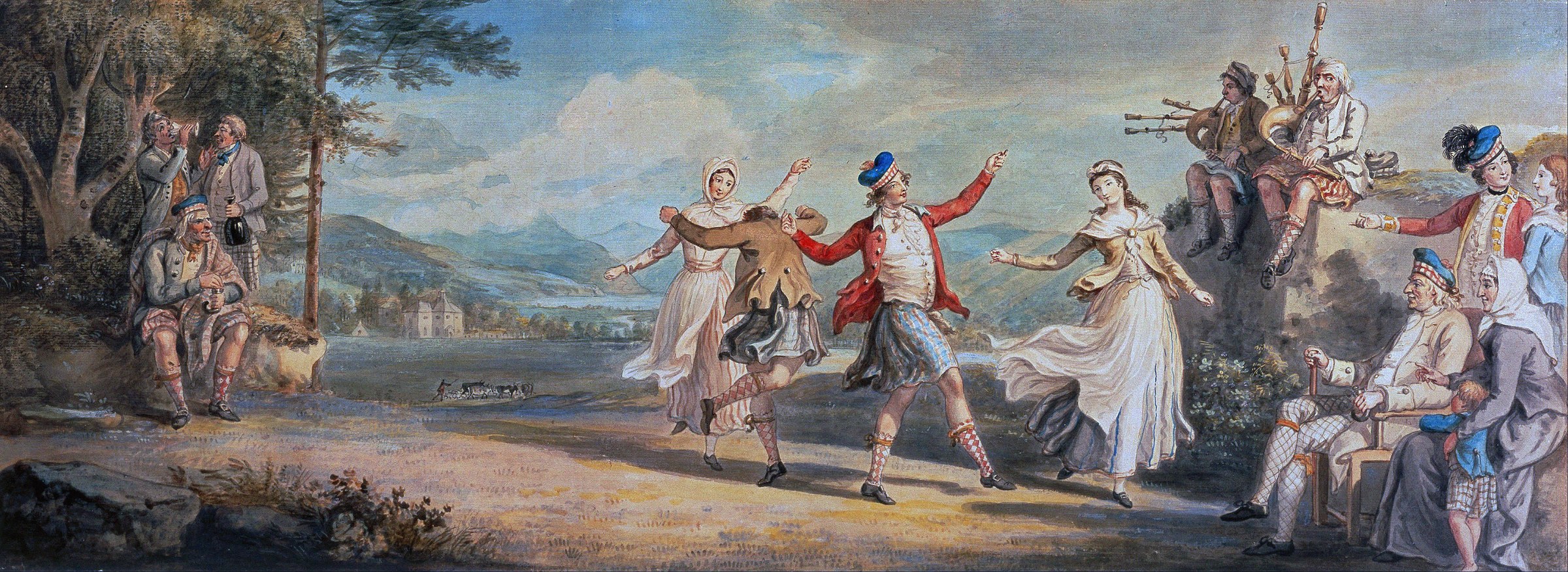
A Highland Dancetitle QS:P1476,en:"A Highland Dance"label QS:Len,"A Highland Dance"
David Allan
- Source:
- Wikimedia Commons
- Rights:
- Public domain — free to use, share and adapt.
- Recorded as:
- public_domain
This painting is one of the earliest serious treatments of Highland dancing in British art and directly influenced how the culture was represented for the next two centuries. It establishes the visual codes—the landscape setting, the costume detail, the emphasis on joyful exuberance—that would become canonical in later representations. For dancers and historians, it is a crucial document of how a living dance tradition was transformed into a nationalized cultural symbol.
What you are looking at
A Highland Dance unfolds in an idealized Highland landscape: a broad valley with distant mountains, a loch, and classical architecture in the middle distance. The foreground presents an open clearing where figures in 18th-century dress gather in small groups. At centre, two principal dancers occupy the space—a man in red coat and blue bonnet and a woman in white muslin dress with a brown bodice—engaged in an animated, exuberant dance. Both are captured mid-movement with arms raised and bodies in sprightly positions suggesting rapid footwork. Around them, spectators form informal clusters: on the left, kilted figures and gentlemen observe from beneath a tree; on the right, seated and standing onlookers in a mix of Highland and Lowland dress watch intently. A musician plays bagpipes, visible among the right-hand group. The composition bathes the scene in warm, golden light that suggests a summer afternoon celebration. The overall effect is festive, sociable, and consciously picturesque—a romanticized view of Highland culture framed for an 18th-century polite audience.
The dancing
The central dancers occupy fully extended, high-energy postures characteristic of vigorous folk dancing: the man's legs appear to be executing quick, springing steps while his arms are raised and spread, the woman's pose echoes this dynamic frame with arms similarly aloft and her skirts lifted to accommodate active footwork. Neither dancer maintains a closed hold; instead both move freely within the same patch of ground, their gestures emphatic and joyful. The spectators—roughly a dozen figures distributed around the perimeter—are rendered in studied poses of genteel leisure: some sit cross-legged on the grass, others stand in conversational attitudes, creating a frame of civility around the dancers' exuberance.
The dance depicted
This depicts a Highland reel or strathspey, the social dance forms that dominated Scottish festive culture in the 18th century. The exuberant, springing carriage of the dancers, the raised arms, and the evident rapidity of the footwork all align with contemporary descriptions of Highland dancing. The title makes the identification explicit. This is not a formal dance of the ballroom or court but a folk celebration—yet it is being presented here through the lens of Augustan aesthetics, picturesque composition, and ethnographic curiosity. The presence of bagpipes confirms the Scottish context and suggests music-driven, communal participation.
How it was made
The work is executed in oil paint on canvas (or possibly panel; the record does not specify). The technique is that of classical landscape composition: the scene is structured as a theatrical vignette, with foreground action set against a carefully receding background of mountains and water rendered in atmospheric perspective. The finish is polished and refined—this is not a sketch or folk record but a considered exhibition work, suggesting that it was created for an educated audience with leisure and money. The brushwork in the landscape is fluid; the figures are rendered with clear outlines and careful attention to costume detail.
About this work
David Allan's *A Highland Dance* (1780) is a pivotal work in the visual culture of Scottish Romanticism and the aestheticization of folk practice for polite society. It captures a moment of social dancing from rural Highland life and frames it as a scene of picturesque charm and ethnographic interest—neither mockery nor condescension, but rather a fascinated presentation of a culture perceived as ancient, spirited, and picturesque. The painting records how Highland dancing was understood and valued at a moment when Scottish identity was being renegotiated following the failed Jacobite risings. Allan's composition—with its balanced, Claudian landscape and its careful calibration of active dancers and genteel observers—models a new way of looking at folk practice: as spectacle worthy of aesthetic contemplation and historical attention.
How to look at it
Attend first to the central dancers' posture and the artist's choice to freeze them mid-motion: both are captured at the apex of a leap or spring, bodies fully extended and animated, which conveys the sense of continuous, exuberant motion rather than a posed moment. Notice too the compositional strategy: the dancers occupy the brightest, most visibly lit patch of ground, while the observers—arranged in a careful frieze—provide a frame of refined spectatorship that legitimizes the dancing as an object of aesthetic attention. The landscape background is rendered with meticulous care, suggesting that Highland scenery itself is understood as part of the dance's authentic cultural context.
The artist
David Allan (1744–96) was a Scottish painter trained in Rome and celebrated for historical and genre scenes. He was a founder of the Royal Scottish Academy and a leading figure in establishing a distinctly Scottish artistic identity during the period of cultural reassertion following the Union. His practice often turned to Scottish subjects, folk customs, and historical moments, positioning him as a key maker of Scottish visual culture during the emergence of Romanticism.
The period
Allan painted this work in 1780, a generation after the failure of the 1745 Jacobite rebellion and in the midst of the Scottish Enlightenment. Highland culture had moved from being perceived as a dangerous, rebellious threat to being romantically re-imagined as ancient, noble, and picturesque—a transformation closely tied to the rise of Romanticism and the growth of antiquarian interest. The period saw increased celebration of folk customs, traditional music, and national identity across Britain. Allan's painting sits at the intersection of this cultural revaluation and the emergence of ethnographic interest in dance and costume as markers of national character.
Where it lives
The work is recorded as being held in Wikimedia Commons, indicating it has entered the public digital archive. The original location and institutional history are not specified in the catalogue record.
Dance in this work
Questions about this work
Is this a real dance or a fantasy?
This depicts a real dance tradition—the Highland reel or strathspey—but through an aestheticized, picturesque lens. The postures, footwork, and social context are recognizable and historically grounded, but the idealized landscape and composed arrangement of spectators make this a romanticized, theatrical presentation rather than a documentary record. Allan is not claiming to show exactly how the dance was performed, but rather how Highland dancing was imagined and valued by educated audiences of his time.
Why is the landscape so prominent?
The landscape serves multiple purposes: it authenticates the dancing as genuinely Highland; it provides aesthetic elevation by positioning the dance within the sublime Scottish scenery; and it reflects the 18th-century Romantic preference for framing folk customs within nature. The mountains, loch, and classical building in the distance suggest that Highland culture belongs to a landscape and history that Augustan viewers found both exotic and noble.
What does the clothing tell us?
The costumes are historically accurate in broad terms—the male dancer wears a red coat, blue bonnet, and what appears to be the beginnings of Highland dress; the female dancer wears white muslin and a brown bodice typical of late-18th-century genteel fashion mixed with folk elements. The mix of fully Highland-dressed figures (kilts, bonnets) and Lowland-dressed observers (breeches, formal coats) reflects the real social composition of Allan's era, when Highlands and Lowlands were culturally and sartorially distinct.
Why are spectators positioned the way they are?
The arrangement mirrors the structure of polite society: the dancing is made into a spectacle to be observed and appreciated by an educated, seated audience. This composition legitimizes folk dancing as a fit subject for aesthetic attention, transforming a spontaneous community celebration into a staged, gallery-worthy scene. It reflects how Romantic-era culture was beginning to frame folk practice as heritage rather than mere custom.
More dance artwork





