49 works in this view — arrow keys or swipe to move between them.
Dance in Art
Allan-highlandwedding1780
http://en.wikipedia.org/wiki/User:PKM
- Source:
- Wikimedia Commons
- Rights:
- Public domain — free to use, share and adapt.
- Recorded as:
- public_domain
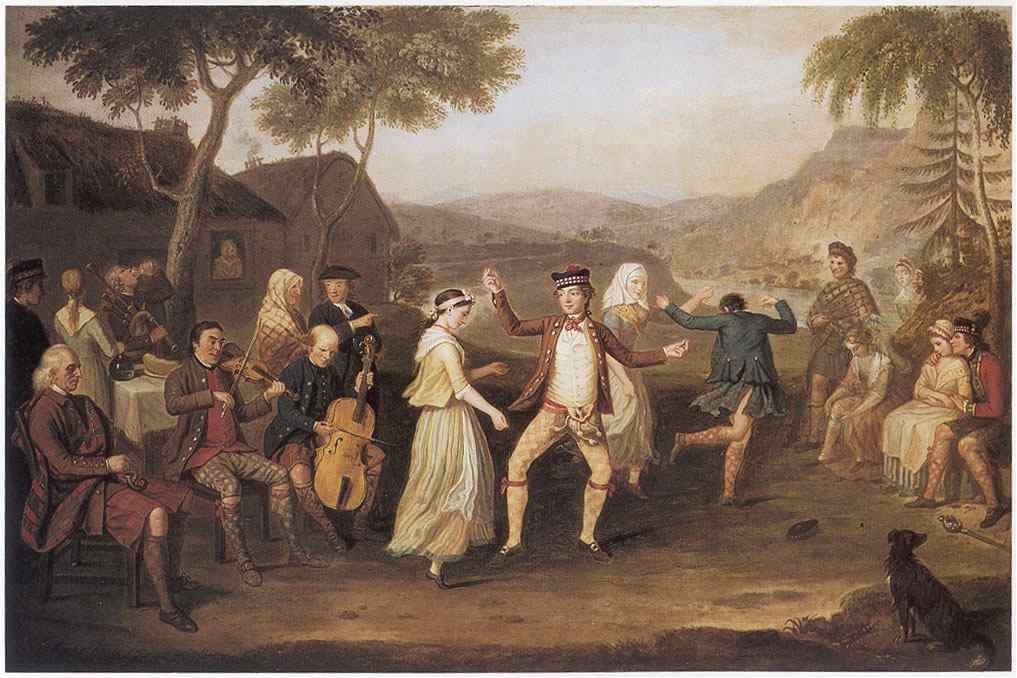
This is one of the few contemporary images of Scottish folk dance from the period before it was formalized or theatricalized. It documents the physical quality—the springing, vigorous movement—of Highland reel dancing as it was actually performed in social settings, and shows the integral role of bagpipe music and community participation. For dance historians and performers, it is evidence of how country and folk dances were danced before they were codified, preserved, or adapted for the stage.
What you are looking at
A Highland wedding celebration unfolds in a mountain valley, with figures arranged in informal groups across an open grassy space. In the middle distance, a man in light breeches and a woman in a pale dress with a shawl perform a vigorous dance, their bodies energetically engaged while musicians—visible to the left with bagpipes and what appears to be a cello—provide accompaniment. Around them, onlookers in darker period dress (reds, browns, blacks) cluster in conversational groups: some seated on the ground or on rough furniture, others standing and watching. The setting is rustic and rural, with simple stone buildings to the left, mature trees providing dappled shade, and mountains visible across the valley under a hazy sky. A dog lies in the foreground. The composition captures a moment of social celebration rather than formal ceremony, with the dancers central but the wider community equally important to the narrative.
The dancing
The two central dancers are in vigorous movement: the man appears to be in a springing or lifting motion, arms open and raised, weight shifted dynamically; the woman beside him moves with equal energy, her skirts swinging, her posture responsive to his. Their positioning suggests they are not in a closed ballroom hold but rather in an open, improvisational partnership—characteristic of country or folk dancing of the period. The surrounding figures are static or seated, creating a clear frame around the active dancers. No other couple is dancing simultaneously; this is a solo performance by two while others watch.
The dance depicted
This appears to be a Scottish country or Highland reel or strathspey, danced at a rural wedding celebration. The vigorous, springing quality of the dancers' movement, the open hold, the presence of bagpipes and traditional instrumentation, and the Highland setting all support identification as a folk-regional dance tradition specific to Scotland. The informality of the scene—the mixed ages of spectators, the outdoor setting, the lack of a formal dance floor—suggests this is a social vernacular dance rather than a staged or ballroom version. The artist captures a moment of uninhibited, communal celebration typical of 18th-century Highland social life.
How it was made
The work appears to be an oil painting based on the handling of light and color, the soft blending of tones in the sky and landscape, and the detailed yet painterly treatment of the figures. The artist has used warm earth tones and muted greens to establish the valley setting, with careful attention to the fall of light across the grass and the modeling of the figures through light and shade. This technique allows for narrative detail—individual expressions, the texture of dress, the specificity of gesture—that would be harder to achieve in a print medium. The scale and finish suggest this was a finished exhibition work rather than a sketch, indicating it was intended for a viewing public with interest in Scottish rural life and customs.
About this work
This is an oil painting of a Highland wedding dance, depicting a moment of social celebration in rural Scotland during the late 18th century. The work captures a specific cultural practice—the communal dance at a wedding—with ethnographic interest in costume, setting, and social structure alongside its interest in movement itself. The painting sits within a broader 18th-century European interest in 'national' or regional customs and the picturesque qualities of rural and mountainous landscapes. As both a dance document and a social narrative, it records how dance functioned in Highland society: not as a formal or staged event, but as an integral, vigorous part of community life.
The work belongs in a gallery of dance imagery precisely because it treats dance not as an isolated performance but as an embedded social practice. The dancers are central compositionally but not separated from their community; the bagpipes and the watching figures are as much part of the 'dance' as the movement itself. For historians of dance, this is a rare image of vernacular Scottish dance in its actual social context, rather than as a ballroom abstraction.
How to look at it
Attend first to the dancers' bodies: the springing quality of the man's movement, the swing of the woman's skirts, the open and responsive positioning rather than a fixed ballroom hold. Notice how the artist has frozen a moment of high energy—this is not a posed moment but a glimpse of vigorous motion. Then look outward from the dancers to the community: the seated musicians, the standing onlookers, the mix of ages and social positions, the dog, the rough ground and simple buildings. This framing—the dancers as central but not separated from their community—is crucial to understanding what the artist is documenting: not a performance for an audience, but a celebration in which all present are participants.
The artist
David Allan (1744–1796) was a Scottish painter known for scenes of Scottish rural and domestic life, often with an interest in ethnographic detail and narrative incident. He worked in the later 18th century, when there was growing artistic and cultural interest in Scottish identity, landscapes, and customs, particularly following the Union with England. Allan's approach combined academic training with sympathy for vernacular subject matter, making him attuned to the visual specifics of everyday social life. His work helped establish the visual vocabulary for picturesque representations of the Highlands that would influence Scottish and British art for decades.
The period
This painting dates to 1780, a moment when Scottish dance and culture were becoming subjects of artistic and antiquarian interest across Britain. The later 18th century saw the rise of 'picturesque' aesthetics, which valued rural, mountainous, and culturally distinctive landscapes and practices. In Scotland specifically, this period followed the 1746 defeat at Culloden and the subsequent period of Highland cultural suppression and change; by the 1780s, Highland dress and customs, while still subject to legal restrictions, were becoming subjects of romantic and patriotic interest among both Scottish and English audiences. At the same time, formal dance was becoming increasingly codified and ballroom-centered in polite society. Allan's painting thus captures a moment when vernacular dance was being recognized and aestheticized by the artistic establishment even as it was undergoing social and legal pressure.
Where it lives
The work is recorded as in Wikimedia Commons, sourced from a public collection. The catalogue record attributes it to David Allan and dates it to 1780. No holding institution is currently specified in the catalogue record provided.
Dance in this work
Questions about this work
How do I know this is Scottish dance and not English country dance?
The specific markers are the Highland setting (mountains, rural isolation), the presence of bagpipes among the instrumentation, the traditional Highland dress of some figures, and the vigorous, springing quality of the movement. English country dances of the period were typically more formally arranged and danced in geometric patterns. The vigor and openness of the hold, combined with the bagpipes, point clearly to a Scottish Highland reel or strathspey.
Were women really dancing at weddings in the Highlands?
Yes. This painting is evidence that women participated actively in wedding celebrations and social dancing in Highland society. The woman here is not a passive onlooker but an equal partner in the dance, moving with as much energy and freedom as the man. Wedding dances were communal events that involved both sexes.
What do the instruments tell us?
The presence of bagpipes is definitive for Scottish dance; bagpipes were the instrument of Highland music and remained central to Scottish identity even during periods when Highland culture was suppressed. The presence of what appears to be a cello suggests a more elaborate band than might be typical for a remote wedding, or may indicate the artist's artistic choice to include varied instrumentation for visual interest.
Why paint a wedding dance?
By the 1780s, Scottish culture and landscapes were becoming fashionable subjects for British art. A Highland wedding was picturesque, distinctive, and represented authentic 'national' character—the very qualities that appealed to 18th-century collectors and audiences. For Allan, such scenes also offered opportunities to demonstrate his skill in depicting landscape, costume, and narrative simultaneously.
More dance artwork





