49 works in this view — arrow keys or swipe to move between them.
Dance in Art
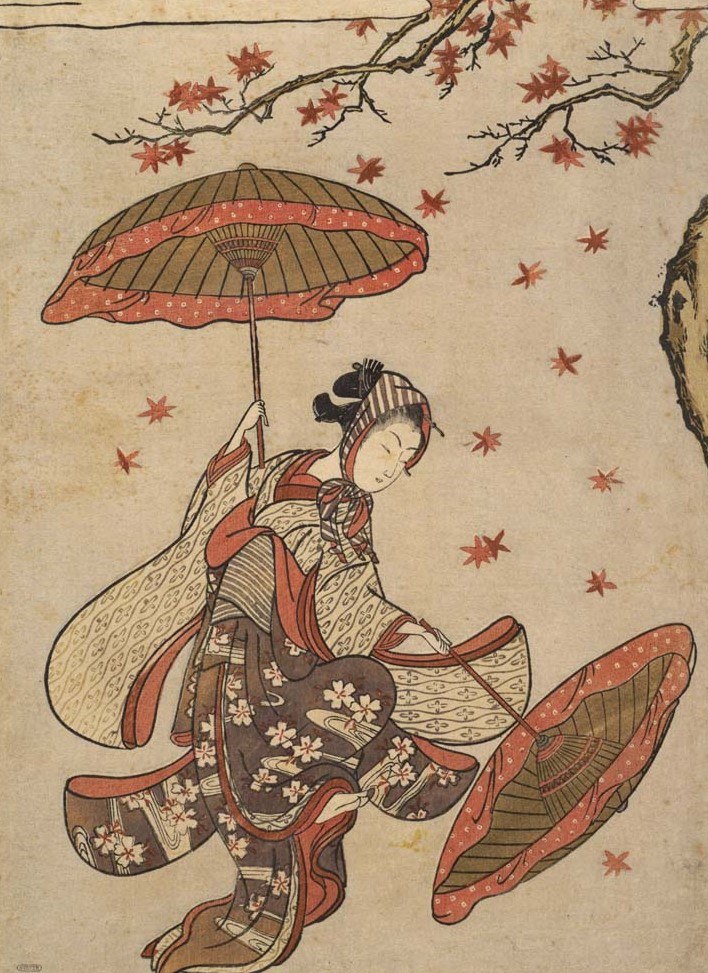
Dance of Autumn Leaves-by Suzuki Harunobu-Tokyo National Museum
鈴木春信(東京国立博物館所蔵)
- Source:
- Wikimedia Commons
- Rights:
- Reusable with conditions: credit the creator. Source record ↗
- Recorded as:
- cc by 4.0
This work reveals how Japanese artistic tradition treated the female body and movement as a subject worthy of sustained aesthetic attention, capturing refinement and elegance in a single suspended moment. It shows that 'dance' in the broadest sense encompasses not only formalised performance but also the cultivation of beautiful, controlled movement in daily life.
What you are looking at
A single figure in an elaborate kimono stands beneath a decorated parasol, holding it aloft against a shower of falling maple leaves. The woman wears a richly patterned robe in red and cream, with an ornate hairstyle secured by a pin. Her garments billow around her, caught mid-movement, with the fabric of her outer robe and trailing sleeves creating sweeping curves. The parasol above her is rendered in coral-red with geometric patterns and radiating panels, tilted at an angle that suggests both shelter and grace. Delicate maple leaves—a motif of autumn—drift across the composition from the branches of a gnarled tree to the left and right. The colour palette is restrained: red, black outlines, cream, and ochre tones on paper aged to pale gold. The overall effect is of captured motion within a formal composition, the parasol and falling leaves framing a moment of seasonal beauty.
The dancing
The figure's posture is graceful and upright, with the parasol held aloft in one hand, the arm extended and slightly curved. Her body is angled in a gentle contrapposto stance, with weight distributed to suggest movement across the ground. The opposite arm hangs loosely, adding to the sense of ease and floating elegance. Her head is tilted downward in a contemplative pose, regarding the falling leaves. The silhouette created by the flowing robes and the parasol reads as a unified compositional shape rather than a rigid pose—everything flows from the centre outward.
The dance depicted
This does not depict theatrical dance but rather captures a moment of seasonal grace and feminine beauty drawn from everyday experience. The stance and gesture suggest a refined, deliberate movement—the kind of controlled, flowing motion associated with the formal practices of Japanese courtly life and aristocratic deportment rather than stylised performance. The parasol-holding and the gentle weight shift read as a habitual gesture elevated to aesthetic moment. If this relates to dance at all, it is to the codified movements of classical Japanese theatre or courtly ceremony, where even walking and standing were disciplined movement practices. However, the image is more accurately read as a study in beauty and seasons than as a documentation of named dance practice.
How it was made
This is a woodblock print in the ukiyo-e tradition, specifically a medium-sized colour print (chūban-e) with hand-colouring or early colour-printing techniques. The medium is identifiable from the bold black outlines, the flat colour fields, the precise registration of multiple blocks, and the subtle gradations in the red and cream tones. Woodblock printing allowed for rapid dissemination and multiple impressions, making such images accessible to a broad urban audience in Edo-period and early modern Japan. The technique imposed elegant constraints: limited but carefully chosen colours, bold linear design, and composition that reads clearly from a distance—all of which shape the formal, almost heraldic quality of the figure against the void of the background.
About this work
This is a woodblock print from the ukiyo-e tradition depicting a woman in fine dress holding a parasol amid falling autumn leaves. While not a representation of formal dance, the image captures a moment of refined, controlled bodily grace that reflects the aesthetic principles and deportment practices of the Japanese aristocracy and performing arts traditions. The work sits at the intersection of fashion, seasonal observation, and the elevation of everyday gesture to art. For a gallery of dance in art, it documents a historical moment when the boundary between dance, theatre, courtly behaviour, and visual beauty was fluid and permeable—when even standing still could be an art form.
How to look at it
Notice how the artist has used the parasol and falling leaves to create a frame within the frame, concentrating attention on the figure's posture and the flow of her garments. The angle of the parasol is crucial—it is neither vertical nor fully tilted, but caught in a moment of adjustment or presentation, creating a sense of gentle animation. Observe the pattern-work on the robe: the artist has differentiated fabrics and decorative schemes to suggest luxury and status. The composition is balanced almost geometrically, with the gnarled tree branches framing the figure on either side, yet the falling leaves prevent the image from becoming merely decorative. The blank space around the figure creates an almost stage-like setting, appropriate to a tradition saturated by theatrical influence.
The artist
Suzuki Harunobu (鈴木春信) was an Edo-period woodblock artist known for bijin-e (pictures of beautiful women) and genre scenes. He worked in the mid-18th century and is recognised for the delicacy of his compositions and his sensitive treatment of female subjects. His prints typically feature refined domestic or seasonal moments, often with careful attention to fabric pattern, posture, and the interplay of figure and environment.
The period
This work dates to the height of the ukiyo-e tradition in Japan, a period when colour woodblock printing had reached technical maturity and urban merchant culture was flourishing. The Edo period saw a rich cross-pollination between courtly aesthetic practices, theatrical forms (Kabuki, Noh), and the visual arts. Autumn imagery and the motif of the parasol were established conventions of beauty and refinement in Japanese poetry, painting, and decorative arts. The work reflects both seasonal consciousness deeply embedded in Japanese culture and the mid-18th-century fascination with rendering texture, pattern, and the play of light on fabric.
Where it lives
This work is held in the Tokyo National Museum, a major public collection of Japanese art. The source for this catalogue entry is Wikimedia Commons, which provides digital access to public-domain and collection-licensed artworks. The work is a chūban-sized woodblock print typical of mid-Edo circulation and urban consumption.
Questions about this work
Is this a dance image?
Not in the strict sense of representing formal dance performance. However, it captures a moment of refined, controlled physical grace that reflects the same aesthetic values—balance, elegance, the beauty of the human body in motion—that underlie both Japanese theatrical traditions and the visual arts. In a period when dance, theatre, courtly comportment, and visual representation were deeply intertwined, the boundary between 'dance' and 'beautiful movement' was permeable.
What do the falling leaves and parasol mean?
Autumn leaves are a central motif in Japanese aesthetic tradition, associated with transience, beauty, and melancholy. The parasol here serves dual purpose: it is both a practical object and a compositional device that frames the figure and suggests her elegance and status. Together, they create a moment suspended in time and season—a fleeting glimpse of refined beauty.
Who was this woman?
The figure is not a portrait of an identified individual but rather an idealised representation of a beautiful woman (bijin). Such prints circulated as aesthetic objects and were collected for their beauty and craftsmanship. She may represent a type—a woman of leisure or courtly refinement—rather than a specific person.
More dance artwork





