49 works in this view — arrow keys or swipe to move between them.
Dance in Art
Chikamatsu Kiken buto no ryakuke
Toyohara Chikanobu alias Yōshū Chikanobu
- Source:
- Wikimedia Commons
- Rights:
- Public domain — free to use, share and adapt.
- Recorded as:
- public_domain
This print is evidence that ballroom dancing in Japan was not a organic social adoption but a directed state practice tied to diplomatic recognition. For dance historians, it shows how Western ballroom forms traveled not through popular enthusiasm but through official channels, and how a non-Western society visibly negotiated between tradition and imported modernity. The image is also a rare depiction of ballroom dance in Asia from the period when it was first being established.
What you are looking at
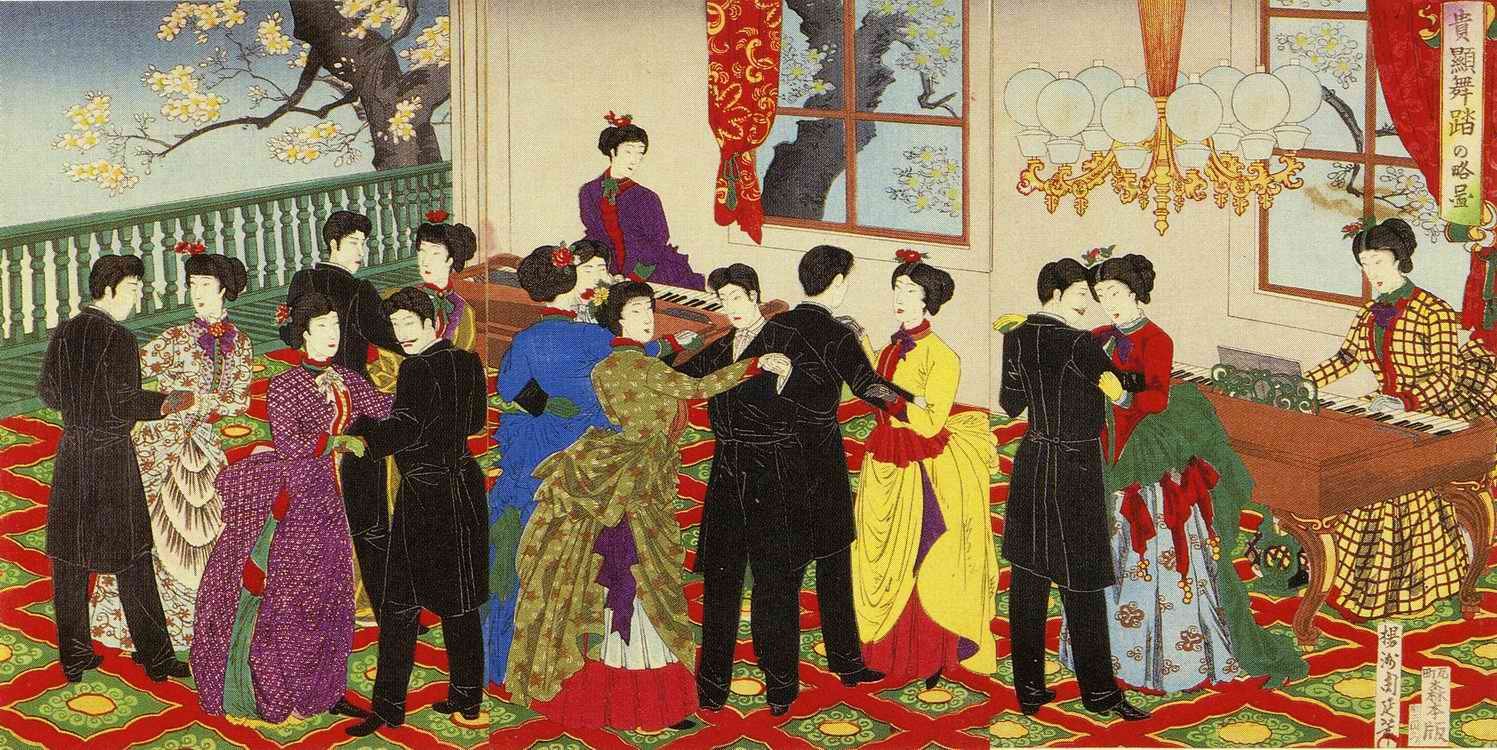
A formal ballroom interior in 1880s Japan, depicted in the style of a ukiyo-e woodblock print. The scene shows two dozen figures arranged across a cream-colored reception room decorated with hanging paper lanterns, ornamental red silk ribbons, and views of flowering trees through tall windows. A woman in a yellow gown sits at a grand piano on the right, while the remaining figures—predominantly in formal Western black evening dress mixed with traditional Japanese silk kimonos in jewel tones (purple, blue, crimson, gold)—stand or move in conversational groupings across a patterned red and gold carpet. The composition suggests a New Year's celebration or diplomatic reception, with the blend of Western and Japanese dress indicating the cultural moment of Meiji-era Japan's selective embrace of Western customs. The artist has frozen a moment of social mingling rather than active dancing, though the formal setting and assembled figures suggest a dance occasion.
The dancing
The figures are posed in small clusters of conversation rather than in dance holds or frames. Most stand with relaxed posture, weight evenly distributed, suggesting social interaction rather than active movement. Several women display the characteristic upright Victorian carriage of formal Western dress, while those in Japanese kimonos show the different silhouette of traditional costume. No couple is shown in a recognized ballroom hold; the spacing and positioning suggest the formal social protocols of a state reception or ceremonial gathering rather than active partnered dance.
The dance depicted
The image depicts the Rokumeikan (literally 'Deer Cry Pavilion'), an actual government building in Tokyo that hosted Western-style ballroom dances during the Meiji period (1868–1912). These were not spontaneous social dances but carefully orchestrated diplomatic events where the Japanese elite learned and performed European ballroom conventions—primarily waltzes, quadrilles, and contra dances—as part of Japan's modernization strategy. The print captures the transitional moment itself: a room where Western ballroom culture is being formally adopted and displayed, rather than a moment of uninhibited dancing. The presence of the pianist confirms the Western musical accompaniment essential to ballroom dancing.
How it was made
A woodblock print (ukiyo-e), recognizable from its characteristic flat color planes, clear black outlines, and the precise registration visible in the overlapping garments. The print combines traditional Japanese compositional principles—elevated viewpoint, decorative patterning of the floor, attention to textile pattern—with Western representational concerns (perspective through the windows, modeling of the interior space). This hybrid technique was itself a product of Meiji cultural fusion and allowed the image to circulate widely among the Japanese public as a record of this visible marker of national transformation.
About this work
This is a documentary record in the form of a popular print: evidence of how ballroom dancing was introduced to Japan as state policy during the Meiji era. The Rokumeikan was not a public dance hall but an official government building where the Japanese elite were trained in Western ballroom etiquette as part of Japan's project to demonstrate to Western powers that it had adopted 'civilization' (bunmei). Toyohara Chikanobu, one of the period's most productive printmakers, captured not a moment of joyful dancing but the formal, almost solemn enactment of a political and cultural strategy. The print is a rare document of ballroom dance as cultural policy rather than social pleasure.
How to look at it
Look first at the two contrasting dress codes in the same room: the Western black evening suits and the traditional Japanese silk kimonos in brilliant colors. This visual coexistence is the subject of the print, not the dance itself. Notice that no couple is actually dancing—the figures are posed in static conversation. The presence of the pianist and the formal arrangement suggest this is the moment before or between dances, a reception rather than a dance proper. The artist chose to document the occasion itself rather than the choreography, which tells us that the social and diplomatic significance of the event mattered more than the actual movement.
The artist
Toyohara Chikanobu (1838–1912), known professionally as Yōshū Chikanobu, was the most prolific and commercially successful ukiyo-e artist of the late Meiji period. He specialized in scenes of contemporary life (muzan-e and later "true depictions" of events), particularly high society, theater, and—notably—scenes of Westernization and modernization. His workshop produced thousands of prints on commission for newspapers, publishers, and collectors; he was the primary visual chronicler of Meiji transformation. This print is typical of his documentary approach to social life.
The period
The Rokumeikan was built in 1883 and operated as a venue for diplomatic receptions and Western-style social events until the mid-1890s, after which it was closed as nationalist sentiment turned against uncritical Westernization. The ballroom dances held there were part of a deliberate government program to demonstrate Japan's adoption of Western social forms. Japanese participants learned ballroom dance from Western dance masters or from instruction manuals; the practice was understood as a competency required of the modern nation-state. By the 1890s, however, backlash against Westernism and renewed interest in Japanese tradition led to reduced enthusiasm for these events. The print was made during the height of this official adoption (late 1880s) and documents a brief, specific historical moment.
Where it lives
The source is Wikimedia Commons. The work is identified as a ukiyo-e print from 1888 in the Meiji period. The catalogue record is minimal, and the medium (woodblock print) has been inferred from the image's characteristics.
Dance in this work
Questions about this work
Was ballroom dancing popular in Japan?
Not initially. These dances were introduced by government directive as a sign of modernization and international sophistication. They were practiced by the elite at official events like those at the Rokumeikan, not by the general public. By the 1890s, backlash against indiscriminate Westernization made them less fashionable.
What is the Rokumeikan?
A government building constructed in 1883 specifically to host Western-style diplomatic receptions and ballroom dances. It was part of Japan's strategy to demonstrate to Western powers that the nation had adopted 'civilization' and was worthy of equal diplomatic standing. It closed in the mid-1890s as nationalist sentiment shifted.
Why does everyone look so formal and still?
They are not mid-dance. This is a reception or social gathering where dancing might occur, but the artist has frozen a moment of formal social conversation. The uptight postures reflect both the formal Western dress code and the ceremonial nature of a state-sponsored event.
Who is the woman at the piano?
The catalogue record suggests she may be Uryū Shigeko, though this is not confirmed. She is likely a member of the elite or an imported dance instructor, serving as the musician for the ballroom dances.
More dance artwork





