49 works in this view — arrow keys or swipe to move between them.
Dance in Art
Dance Of the Seven Veilslabel QS:Len,"Dance Of the Seven Veils"label QS:Lfr,"La Dance des sept voiles"label QS:Lpt,"Dança dos Sete Véus"
Armand Point
- Source:
- Wikimedia Commons
- Rights:
- Public domain — free to use, share and adapt.
- Recorded as:
- public_domain
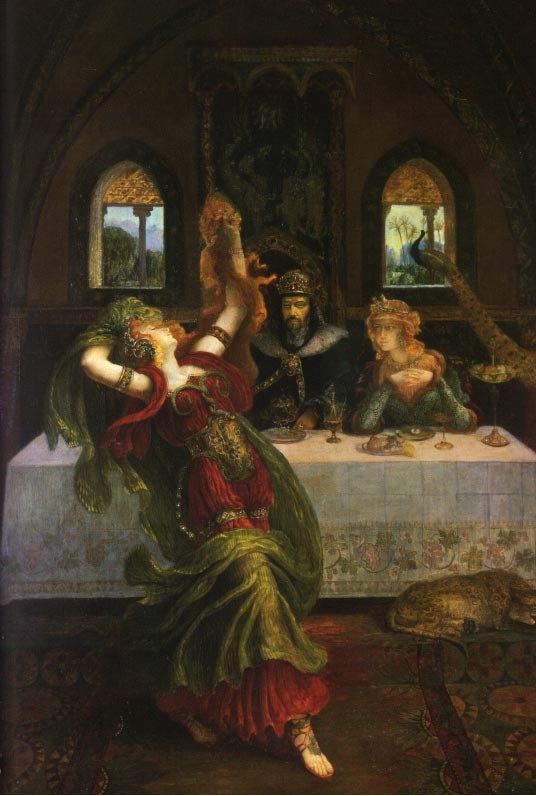
The painting exemplifies Symbolist and Orientalist attitudes toward dance and the female body at a moment when those attitudes were shaping European responses to actual non-European performance. The work also became entangled with the Salome myth through Oscar Wilde and later with the 1907 premiere of Richard Strauss's *Salome* opera, making it a key visual reference for how 'the Dance of the Seven Veils' entered Western cultural imagination as a coded symbol of seduction, power, and transgression.
What you are looking at
A figure in elaborate costume performs a sensual dance before a richly dressed audience of three seated figures in what appears to be a medieval or Renaissance palace interior. The dancer, wearing a flowing red and gold garment with green underdressing, stands with one arm raised dramatically and body in a sinuous contrapposto pose. She faces a bearded man in dark robes and crown, flanked by two women in ornate headdresses and jeweled clothing. The setting is defined by three arched windows with golden frames; two look out onto verdant landscapes, while the central arch frames a dark doorway. A white tablecloth with decorative borders and wine vessels rest on a low table before the seated figures. The floor is dark and decorated with floral patterns, and the entire scene is bathed in warm golden light from the windows, creating strong chiaroscuro that emphasizes the dancer's form against the shadowed interior.
The dancing
The dancer's body is weightless and elongated, with the near hip thrust forward and the torso twisted in an S-curve—a posture of invitation and display rather than structural balance. Her raised arm curves gracefully overhead, while the other hangs at her side; her legs are obscured by the flowing fabrics, making footwork impossible to assess. The audience maintains formal court posture: the central male figure is frontal and statuesque, while the two women turn slightly toward the dancer, their upper bodies composed. The spatial relationship emphasizes display and observation rather than participation—the dancer performs *for* rather than *with* her audience.
The dance depicted
This appears to be a salon or court dance of invitation, likely representing either a historical moment (such as Salome's dance before Herod, a common subject in 19th-century art) or a fictionalized 'oriental' or harem performance popular in Orientalist painting. The title 'Dance of the Seven Veils' is a 19th-century Western invention associated with Oscar Wilde's *Salome* (1891), though that work postdates most interpretations of the biblical account. The artist has chosen a moment of stillness—neither vigorous movement nor complete repose—that reads as seduction and display. The costume and setting suggest historical or exotic fantasy rather than documented practice, and the composition emphasizes the gaze of the audience as much as the body of the dancer.
How it was made
This is an oil painting, executed with precise draftsmanship and luminous glazing typical of academic Symbolist work of the 1890s. The artist has used warm golden light and cool shadow to model form, and has paid meticulous attention to textile surfaces—the sheen of silk, the opacity of velvet, the transparency of gauze. The technique enabled a large-scale, gallery-exhibition work intended for educated urban audiences familiar with both historical painting and contemporary Symbolist aesthetics. The labor-intensive medium and finish signal this as a prestigious commission or salon piece rather than a sketch or popular print.
About this work
Armand Point's 'Dance of the Seven Veils' is an 1890 oil painting depicting a solo dancer in exotic costume performing before a seated court audience in a palatial interior. The work sits at the intersection of Symbolist aesthetics, Orientalist fantasy, and historical or biblical narrative—genres that fascinated late 19th-century European artists and their audiences. The painting does not document a real dance practice, but rather stages a fantasy of sensuality, exoticism, and power organized around the male gaze. It belongs in a gallery about dance in art as evidence of how Western artists imagined non-Western performance, and how the female dancing body was deployed symbolically in high art.
How to look at it
Attend to the frozen moment Point has chosen: not a leap or a turn, but a pose of display and stillness that reads as both the climax of motion and a moment of total self-presentation. Notice how the light isolates the dancer's body and costume from the shadowed audience, emphasizing her as the object of an organized gaze. The three arched windows create a rhythmic frame that echoes the dancer's sinuous form, and the contrast between her red and gold costume and the dark interior amplifies her as a visual spectacle. The artist's decision to paint the audience clearly visible and engaged (rather than implied) makes this as much about the politics of looking as about the dance itself.
The artist
Armand Point (1860–1932) was a French Symbolist painter known for historical and mythological subjects, often with erotic or exotic themes. He exhibited at the Salon and was part of the broader Symbolist movement that rejected naturalism in favor of dreamlike, subjective imagery. His work is characterized by technical precision in the academic tradition combined with imaginative or fantastical subject matter, and he frequently returned to themes of female beauty, sensuality, and performance.
The period
In the 1890s, 'oriental' dance was a subject of intense fascination in European visual culture, fueled by colonialism, tourism, and the international circulation of photographs and exhibitions. At the same time, Symbolism was the dominant aesthetic movement in avant-garde art, and many Symbolist painters—including Gustave Moreau and Pierre-Auguste Renoir—treated dance, the body, and sensuality as vehicles for philosophical or psychological exploration. The publication of Oscar Wilde's *Salome* in 1891 and its subsequent adaptations (notably the 1905 play by Wilde, and Strauss's 1905 opera) made the 'Dance of the Seven Veils' a recognizable motif in European high culture, though the specific choreography remained undefined and was open to artistic interpretation.
Where it lives
The work is recorded as a painting by Armand Point dated 1890, held in an unspecified collection. It is known through the Wikimedia Commons database and may exist in a European museum or private collection, but the catalogue record does not specify location or accession history.
Questions about this work
Is this the 'Seven Veils' dance from the Bible?
The 'Dance of the Seven Veils' as a specific, named choreography does not appear in the Bible or in historical accounts. The biblical Salome dances before Herod in Matthew 14 and Mark 6, but no veil count is given. The 'Seven Veils' became a stock motif in 19th-century European art and was later popularized through Oscar Wilde's *Salome* (1891) and Richard Strauss's 1905 opera. This painting participates in that European fantasy tradition rather than documenting historical practice.
Did women actually dance like this in harems or Middle Eastern courts?
The costume, setting, and pose in this painting reflect European Orientalist fantasy rather than documented dance practices from the Middle East or Asia. Orientalist paintings of the period frequently misrepresented non-European cultures, combining garments and practices from different regions and times into an exotic blend designed for European viewers. Real Middle Eastern and Asian dance traditions had their own distinct forms, costumes, and contexts that differ significantly from what Symbolist painters imagined.
What does the title 'Seven Veils' actually mean?
The title remains mysterious and poetic rather than literal. Some sources suggest it may refer to layers of revelation or concealment, or to a striptease-like removal of garments, though there is no definitive historical source. In Wilde's play and Strauss's opera (both post-dating this painting), the 'Dance of the Seven Veils' is sometimes choreographed as a striptease, but other interpretations read it as symbolic or metaphorical. The vagueness of the term was part of its appeal to artists and audiences.
Is this painting about real dance or about fantasy?
It is unquestionably about fantasy—specifically, the European Symbolist and Orientalist fantasy of exotic female performance. The painting was made for an educated urban audience in Europe, not as documentation of actual practice. Its value lies in what it reveals about Western attitudes toward non-Western cultures, female bodies, and performance in the 1890s, rather than in any claim to authenticity.
More dance artwork





