49 works in this view — arrow keys or swipe to move between them.
Dance in Art
Dance of Shiva and Kali - 1778-1882
Unknown authorUnknown author
- Source:
- Wikimedia Commons
- Rights:
- Public domain — free to use, share and adapt.
- Recorded as:
- public_domain
This painting reveals the visual stereotypes and hierarchies embedded in 18th-century European responses to South Asian performance and spirituality. Dancers and historians should attend to how the scale distortion, exaggerated expression, and rendering of the female and dark-skinned figures served to present non-Western dance as primitive, frenzied, or possessed rather than as skilled, intentional practice—a visual rhetoric that shaped European (and later Western) understanding of global dance for centuries.
What you are looking at
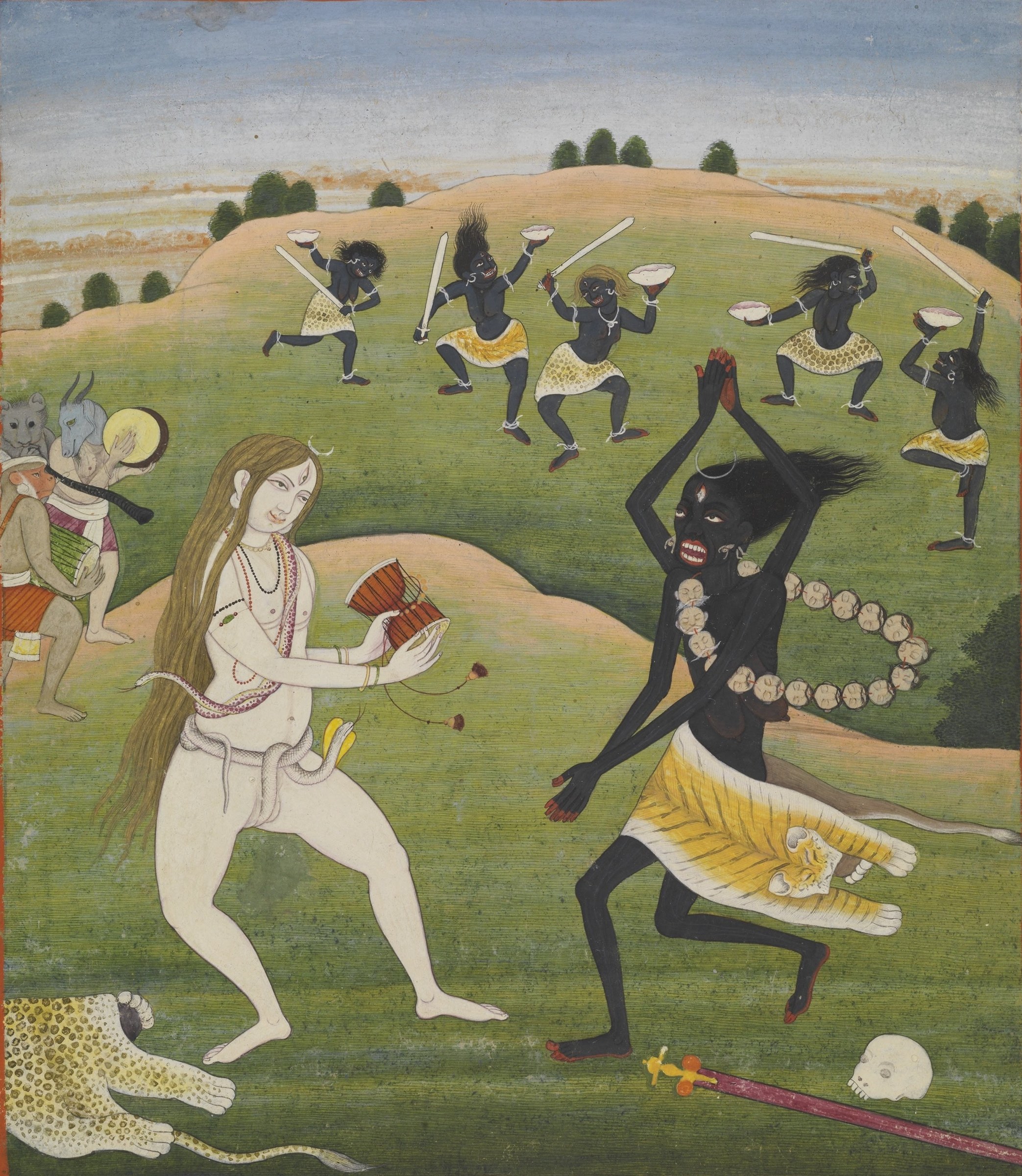
A densely populated landscape painting depicts a hillside scene of revelry and chaos. In the foreground, two monumental figures dominate: a pale-skinned woman with long auburn hair, rendered almost life-size, faces a dark-skinned figure with exaggerated features and an expression of frenzy or rapture. The woman wears jeweled ornaments and minimal clothing; the dark figure wears a yellow skirt with shell decoration and a long strand of skull beads. Between and behind them, a band of smaller dark-skinned figures—rendered in animated postures with raised arms, weapons (swords), and drums—cavort across a rolling green hillside. A pale leopard crouches in the lower left; a skull and sword lie on the ground. In the background, water and marshland stretch to a distant horizon dotted with trees. The perspective and scale are deliberately distorted: the foreground figures tower over the dancers and landscape alike, creating a dreamlike or visionary effect.
The dancing
The two central figures are posed in a confrontation or encounter: the woman leans back with arms raised, holding what appear to be tambourines or ritual vessels, her body weight shifting backward in a posture of provocation or trance. The dark figure beside her is rendered in an exaggerated contrapposto, one leg raised, arms spread wide, mouth open, conveying ecstatic movement or possession. The smaller figures behind them are captured in multiple overlapping poses of abandon: some hold weapons aloft, some beat drums, several are caught mid-stride or mid-leap. The composition suggests simultaneous action rather than a choreographed formation, with bodies at different heights and orientations across the hillside.
The dance depicted
This work depicts a Hindu mythological encounter or vision, identified in the title as involving Shiva and Kali—deities associated with ecstatic, transgressive, and visionary states. The smaller figures appear to represent a court, attendants, or demon host. No conventional Western dance form is present. The image instead represents sacred-ceremonial or mythological choreography as understood through an 18th-century European colonial or Orientalist lens: movement rendered as frenzy, possession, or divine intoxication rather than as technique. The dancing figures lack the codified mudras and frame positions of Kathakali or other South Asian classical forms, suggesting the artist worked from secondhand European accounts of Indian ritual and imagination rather than direct observation.
How it was made
This appears to be a watercolor or gouache painting on paper, with fine detail and careful layering of pigment. The technique allows for the subtle modeling of flesh tones and the precise rendering of jewelry, garments, and landscape features, while also enabling the vivid contrasts of color (pale flesh against dark skin, gold against green) that create the work's jarring visual impact. The medium and style suggest circulation among European collectors and scholars of the period, likely as part of a portfolio of Indian, Islamic, or other non-European subjects. The painterly technique and documentary ambition indicate an artist trained in European representational conventions applying them to colonial or Orientalist subject matter.
About this work
This is an 18th-century European painting of a mythological scene involving Hindu deities and their retinue, rendered in a style that mingles European painting technique with Orientalist fantasy and distortion. It exemplifies how dance imagery functioned in colonial discourse: as a window onto exotic 'otherness' and spiritual excess, refracted through the artist's own cultural assumptions and formal training. The work is valuable not for accurate documentation of Hindu dance forms but as evidence of how Europeans imagined non-Western movement, spirituality, and the body at a moment when direct engagement with Indian performance traditions was limited by geography and cultural barriers.
How to look at it
Attend first to the scale distortion: the two foreground figures are rendered vastly larger than the dancers and landscape, collapsing the distance between viewer and scene and creating a sense of overwhelming presence or hallucination. Notice how the pale woman and dark figure are posed in opposition or confrontation, each rendered with exaggerated features and an intensity of gesture that signals not technical accomplishment but passion or possession. Look at the smaller figures: their varied poses and the overlapping of their bodies suggest frenzied simultaneous action rather than choreographed sequence. The landscape itself—the rolling green hill, the distant water, the crouching leopard—situates the scene in an imagined 'India' that is more dreamlike than documentary. The painting invites the viewer to witness a moment of spiritual transgression or divine madness, rendered through movement and bodily display.
The artist
The artist is recorded as unknown. The style, pigment, paper, and technique suggest training in European academic or commercial art traditions, possibly German, Dutch, or British given the period and the work's eventual placement in a European collection. The painting may be the work of a court artist, a merchant or military illustrator, or a European resident of India; the subject matter and execution suggest it was made for a European patron interested in Indian exotica.
The period
This work dates to the height of European Orientalism and early colonial engagement with India. The late 18th century saw an explosion of European interest in Indian art, philosophy, and performance—mediated largely through travel accounts, translations, and the collections of the East India Company and wealthy collectors. European artists had minimal direct access to Indian classical dance forms; instead, they worked from written descriptions, hearsay, and their own imagination. Hindu and Buddhist deities and mythology became fashionable subjects in European high art and decorative practice. Simultaneously, colonial discourse was constructing non-European peoples and their practices as fundamentally 'other': less rational, more bodily, more spiritual or primitive. Dance, as the most ephemeral and embodied of arts, became a key site for expressing these othering fantasies.
Where it lives
The work is held in Wikimedia Commons, indicating it is either in a public collection with open-access photography or has entered the public domain. The catalogue record provides minimal information: unknown artist, 1788 date (though the record also lists 1778–1882, suggesting dating uncertainty), watercolor or similar medium not recorded, collection and current location not recorded.
Dance in this work
Questions about this work
Who are the two large figures in the foreground?
According to the title, they represent Shiva and Kali, major Hindu deities. Shiva is associated with destruction, asceticism, and ecstatic dance; Kali with fierce energy and transgression. However, the artist appears to have worked from secondhand or fantastical sources rather than iconographic tradition, so the rendering may not be recognizable to practitioners of Hindu art or ritual.
Is this depicting a real dance tradition?
Not in any documentable sense. The work is a European fantasy of Indian dance and ritual, shaped by 18th-century Orientalism and colonial imagination. No South Asian classical dance form—Kathakali, Bharatanatyam, Kathak, or others—is represented. The small figures are rendered as frenzied and possessed rather than technically accomplished, reflecting European assumptions about non-Western performance.
Why are the figures rendered at such different scales?
The scale distortion is deliberate and visionary rather than naturalistic. It creates a dreamlike or supernatural atmosphere, emphasizing the mythological or spiritual content of the scene. The monumental foreground figures dwarf the landscape and attendants, drawing the viewer into an overwhelming encounter with the divine or demonic.
What does the skull and sword on the ground symbolize?
These are attributes associated with Kali in Hindu iconography: symbols of death, destruction, and the fierce divine power to annihilate ego and illusion. However, as rendered here by a European artist, they may simply signal danger, transgression, or spiritual wildness to the European viewer.
More dance artwork





