49 works in this view — arrow keys or swipe to move between them.
Dance in Art
Dance-of-death-german-18th
Unknown authorUnknown author
- Source:
- Wikimedia Commons
- Rights:
- Public domain — free to use, share and adapt.
- Recorded as:
- public_domain
The *Danse Macabre* is foundational to European dance iconography and demonstrates how dance—as metaphor and image—was used to teach theology and enforce social hierarchy (by showing it dissolving). This print reveals the deep medieval roots of the association between dancing, the body, and death, a tension that resurfaces throughout art history. For historians of both dance and mortality, this is a canonical text.
What you are looking at
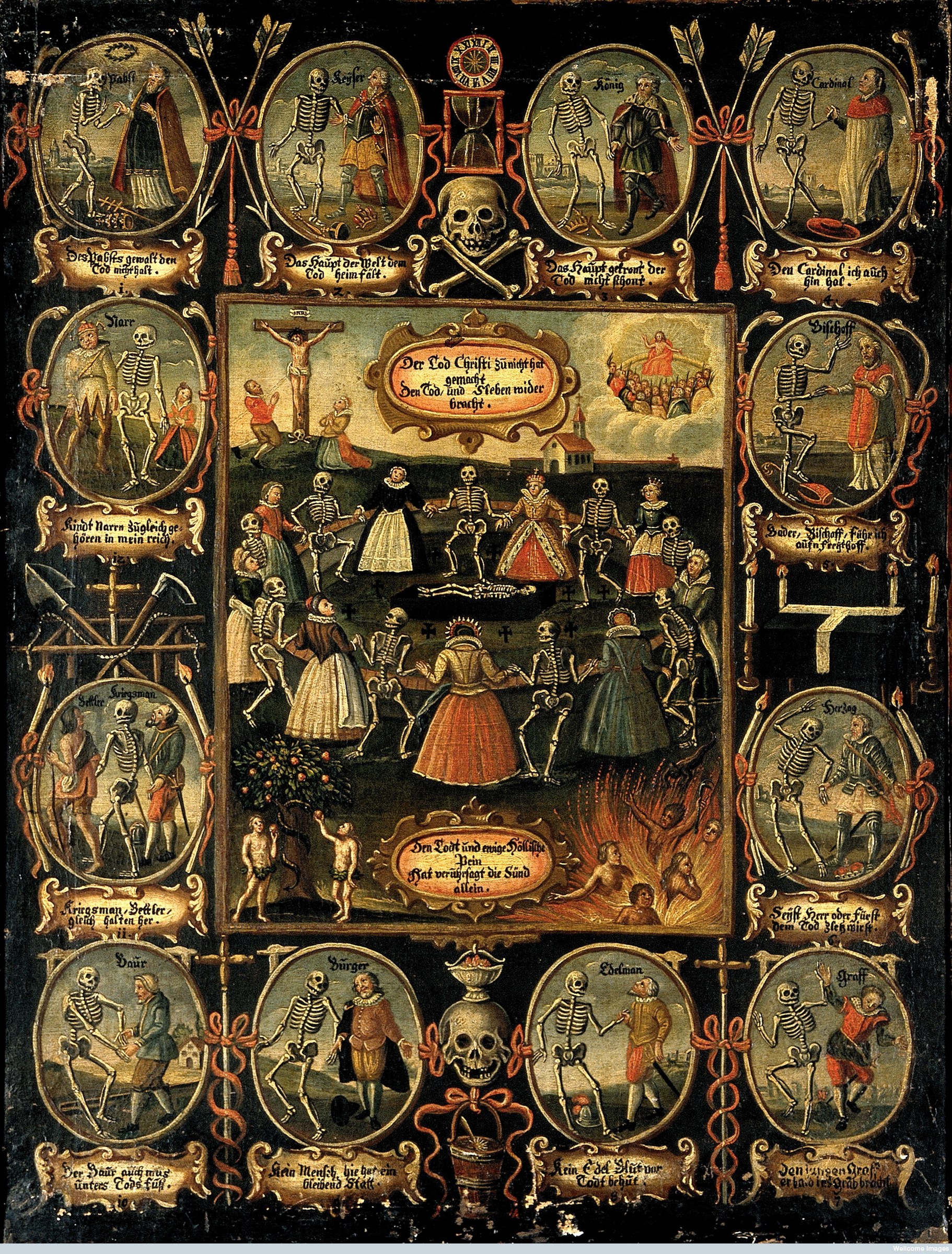
This is a German *Danse Macabre* woodcut or engraving organized in two registers. The central panel shows a dramatic scene of Death's triumph: skeletal figures dance with the living—emperors, noblewomen, clergy, and commoners—in a chaotic round. Above this central tableau hovers Christ on the cross, attended by angels and crowned by a skull-faced Death figure. Below, the damned burn in Hell's flames while the saved ascend to Heaven. The entire composition is framed by twelve oval medallions on all four sides, each containing a pair of figures—the living and the skeletal—in close encounter. These pairs represent the classic medieval *Danse Macabre* procession: pope and emperor at top, descending through bishop, knight, merchant, peasant, child, and fool. Gold leaf illuminates the background and details throughout. The overall tone is didactic morality: death comes for all ranks, and the fate of the soul—salvation or damnation—determines the afterlife.
The dancing
In the central panel, the living figures stand upright in formal dress (long gowns, court attire), some appearing to be led or partnered with skeletal figures rendered in anatomical detail. The skeletons exhibit loose, ungoverned postures—knees bent, arms raised or extended—in marked contrast to the stiffness and dignity of their living partners. The women's full skirts and the men's structured doublets emphasize the order of the living against the formlessness of death. The twelve marginal pairs show the same pattern: the skeleton typically gestures toward or embraces the living figure, who recoils or submits. The composition suggests no coordinated choreography, but rather an inexorable separation and claim.
The dance depicted
This is not a depiction of actual dance steps or technique, but rather a *memento mori* using the metaphor of the *Danse Macabre*—a late-medieval allegorical procession in which Death claims figures of all social rank. The work makes moral rather than kinetic claims: it teaches that death is the great equalizer and that pious preparation determines salvation. The skeletal figures do not dance in any historical sense; they are actors in a theological drama. The formal dress of the living and their orderly (if terrified) bearing suggests a court or processional context, but the 'dance' here is purely symbolic—a visual sermon on mortality and the economy of salvation.
How it was made
This appears to be a hand-colored woodcut or engraving, likely produced in the 16th or 17th century and hand-finished with gold leaf and watercolor or tempera. The technique of surrounding a large central narrative with smaller framing medallions suggests a devotional print designed for private contemplation or instruction. The gold leaf on dark ground, the careful hatching and line work, and the hierarchical composition all indicate a product intended for circulation among the educated and pious—merchants, clergy, nobility—who could afford colored and gilded impressions. The work is characteristic of German Renaissance printmaking, designed to instruct through visual impact rather than detailed naturalism.
About this work
This is a *Danse Macabre* morality print that uses the image of death dancing with the living—transcending all social rank—to teach Christian doctrine about salvation and damnation. The central panel shows the chaotic round of the living and dead, flanked by scenes of crucifixion, heaven, and hell; twelve marginal pairs show the classic *Danse Macabre* sequence of social types confronted by skeleton figures. The work belongs in a dance gallery not because it depicts actual dance practice, but because the *Danse Macabre* is one of the oldest and most influential uses of dance imagery in European visual culture—a form that shaped how artists represented movement, mortality, and the body for three centuries. It is an ancestor to all later danse macabre imagery and a primary document of how medieval and Renaissance Europe visualized death through the metaphor of the dance.
How to look at it
Look first at the central roundel: notice how the skeletal figures are posed in loose, articulated postures (bent knees, raised arms) while the living stand rigid in their formal dress, creating a visual argument about disorder and order, death and life. Then trace the marginal medallions clockwise, observing how each social rank—pope, emperor, bishop, merchant, peasant—encounters the same skeletal partner, leveling all hierarchy. Finally, observe the iconography above and below: Christ and angels at top, Hell-fire at bottom. The whole composition moves the eye from center outward and top to bottom, reinforcing the theological hierarchy even as it preaches the democracy of death.
The artist
Unknown. The work is typical of 16th–17th century German devotional printmaking, a tradition that included both named masters and anonymous workshop productions. The technical refinement and use of gold leaf suggest it was produced in an established printmaking center (likely a city such as Nuremberg, Frankfurt, or Strasbourg) and was considered a luxury object.
The period
The *Danse Macabre* emerged in late-medieval culture (14th–15th centuries) as a response to plague, war, and the memento mori tradition. By the 16th and 17th centuries, when this print was made, the motif had become a standard didactic and artistic formula across German, French, and Netherlandish printmaking. The composition also reflects Renaissance court culture—the formal dress and hierarchical arrangement of social ranks—while maintaining medieval theological concerns about salvation and judgment. The work synthesizes Renaissance aesthetics (proportion, classical framing, gold-ground painting) with medieval allegory.
Where it lives
Source: Wikimedia Commons. The work is catalogued as a German print of circa 1750, though the style and composition suggest it may be a later impression or copy of an earlier design. No collection holding is recorded.
Questions about this work
Is this actually a dance?
No—not in the sense of steps or technique. The *Danse Macabre* is a medieval allegorical procession in which Death claims the living. Artists used the visual metaphor of 'dancing with death' to teach that mortality is universal and inescapable. The 'dance' is theological, not choreographic.
Why are the skeletons so loose and the living so stiff?
The contrast is intentional and symbolic. The rigid, formal dress and posture of the living represent order, rank, and worldly power—all of which death dissolves. The loose, articulated skeletons represent the formlessness of death, the body stripped of dignity and control. The visual opposition teaches the futility of earthly status.
What do the top and bottom scenes mean?
The crucifixion and heavenly scene at top represent salvation through Christ; the Hell-fire scene at bottom represents damnation. Together, they frame the central *Danse Macabre* as a warning: all must die, but the fate of the soul depends on piety and preparation. This is the 'entire economy of salvation' mentioned in the catalogue record.
Why are there twelve smaller scenes around the border?
These show the classic *Danse Macabre* sequence: Death comes for representatives of every social rank, from pope and emperor down to fool and beggar. The repetition of the same encounter—living figure confronted by skeleton—across all ranks teaches that death is the one true equalizer.
More dance artwork





