49 works in this view — arrow keys or swipe to move between them.
Dance in Art
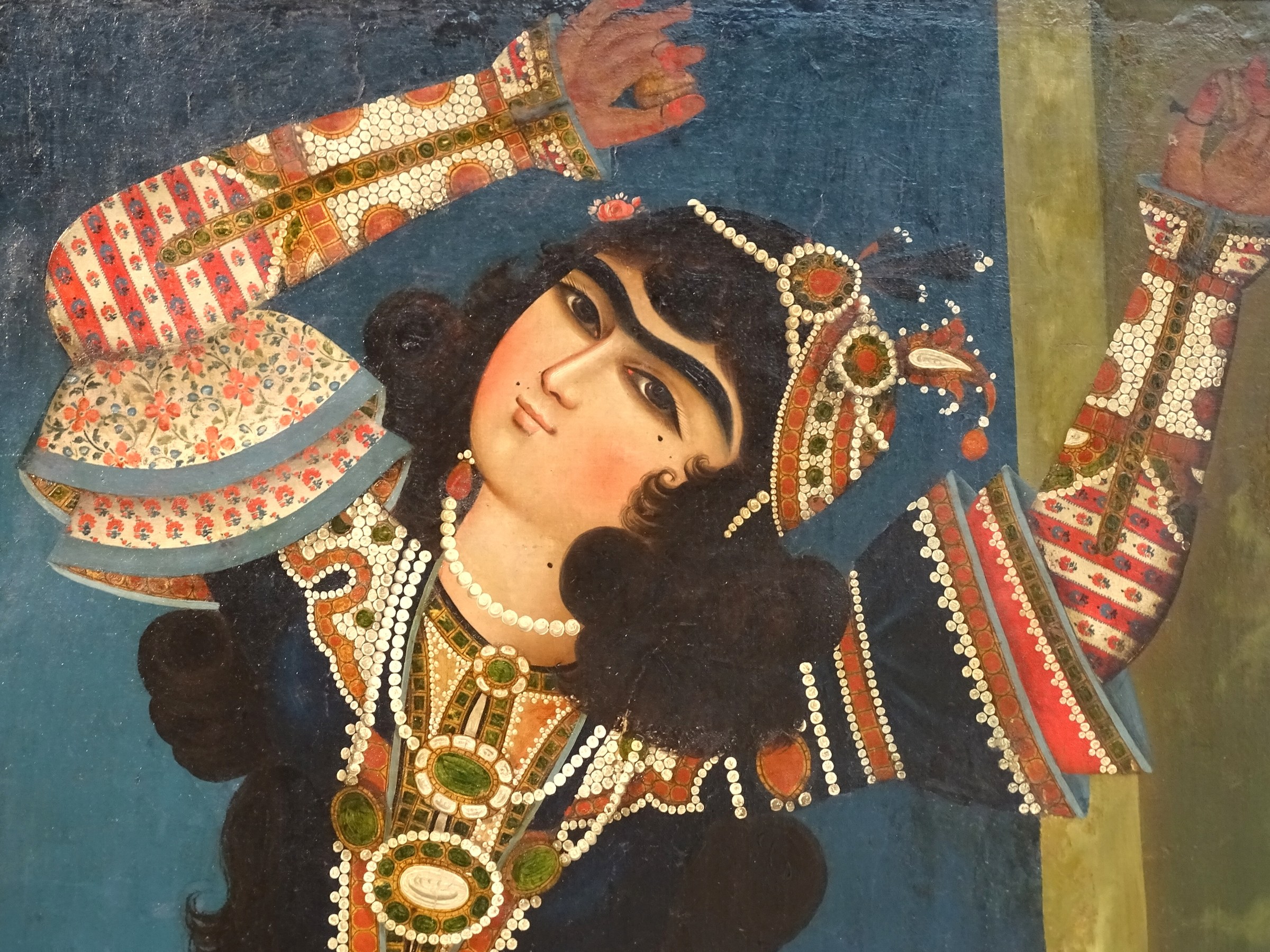
Dancer with Castanets - Late 18th-Early 19th Century Persian Painting Museum of Georgia - Tbilisi - Georgia (18899050625)
Adam Jones from Kelowna, BC, Canada
- Source:
- Wikimedia Commons
- Rights:
- Reusable with conditions: credit the creator; share any adaptation under the same license. Source record ↗
- Recorded as:
- cc by-sa 2.0
This painting is one of the few surviving visual records of Persian courtly dance from this period. It shows that the performer — and by extension, dance as an art form — was considered worthy of formal artistic commemoration at the highest social level. For historians of dance outside the Western tradition, it provides concrete evidence of the costume conventions, the use of hand percussion, the quality of posture, and the relationship between decorative adornment and movement that characterized elite Persian performance.
What you are looking at
A single figure occupies the composition against a deep teal background, shown in three-quarter view with the head tilted slightly back. The dancer wears an elaborate costume of Persian or Central Asian style: a high, intricately patterned headdress in cream with red geometric designs; a dark garment (possibly velvet) forming the bodice; and multiple overlapping robes or wraps of patterned fabric in cream, red, and gold with fine floral or geometric repeating motifs. Pearl and jeweled ornaments cascade down the front — multiple strands of pearls, circular gems set in gold bezels, and ornamental plaques. The arms are raised in a graceful arc, the upper arm draped in patterned fabric and the forearm adorned with more jeweled ornament. The left hand (visible in profile) holds or gestures toward what appears to be a castanet or similar percussion instrument. The pose suggests a moment of movement — the body slightly twisted, the head held back as if in the arc of a turn or a moment of expressive gesture. A green pillar or architectural element frames the right edge. The painting shows age and wear, with visible cracking and discoloration consistent with 18th-century oil on canvas.
The dancing
The dancer's posture shows classical training in the use of the upper body: the arms are held high and open, the shoulders engaged, the spine extended. The head position — tilted back and to the side — suggests either a preparatory moment before turning or the freeze-frame of a spinning motion. The weight appears grounded in the lower body, while the upper torso and arms express an upward, outward reach. The fingers of the visible hand are extended and articulate. One hand clearly holds a castanet, suggesting the dance incorporates hand percussion and the characteristic sharp accent rhythms associated with castanets.
The dance depicted
This image almost certainly depicts a Persian court dancer of the late 18th or early 19th century, though the title's reference to castanets is puzzling — castanets are primarily associated with Spanish flamenco and are not a known feature of classical Persian dance. The costume and jeweled ornamentation point instead to the classical Persian tradition of courtly movement, which valued elaborate dress, controlled upper-body articulation, and refined hand gestures. The dancer's controlled posture and the formality of the composition suggest a trained performer in an elite context. The artist has chosen to freeze a moment of expressive stillness rather than extreme movement — a choice consistent with Persian dance aesthetics, where beauty often resides in the sustained arm line and the relationship between body and ornament rather than in traveling or jumping.
How it was made
This is a painting in oil on canvas, executed in a style that combines Persian miniature-painting traditions with the conventions of European oil portraiture — a hybrid approach common in 18th-century court art from the Caucasus and Persia. The jewels and gold ornaments are rendered with fine linear detail and often appear to be applied with a layering technique that gives them dimensional presence. The background is a clear, flat color that allows the complex patterning of the costume to read as a unified composition. The painting shows the craquelure (fine cracking) and discoloration typical of museum pieces of this age, indicating it has been preserved as a valued object.
About this work
This is a formal portrait of a solo dancer in late-18th-century Persian court dress, likely commissioned to document a performer of note or to record the costume and aesthetic conventions of elite courtly dance. The work combines the refined figural style of Persian court painting with the scale and permanence of European oil portraiture, suggesting it was created for a patron of high status — possibly a court or a collector with access to both Persian and European artistic traditions. The painting circulates through museum collections and digital archives as an example of how dance was documented in non-Western court cultures, and specifically how the elaborate costume and jeweled ornament were integral to the artistic identity of the performer.
The work belongs in a dance history collection because it captures not just a pose but an entire system of meaning: the relationship between movement, adornment, social status, and aesthetic value in a specific historical court. It is a rare visual record of how a trained Persian dancer moved and presented herself to her audience.
How to look at it
Observe the moment the artist chose: not a leap or a rapid turn, but a held, expressive pause — the body weight grounded and the upper body engaged in what feels like a sustained reach or a moment of turning. Notice how the costume is not passive drapery but an active part of the composition: the patterns and jewels structure the silhouette and guide the eye. Look at the hands — one grasps a castanet, the other is open and articulate — and consider how the dancer's control of the hands and arms differs from contemporary European dance, where the legs and torso are dominant. The artist has rendered the face serene and somewhat distant, suggesting that the beauty of the performance lies not in facial expression but in the poise of the whole figure.
The artist
The catalogue lists the current image as photographed by Adam Jones from Kelowna in 2015 from the Museum of Georgia in Tbilisi. This is metadata about the digital image, not the original artist. The painting itself is attributed only to "Late 18th-Early 19th Century Persian." The style suggests training in Persian court painting traditions, but without signature or documented provenance, the original artist remains unknown. The work was at some point acquired by or transferred to the Museum of Georgia, suggesting a complex history of imperial collecting or cultural exchange between the Persian and Russian empires during the 19th century.
The period
In the late 18th century, Persian courtly dance was undergoing change due to political upheaval — the Safavid dynasty had ended in 1722, and the subsequent decades saw regional fragmentation and the rise of new dynasties seeking to consolidate power through cultural patronage. Court painters in this period often documented the elite entertainments and performers who served the ruler's image. Simultaneously, European oil painting was becoming a status symbol even in non-Western courts, leading to hybrid artistic approaches like this one. In Europe at the same moment, dance was becoming increasingly codified (ballet technique was being systematized) and increasingly documented in prints and paintings, but courtly dance in Persia and the surrounding regions followed different aesthetic and technical principles, centered on grace, restraint, and the marriage of costume to movement.
Where it lives
The painting is held by the Museum of Georgia in Tbilisi. This institution holds one of the largest collections of Persian and Caucasian art from the pre-modern period, many pieces acquired through imperial Russian collecting. The painting entered public knowledge through its documentation in museum databases and circulation as a digital image on Wikimedia Commons.
Dance in this work
Questions about this work
Why does a Persian painting show someone with castanets?
Castanets are primarily associated with Spanish flamenco, and there is no documented tradition of their use in classical Persian dance. This may be an error in the English-language title applied later by a curator or cataloguer unfamiliar with Persian performance traditions. It is also possible that the instrument depicted is not a castanet but a different hand percussion device — the image quality and distance make exact identification difficult. Finally, in the 18th century, some court performances may have incorporated musical instruments from other regions due to trade and cultural exchange.
How do we know this person was actually a dancer?
The title records her as a dancer, and the castanet (or similar hand percussion) supports this. However, the formal pose and the portrait convention suggest she may also have been a notable performer whose likeness was worth documenting — which would have granted her unusual social visibility. The elaborate costume and jewels indicate she was wealthy or patronized by someone wealthy, which was typical for elite court entertainers in Persian society.
What can we learn from the costume about how she danced?
The weight of the jeweled ornament and the construction of the headdress suggest the dancer needed a strong neck, upper back, and core to move without losing control. The pattern and layering of the garments allow for upper-body articulation and hand visibility while constraining the legs — implying the dance prioritized arm, hand, and torso movement over footwork. The open hand position and the precision required to articulate the fingers suggest hand gesture was a key expressive tool.
Is this a portrait or a genre scene?
It is a formal portrait of an individual dancer in professional dress, not a genre scene of an unnamed performance. The scale, the three-quarter pose, the direct engagement of the viewer's eye, and the careful documentation of costume all follow portrait conventions. At the same time, it documents a specific moment of movement and a specific dance tradition, which makes it both portraiture and a record of dance practice.
More dance artwork





