49 works in this view — arrow keys or swipe to move between them.
Dance in Art
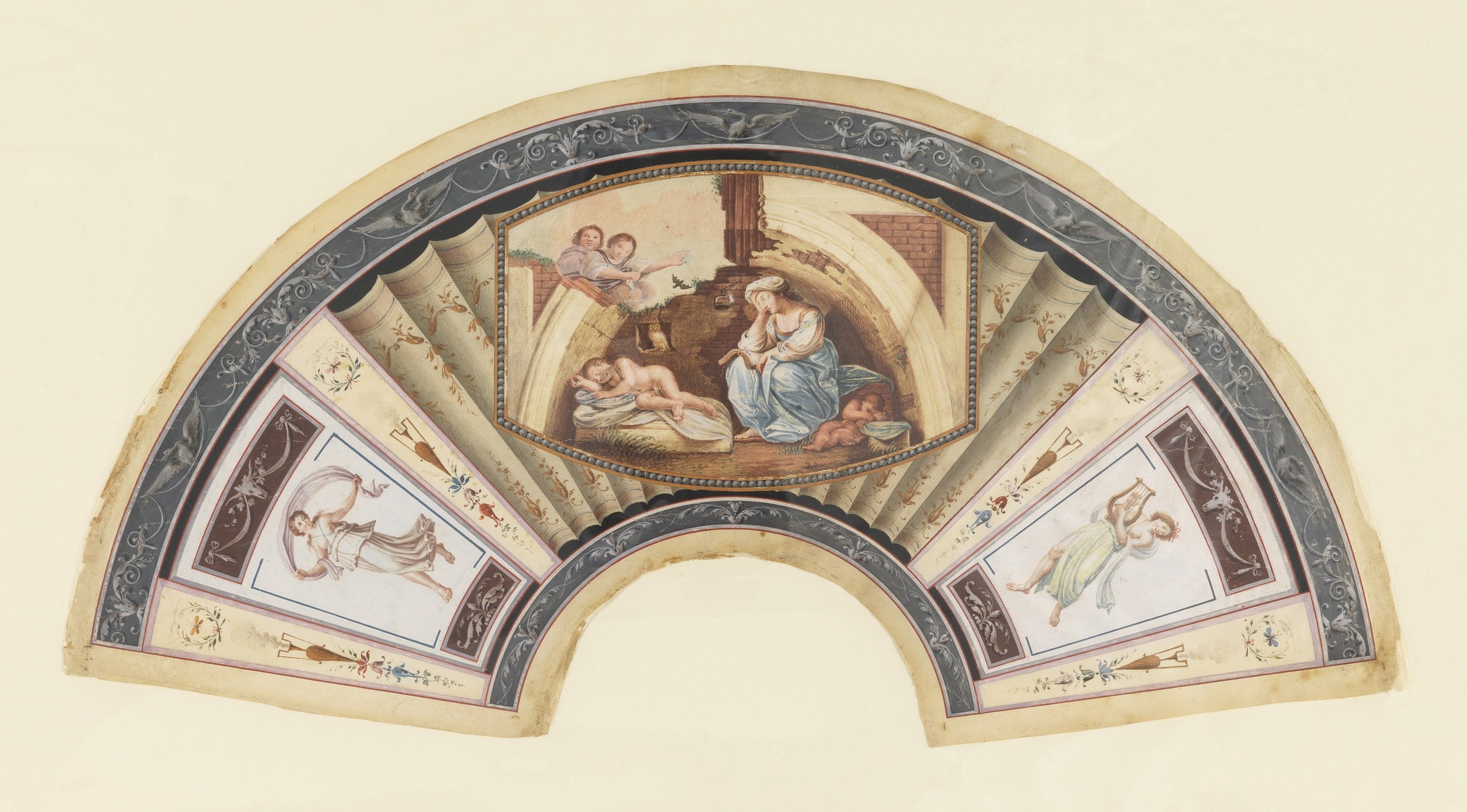
Fan Leaf, late 18th century
Unknown artistUnknown artist
- Source:
- Wikimedia Commons
- Rights:
- Public domain — free to use, share and adapt.
- Recorded as:
- public_domain
The dancing figures on this fan demonstrate how extensively neoclassical visual culture was shaped by Pompeian archaeology, creating a fantasy of ancient dance that never existed but became the template for aesthetic refinement across the 18th-century minor arts. For historians of dance imagery, the work illustrates the gap between painted classical allusion and actual dance practice—what contemporary dancers were doing in 1780–1800 is largely absent from such objects, which preferred timeless allegorical figures to the messy specificity of living choreography.
What you are looking at
A late eighteenth-century fan leaf painted in neoclassical style, rendered on parchment in a delicate palette of pinks, creams, and browns. The composition is organized as a semi-circular architectural space with a deep frieze border in grisaille depicting swans among swags. The interior is divided into three illusionistic chambers created by trompe-l'oeil pleats in the parchment itself—folds that appear to cast real shadows. The central oval panel shows a woman in a blue drapery tending to a sleeping male infant, with a second child visible above; this tender domestic scene sits within a bead-molded arch. Flanking this on either side are smaller rectangular panels depicting solo dancing figures in the style of Pompeian or Roman frescoes, posed against cream backgrounds beneath ornamental bull skulls and fabric swags. The entire composition uses the fan's crescent shape to suggest the curve of an apse or interior dome.
The dancing
The two dancing figures at the flanks are rendered in the attenuated silhouette style of Roman fresco painting: one reaches upward with one arm extended, the other holds a similar pose. Their limbs are elongated and delicate; they wear classical drapery that clings to the body. The stance suggests a moment of lyrical, weightless movement rather than grounded balletic technique—the figures appear to float within their framed spaces. The central nurturing figure is static and grounded, creating compositional contrast with the lateral dancers.
The dance depicted
The flanking figures represent Terpsichore or generic classical dancers in the Pompeian style that became fashionable in neoclassical design following the rediscovery of Herculaneum and Pompeii in the 1740s–1760s. These are not performers executing a specific historical dance form, but rather idealized allegorical or decorative figures meant to evoke antique grace and refinement. The extended arm, uplifted posture, and floating drapery suggest an imagined classical dance vocabulary rather than any contemporary 18th-century dance practice. This is ornamental classicism applied to a functional luxury object.
How it was made
The work is painted in gouache or watercolor on parchment, a technique that allowed for fine detail and transparency while maintaining the delicate, luminous quality essential to fan leaves. The use of trompe-l'oeil pleating—painting shadows to suggest three-dimensional folds in the parchment itself—demonstrates skilled illusionistic technique and knowledge of perspective. Fan leaves were luxury commodities, often created by professional workshops and distributed through fashionable society; the refined execution and neoclassical subject matter indicate this was a high-quality commissioned or workshop piece intended for an elite clientele. The fragile medium and portable format meant such fans were viewed intimately in social and domestic settings.
About this work
This is a decorative fan leaf from the late 18th century, painted in the neoclassical taste that dominated European design and the minor arts following the excavation of Pompeii. The central composition celebrates maternal care and domestic virtue, while the flanking dancers invoke an imagined antique world of grace and refinement. Rather than documenting contemporary dance practice, the work uses classical allusion to elevate the humble fan into a miniature art object worthy of display in an enlightened household. The painted dancers are quotations from an imagined Pompeian vocabulary, not portraits of living movement.
How to look at it
Observe how the artist created spatial illusion on a flat, curved surface: the shadows painted along the pleats convince the eye that the parchment itself is three-dimensional, and the oval frame around the central figures suggests architectural recession. Notice the stylistic break between the static, realistically rendered mother and child at the center and the attenuated, ethereal classical dancers at the flanks—this is intentional, marking a shift from contemporary bourgeois virtue to timeless allegorical fantasy. The bull skulls and fabric swags that frame the dancers are direct visual quotes from Pompeian frescoes and Renaissance art, signaling to an educated viewer that these figures belong to an imagined antiquity rather than the present moment.
The period
The late 18th century witnessed an explosion of neoclassical taste across Europe following the mid-century excavations of Herculaneum (1738) and Pompeii (1748). Publications of engraved Pompeian designs by artists such as the Abbé Sant'Angelo circulated widely, and the newly visible fresco paintings of classical antiquity became a model for contemporary decorative arts. Fan leaves were a particularly favored vehicle for such imagery, as their small scale and intimate viewing context made them ideal for displaying refined taste and knowledge of antique forms. At the same time, ballet was undergoing its own neoclassical reformation under choreographers like Noverre and later Vigano, who similarly looked to antique sources for authority and elegance—yet the visual culture of fans and decorative arts, and the actual practice of staged dance, proceeded largely in parallel, each with its own classical reference and its own reality.
Where it lives
The object is documented as a fan leaf from the late 18th century, held in a collection accessible through Wikimedia Commons. No holding institution, accession number, or provenance chain is recorded. Fan leaves of this type were typically mounted on wooden or ivory sticks and blades; this image shows only the painted leaf itself, divorced from its functional mount.
Questions about this work
Are these real classical dances, or is the artist making them up?
Both, in a sense. The poses and drapery style are drawn from actual Pompeian frescoes and other Roman sources visible in contemporary engravings. But the Romans themselves did not have a codified 'classical dance' in the way the 18th century imagined it. What you are seeing is a neoclassical fantasy—a conversation between contemporary taste and ancient fragments, mediated by engraving and educated imagination. It tells us more about 1780 than it does about Rome.
Why would someone paint a fan with dancers rather than fashion plates or flowers?
Fans were not merely functional objects; for affluent women, they were displays of taste, education, and social position. A fan painted with classical allegorical figures signaled knowledge of antique culture and sympathy with the refined aesthetic of neoclassicism. The dancing figure, ethereal and timeless, was a particularly elegant emblem of grace and refinement—qualities every educated woman was expected to cultivate.
What is the woman with the children doing in the center?
She appears to be watching over sleeping infants, a scene that celebrates maternal virtue and domestic tenderness. This imagery became extremely popular in the late 18th century as bourgeois ideology placed the virtuous mother at the heart of family life and national virtue. The contrast between this contemporary domestic scene and the classicizing dancers on either side suggests a hierarchy of meaning: domesticity in the present, timeless beauty in the realm of allegory.
More dance artwork





