49 works in this view — arrow keys or swipe to move between them.
Dance in Art
Italian: Il ballettoThe ballettitle QS:P1476,it:"Il balletto"label QS:Lit,"Il balletto"label QS:Len,"The ballet"
Ulisse Caputo
- Source:
- Wikimedia Commons
- Rights:
- Public domain — free to use, share and adapt.
- Recorded as:
- public_domain
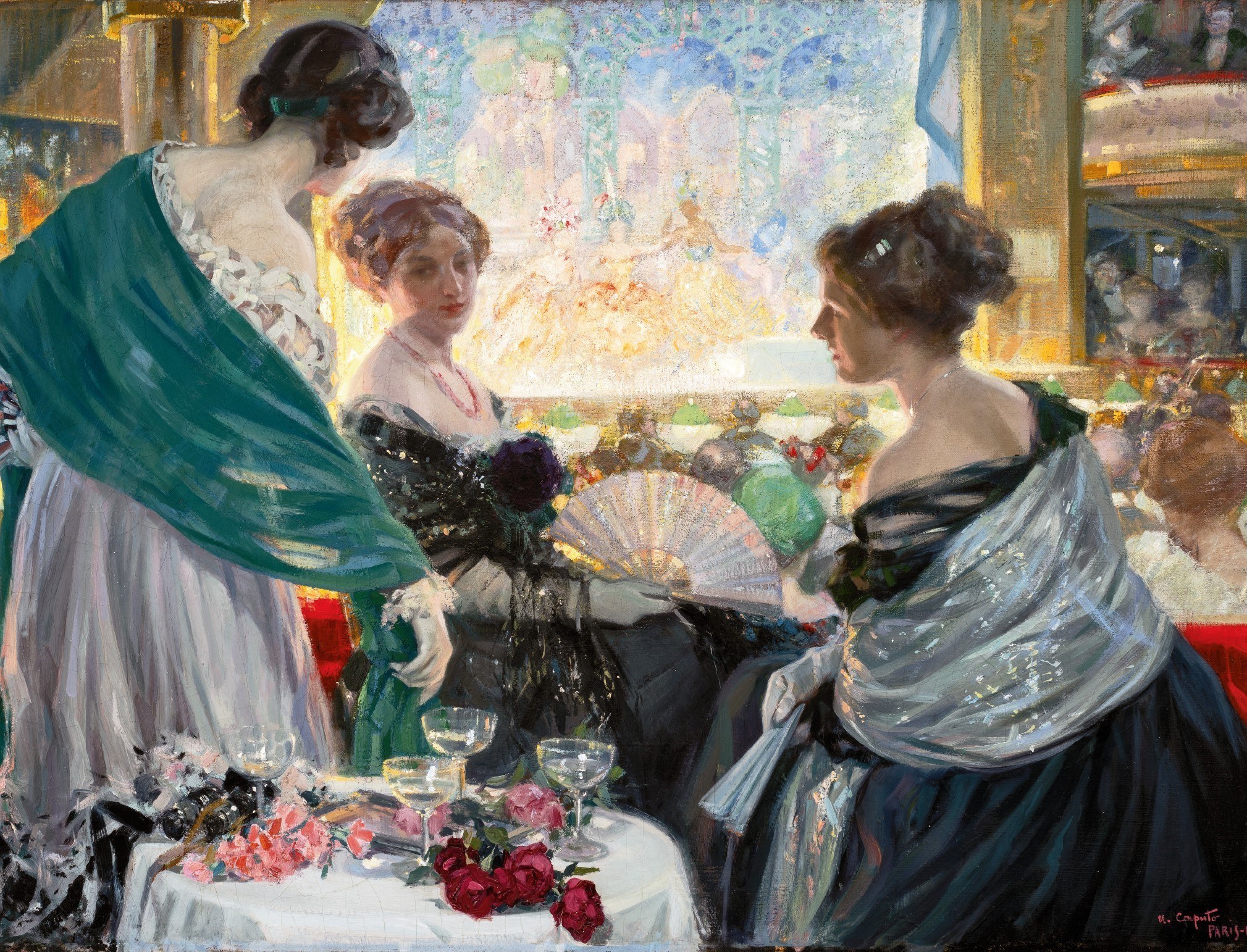
This painting documents the social world of ballet attendance rather than the dance itself—what historians call the 'spectatorial culture' of the period. It reveals that by 1911, attending the ballet was an act of social performance as elaborate as any movement on stage, and shows how women of means used their presence and deportment at such events to signal their cultural position.
What you are looking at
This painting depicts an elegant social gathering at what appears to be a fashionable theatre or ballroom, likely in early 1900s Paris. Three well-dressed women in the foreground are the focus: one seated in a black gown with a decorative fan, and two standing figures—one in pale pink, one in dark blue with a translucent grey shawl. The woman on the left wears a striking emerald-green wrap over a lavender skirt. The composition is suffused with golden afternoon light streaming from tall windows, which illuminates the women's faces and clothing while casting the crowded audience visible in the background into softer focus. Flowers—pink and red carnations—rest on the white tablecloth in the lower left. The scene captures a moment of social conversation and observation: the women are attending rather than performing, though the title and setting invoke the ballet.
The dancing
The three female figures display the poised, upright carriage of well-bred society women of the period. The seated woman holds her fan with practiced elegance, her posture composed and observant. The standing figures lean slightly toward one another in a posture of intimate conversation, their bodies angled to suggest they are discussing what they see before them—possibly the performance or the crowd. None of the women depicted are in dance posture or movement; they are spectators. The artist has captured the refined, constrained bearing expected of fashionable women in a formal social setting.
The dance depicted
The title 'The Ballet' refers not to a dance being performed but to the social event itself—a visit to the theatre or opera-ballet. This is a painting about the audience for ballet rather than a depiction of ballet as a physical practice. The work belongs to a tradition of Impressionist and post-Impressionist art that treated the theatre as a site of modern social life. What we learn about dance from this image is indirect: the ballet represented here is something watched, discussed, and consumed as part of fashionable Parisian leisure. The painting tells us more about who attended ballet and how they presented themselves than about the dance itself.
How it was made
This is an oil painting, recognizable from the luminous, painterly treatment of fabric and light. The technique is characteristically Impressionist in its attention to the effects of natural light—particularly the golden afternoon glow—and its loose, energetic brushwork, especially visible in the background crowd which dissolves into impressionistic dabs and streaks. The medium allowed for the subtle rendering of different textures: the glossy surfaces of fans and jewels, the translucency of silk wraps, the matte surfaces of evening gowns. This technique and the subject matter suggest a work intended for a metropolitan art market rather than popular reproduction.
About this work
This painting captures a moment of fashionable leisure in early 1900s Paris—three elegant women at the ballet, observed in a moment of social engagement rather than dance itself. The work is an example of how late 19th and early 20th-century artists, particularly in France, treated the theatre and its audiences as subjects worthy of serious artistic attention. The 'ballet' of the title is not a stage dance but a social performance: the ritual of being seen, of observing, of maintaining refined composure in a public setting.
Ulisse Caputo's painting belongs to a tradition that includes Degas, Renoir, and other artists fascinated by modern entertainment venues and the social dynamics they generated. For a reader interested in dance history, the work is valuable not as a record of how ballet was choreographed or performed, but as evidence of how ballet functioned as a marker of class, taste, and feminine propriety in Belle Époque society.
How to look at it
The viewer should attend first to the frame and composition: notice how the artist has positioned us as if we are standing near the three women, privy to their conversation but not part of it. The painting asks us to observe the observers. Look at the handling of light—the golden glow that picks out the women's faces and finery—and notice how the background crowd is rendered in looser, less distinct strokes, suggesting that their attention is directed elsewhere, to the stage. The moment chosen is one of social pause: not animated conversation but composed observation. This is a painting about the performance of taste and refinement as much as it is about the event being attended.
The artist
Ulisse Caputo was an Italian painter active in the late 19th and early 20th centuries, known for scenes of fashionable social life, theatrical subjects, and portraits. He worked in the Impressionist and post-Impressionist modes that had become dominant in European art by the 1880s-1910s, and he shared with his contemporaries an interest in modern leisure, entertainment venues, and the psychology of social performance. His work is characterized by luminous color, attention to fabric and artificial light, and a focus on the psychology of the moment rather than historical narrative.
The period
By 1911, when this painting was made, ballet in Paris was undergoing dramatic transformation. The Ballets Russes, founded by Sergei Diaghilev, had premiered two years earlier in 1909, revolutionizing the art form with avant-garde choreography, exotic themes, and modernist design. At the same time, attending the opera-ballet remained one of the defining rituals of high society and bourgeois life. This painting captures the world of the established ballet audience—not the avant-garde enthusiasts but the conventionally fashionable public for whom the ballet was a site of social rather than artistic consumption. In the visual arts, Impressionism and its successors had made the theatre, the café, and the concert hall standard subjects for ambitious painters seeking to represent modern urban life.
Where it lives
The work is documented in Wikimedia Commons. No collection, accession number, or detailed provenance is recorded in the catalogue.
Questions about this work
Is this a painting of a ballet performance?
No. The title refers to the ballet as a social event. The women depicted are members of the audience, not dancers. The painting shows the theatre as a site of fashionable social life rather than documenting choreography or performance technique. This was a common subject for painters in the late 19th and early 20th centuries, who were fascinated by modern leisure and the rituals of public entertainment.
What does this tell us about how ballet was viewed in 1911?
The painting suggests that attending the ballet was as much an act of social performance as what happened on stage. Dress, deportment, and the ability to be observed in the right company were essential to the experience. The work documents a moment when ballet was securely established as an elite cultural institution, before modernist avant-garde movements like the Ballets Russes fundamentally challenged what ballet could be.
Who was Ulisse Caputo?
Caputo was an Italian painter specializing in scenes of fashionable social life and theatrical subjects. He worked in the Impressionist mode, emphasizing light, color, and modern urban leisure. His training and practice placed him firmly within European salon painting traditions, though he adopted many of the technical innovations of Impressionism.
More dance artwork





