49 works in this view — arrow keys or swipe to move between them.
Dance in Art
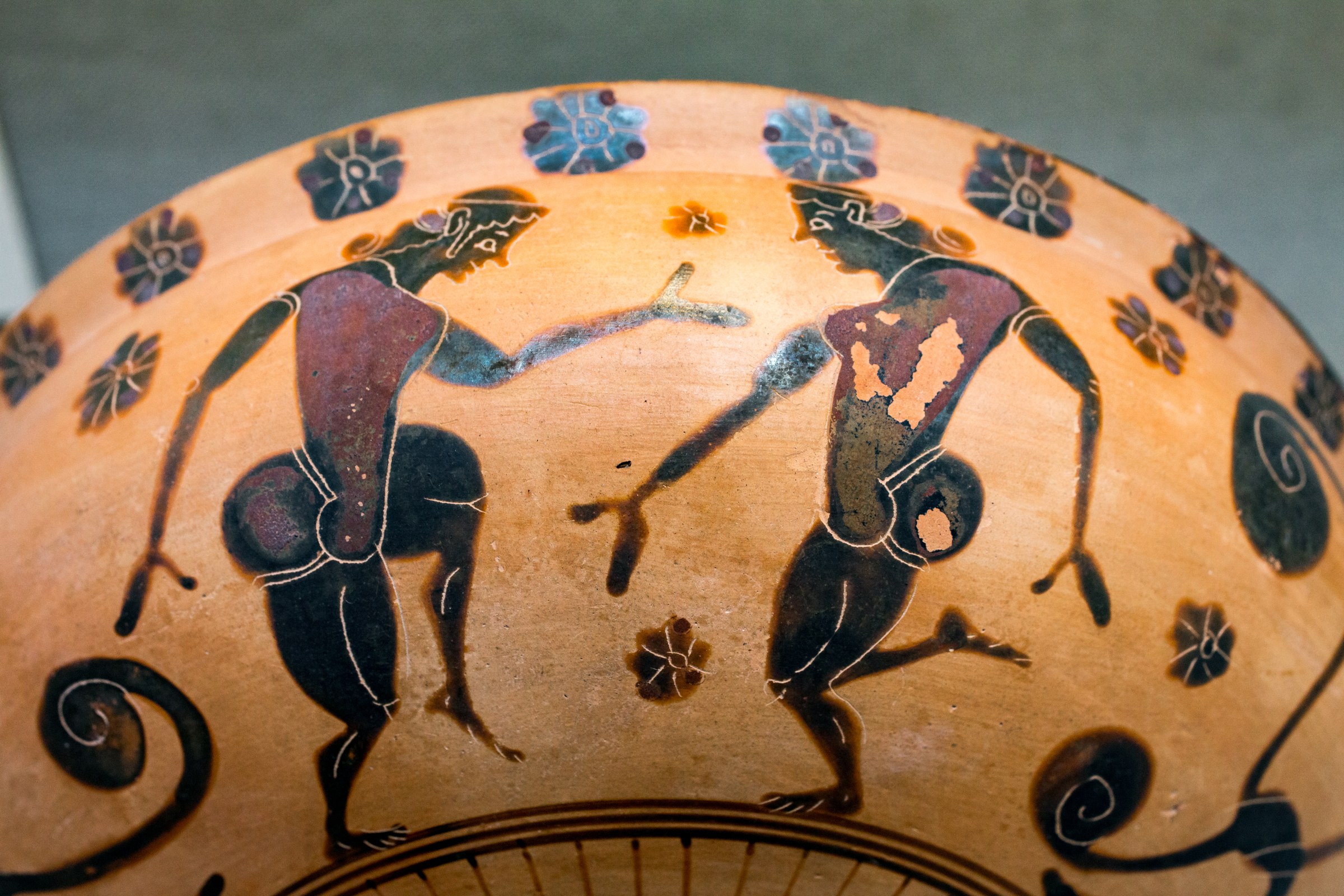
KY Painter - ABV 32 11 - padded dancers - London BM 1920-0216-1 - 02
ArchaiOptix
- Source:
- Wikimedia Commons
- Rights:
- Reusable with conditions: credit the creator; share any adaptation under the same licence. Source record ↗
- Recorded as:
- cc by-sa 4.0
Komast imagery in vase painting is one of our richest sources for understanding Greek attitudes toward the body, comedy, and social performance in the archaic period. This kylix, in particular, preserves a precise record of the costume conventions and gestural vocabulary of komast dancers at a moment when the form was well established. For dance historians, it is evidence of a gendered, social practice that shaped symposial culture and public festivity for centuries.
What you are looking at
This kylix (drinking cup) shows two young male figures in padded costumes facing each other across the interior of the vessel, set against the warm orange-red clay ground. Both wear dark purple-brown padded garments that extend from shoulder to mid-thigh, creating an exaggerated, bulbous silhouette—the characteristic dress of komast dancers. Their legs are thin and bare below the padding, rendered in dark glaze. Between them floats a small golden flower motif. The figures' poses suggest active movement: both lean slightly forward with bent knees, arms raised and extended toward one another in animated gesture. Around the rim runs a band of repeated dark floral or sun-wheel patterns alternating with touches of blue glaze. The whole composition is framed by dark scroll patterns at the base, giving the scene a sense of contained theatrical space. The painting technique is Attic black-figure: dark glaze lines define musculature, costume seams, and anatomical detail against the reserved clay ground.
The dancing
Both figures display the characteristic pose of the komos—a social gathering of young men for revelry and performance. They stand with knees slightly bent in a stance that conveys forward momentum and playful aggression. Their arms are raised and extended, suggesting an exchange of gesture or mock combat. The padding creates a grotesque silhouette that emphasizes the belly and buttocks—a distortion recognizable as comic costume rather than actual physiology. The spare, precise black-figure line work shows the artist's understanding of the body beneath the costume: thin calves and forearms emerge from the padded mass, and the heads remain unpadded and naturalistic, allowing facial features to register expression.
The dance depicted
This is komast dancing, a form of male social performance in archaic and classical Greece, typically associated with symposia (drinking parties) and public festivals. The padded costume is the key identifier: komasts wore these exaggerated suits of thick cloth to create a grotesque, comic effect. The dancers performed satirical mime, acrobatics, and obscene gestures for entertainment and often participated in komos processions through the streets. The painting dates to around 580–570 BCE, placing it in the period when this form was a vibrant and popular social practice, documented extensively in vase painting. The facing, gesturing pose suggests either a competitive exchange or a joint performance—both common formats for komast entertainment.
How it was made
This is a kylix, a shallow two-handled drinking cup, made of clay and decorated in the Attic black-figure technique. The black-figure method—painting with glossy dark glaze on reserved red clay—allowed for fine linear detail and was ideally suited to the precise anatomical and costume information needed here. The interior decoration of a kylix was particularly important, as drinkers would see these images as they tilted the cup. The technique required confident brushwork and planning: errors could not be easily corrected. The artist's ability to render the padded costume convincingly while maintaining legible anatomy suggests a practiced hand working within a well-established tradition of komast imagery.
About this work
This is a document of komast performance in archaic Athens—a window into a form of entertainment that is known to us almost entirely through vase painting. The artist has captured not simply the appearance of komasts but something of their function: the exaggerated padding, the gestural engagement, the mock-aggressive stance all suggest a form of performance that was both comic and participatory. The kylix itself was an object of symposial use, so the decoration served both as entertainment in the moment of drinking and as a reminder of the kind of revelry expected in the symposium setting. The work belongs in a gallery of dance art because komast performance was a recognized and valued form of movement practice, even if it fell outside the realm of formal or competitive athletics.
How to look at it
Look closely at the padding: the artist has rendered it as solid dark form, but with internal lines that suggest the seams and construction of the garment. The contrast between the padded bulk and the thin, naturalistic legs below is deliberately comic—this is costume as disguise and exaggeration. Attend also to the gesture: the arms are raised and extended, the knees bent, the bodies leaning forward. This is not a static pose but a moment of animated exchange. The artist has chosen to show the figures in profile-frontal composite view, a convention of the time that allows both the costume and the gesture to read clearly to a viewer. The small flower between them serves as a spatial divider and fills the composition, a common practice in black-figure painting.
The artist
The work is attributed to the KY Painter, part of the Komast Group, a circle of mid-sixth-century Athenian black-figure painters whose work is organized and identified through systematic study of style and iconography. The Komast Group, as the name suggests, specialized in komast imagery and produced drinking vessels designed for the symposial market. The group's painters were skilled technicians working within a conservative tradition while responding to demand for distinctive imagery. Attribution in archaic Greek vase painting is based on consistency of hand, composition, and subject matter rather than signatures, which were rare.
The period
This kylix dates to the Early Archaic period, ca. 580–570 BCE, a time when Athens was establishing itself as a major ceramic producer and exporter. The sympotic culture that demanded decorated drinking vessels was flourishing, and vase painters responded with specialized imagery tailored to the social context of use. Komast imagery was popular in this period and would remain so through the classical era, but the archaic versions tend to emphasize the grotesque and playful dimensions of the costume. In broader terms, this is a moment when black-figure technique was at its height of technical sophistication, before the red-figure technique would emerge and eventually displace it.
Where it lives
This kylix is held in the British Museum, London (accession 1920,0216.1). It entered the collection in 1920. The object is catalogued in the Beazley Archive Pottery Database, the standard reference work for Athenian black-figure ceramics, and is discussed in Herman Brijder's systematic study of Siana Cups and Komast Cups.
Questions about this work
What does the padding mean?
The padded costume was the distinctive dress of komast performers—exaggerated suits of thick cloth that created a grotesque, bulbous silhouette. The padding emphasized the belly and buttocks, creating a comic, obscene effect. This was not everyday dress but performance costume, and it signaled to viewers that what they were seeing was entertainment, mimicry, and social satire rather than serious athletic or military display.
What were komasts, and where did they perform?
Komasts were young male performers who participated in the komos, a social gathering or procession associated with festivals, symposia, and public celebration in ancient Greece. They performed satirical mime, acrobatics, obscene gestures, and other entertainments for an audience. The komos could be a private affair within a symposium or a public procession through the streets. Komast imagery in vase painting suggests that the form was popular, valued, and widely recognized as entertainment.
Why is this image on the inside of a drinking cup?
A kylix is a shallow, broad drinking cup with handles, and the interior decoration was meant to be seen by the drinker as they held and tilted the cup. The image would appear as the drinker raised the cup, creating a moment of entertainment or contemplation tied to the act of drinking. The symposial context—the drinking party—made komast imagery particularly appropriate: it referenced the kind of social entertainment and revelry that was expected in that setting.
How do we know this is komast dancing and not just two figures?
The padded costume is the definitive marker. Komast padding is consistently represented in Athenian vase painting from the archaic through classical periods, and it is not found in any other context. The exaggerated silhouette, the bulbous padding at the torso, and the thin legs below are unmistakable. The facing, gesturing pose—the animated, forward-leaning stance—is also typical of komast representation and suggests active social performance rather than formal athletic competition.
More dance artwork





