49 works in this view — arrow keys or swipe to move between them.
Dance in Art
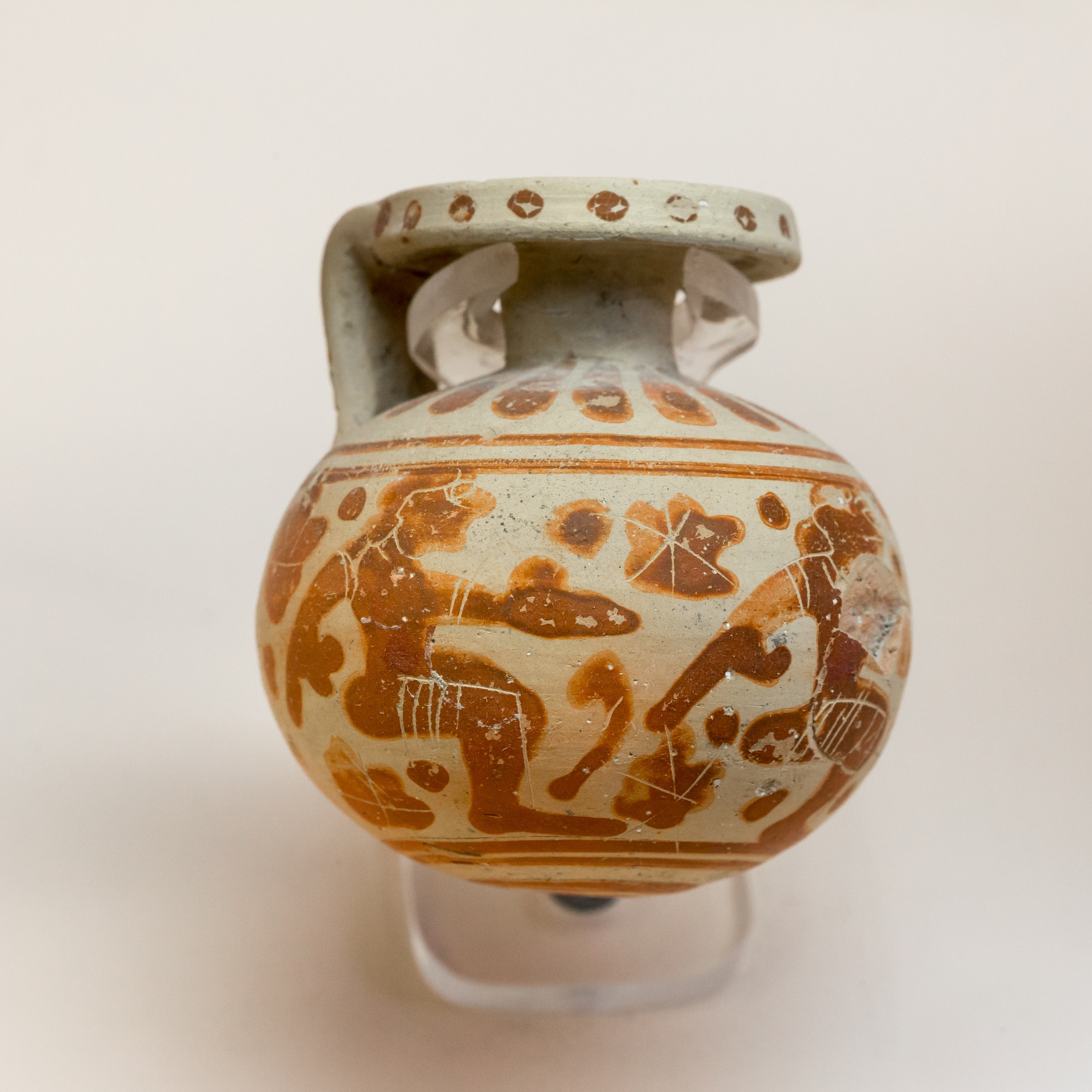
Workshop of the Wellcome Painter - CVPAP 104 C 8 - padded dancers - Rhodos AM 13007
ArchaiOptix
- Source:
- Wikimedia Commons
- Rights:
- Reusable with conditions: credit the creator; share any adaptation under the same licence. Source record ↗
- Recorded as:
- cc by-sa 4.0
For dance historians, this aryballos is direct evidence of Greek performance practice in the archaic period—specifically, the appearance, costume, and physical vocabulary of komast dancing, a genre largely lost to the historical record except through images like this. The padded costume was real and visible; the contorted postures tell us something about the physical demands and expressive vocabulary the dancers employed. The presence of multiple overlapping dancers in a single composition also suggests something about the social or ritual context: this was not a solo virtuoso performance but a collective or competitive entertainment in which bodies were displayed and deformed for effect.
What you are looking at
A small globular vessel, barely six centimeters tall, shows a lively scene of padded komasts rendered in the reddish-brown figure-style typical of early Corinthian pottery. The composition wraps around the body of the aryballos in a frieze of overlapping figures, each outlined and filled with the characteristic thick slip that has survived for nearly 2,600 years. The dancers wear heavy padding—visible as parallel lines and blocks of clay—across their torsos and limbs, a costume element that reads as both comic and ceremonial. Their bodies twist and bend in exaggerated postures: some lean backward with one leg extended, others crouch or arch their spines in positions of strain and release. The padded effect makes them look both grotesque and energetic, their limbs appearing stubby and powerful. Smaller leaf-shaped or circular motifs float between the figures in the reserved (unpainted) space, a common Corinthian filler device. The rim and the strap handle are also decorated with a band of geometric pattern—dots or circles arranged in a repeating sequence. The scale is intimate; this is a vessel for holding precious oils, not a storage jar, yet the imagery sprawls across it with confident, vigorous brushwork.
The dancing
The padded dancers occupy the majority of the visible surface, their bodies densely interlocked and overlapping to create depth and movement within the narrow frieze. Each figure shows a distinct posture: some are bent nearly double, others leap or stride with one leg forward and torso tilted. The padding is rendered as thick parallel lines or hatched zones running down the limbs and covering the torso, making the bodies read as stocky and almost puppet-like. There is no closed-hold partnering visible; the dancers appear as solo performers or in loose aggregation, their attention inward to their own exertion rather than outward to each other. The composition suggests simultaneous rather than coordinated movement—each body pursuing its own grotesque contortion.
The dance depicted
This is almost certainly a depiction of komast dancing, the padded, often obscene male dancers who performed at Greek symposia and public festivals from at least the 7th century BC onward. The padding was genuine costume, worn in performance and adopted in early vase-painting as the defining visual marker of the type. Komasts were sometimes professional entertainers, sometimes revelers participating in a ritual or carnival moment; the context could be sacred procession or raucous entertainment or both simultaneously. The exaggerated bodily contortion visible here—the backward arches, the crouching postures, the stretched limbs—suggests acrobatic or gymnastic skill combined with deliberate comic distortion. No musical instrument is visible, but such figures typically performed to pipes or lyre. The padded costume itself may have had ritualistic significance, possibly connected to fertility rites or the worship of Dionysus, though the exact meaning remains contested.
How it was made
This is a black-figure aryballos, a type of small perfume or oil vessel made by hand in a Corinthian pottery workshop around 620–590 BC. The technique involves painting the figure silhouettes in a thick, glossy slip onto the reserved (unpainted) pale clay body, then incising fine details—such as the padding lines—into the slip with a sharp tool before firing. The small scale and portable size suggest this was a luxury object, likely a precious container or perhaps a gift or prize. Early Corinthian black-figure ware was among the most technically accomplished pottery of the archaic period and was exported throughout the Mediterranean, so this vessel's presence in a tomb in Rhodes (ancient Kameiros) indicates either trade or travel. The strap handle shows the potter's concern for structural logic and usability even as the decoration served a narrative and entertaining purpose.
About this work
This tiny vessel captures the Greek padded dancer, or komast, at the moment of peak exertion and grotesque contortion—a figure type that appeared in Greek visual culture from at least the early 7th century BC. The Corinthian potter has compressed multiple komasts into the narrow frieze around the body, each rendered in the dense, linear style of early black-figure technique, their padding represented as hatched zones across torso and limbs. The work belongs to the workshop tradition of the Wellcome Painter or his circle, a group known for lively genre scenes on small vessels. It survives as evidence of what Greek audiences found amusing and worth commemorating in pottery: the grotesque body, physical skill, and the ritual or festival contexts in which such performers operated.
How to look at it
Attend first to the padding: the hatched or parallel-line zones that cover the dancers' bodies are not mere artistic shorthand but a record of actual costume. The painter has chosen to show the dancers mid-gesture, bodies arched or twisted to maximum effect—this is the moment of exertion and distortion, not a moment of repose or grace. Note how the overlapping and interlocking of figures creates a sense of crowded, simultaneous action rather than a composed tableau. The reserved geometric ornament between the dancers (the leaf or dot motifs) was a common Corinthian convention for filling space, but it also has the effect of making the dancers appear to stand out as the primary visual subject. The scale of the vessel means you are looking at something intimate and precious, yet the scene depicted is raucous and populist—a deliberate contrast between the object's luxury and its content.
The artist
The Wellcome Painter and his workshop were active in Corinth during the Early Corinthian period (circa 640–590 BC) and are known for prolific production of small vessels decorated with figural scenes—often komasts, symposium scenes, animal friezes, and other genre or mythological subjects. The workshop was highly productive and commercially oriented; their wares appear in quantities in tombs and sanctuaries across the Mediterranean. The Wellcome Painter's hand is recognized through repetition of figure types, proportions, and decorative formulas. The workshop represents a moment when Corinthian pottery was at the height of its international market dominance, before Athenian black-figure production overtook it in the 6th century.
The period
The Early Corinthian period (circa 640–590 BC) was the heyday of Greek archaic pottery as a medium for narrative and genre scenes. This is the era in which the black-figure technique was perfected and before it became primarily Athenian. Padded dancers (komasts) appear repeatedly in Corinthian vase-painting from the 7th century onward, suggesting they were a familiar, comic, and culturally significant performance type. In the wider cultural context, this was the period of the Archaic Greek city-state, the stabilization of the polis, the development of athletic and religious festivals, and early contact with the Near East and Egypt. The symposium—the male drinking party where such entertainment often occurred—was becoming codified as a social institution. Padded dancers appear in vase imagery more frequently in Corinthian work than in later Athenian black-figure, suggesting a particular Corinthian interest in comic and grotesque performance.
Where it lives
The vessel was found in tomb 178 at Macri Langoni in Kameiros, Rhodes (ancient Kameiros), where it was catalogued by Giulio Jacopi's expedition in 1931. It is now held by the Archaeological Museum of Rhodes, catalogue number 13007. The fact that it was deposited as grave goods indicates its value as a precious object worthy of accompanying the deceased, despite—or perhaps because of—its frivolous subject matter.
Dance in this work
Questions about this work
What is the padding on these dancers?
The padding was genuine costume worn in performance, not artistic invention. Male komasts wore padded costumes that made their bodies appear grotesquely enlarged, particularly around the belly and genitals. The padding served comic, ritual, and possibly apotropaic (protective) purposes. The Corinthian potter has rendered this padding as parallel incised lines or hatched zones, a visual shorthand that was instantly recognizable to the ancient Greek viewer.
Where did komasts perform?
Komasts performed in multiple contexts: at symposia (elite male drinking parties), at public festivals and processions, possibly at religious rituals connected to Dionysus or fertility cults, and at street celebrations and carnivals. They appear to have occupied a liminal social space—sometimes professional performers, sometimes amateur revelers. The exact social status and meaning of the performance varied by context and time period.
Why is this vessel so small?
This is an aryballos, a perfume or precious oil container, typically held in the hand or suspended from a cord. The small size made it portable and high-value; small vessels required more skill to throw and were often more expensive relative to their volume than large storage jars. The juxtaposition of a luxury object with comic subject matter suggests the owner had a taste for sophisticated, playful design.
What does the incised detail tell us?
The incised lines (visible as thin grooves cut into the clay slip after painting) show not only the padding on the dancers' costumes but also anatomical details like muscles, ribs, and genitals. This technique, called incision or graffito, was the primary way Corinthian potters added precision and visual richness to black-figure decoration. It allowed them to convey both grotesque distortion and actual anatomical knowledge in the same image.
More dance artwork





