49 works in this view — arrow keys or swipe to move between them.
Dance in Art
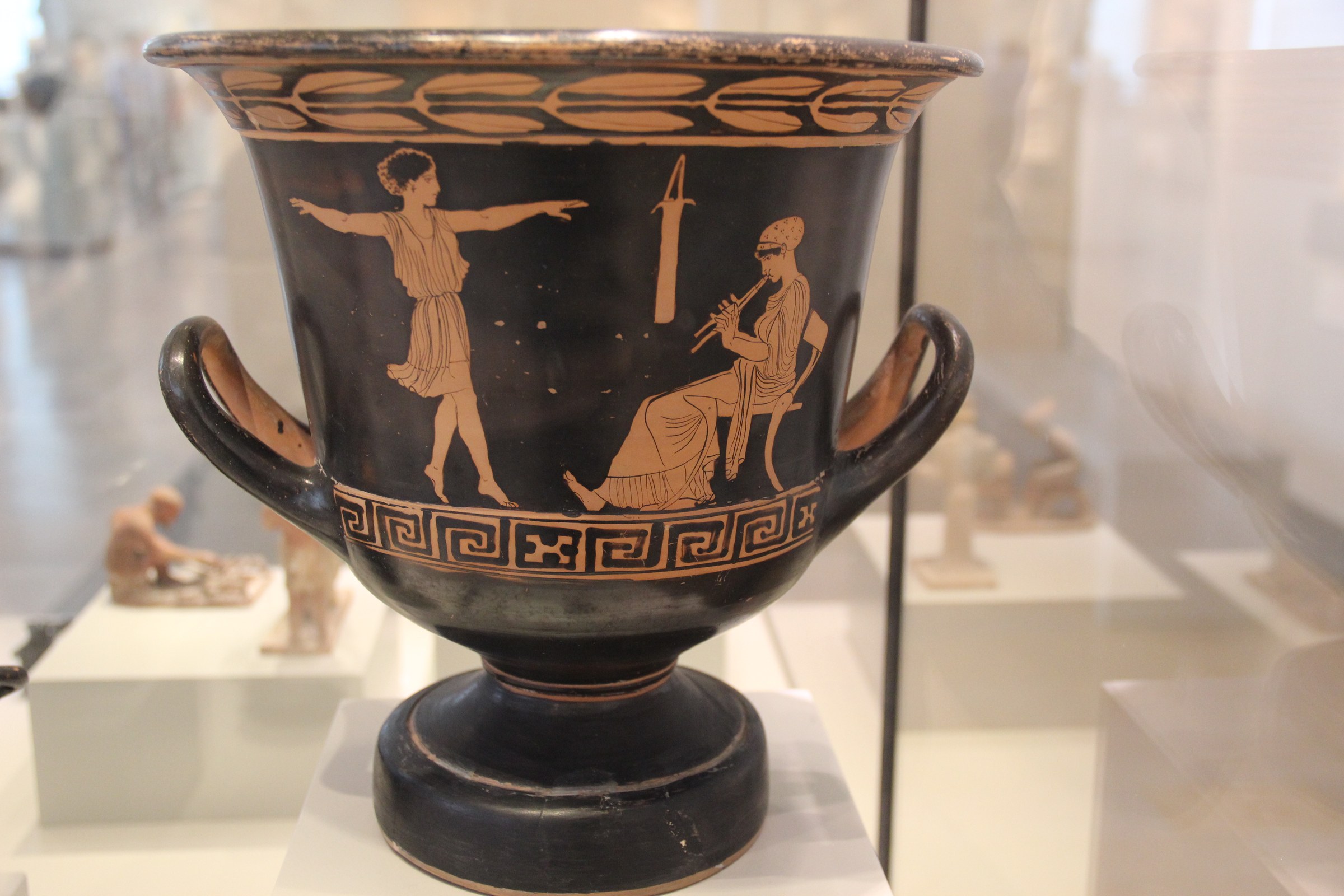
Greek Red-figure Ceramic Calyx Crater Girl in dance class; Berlin Dancers painter, 440-430 BC (28454178810)
Gary Todd from Xinzheng, China
- Source:
- Wikimedia Commons
- Rights:
- Public domain — free to use, share and adapt.
- Recorded as:
- cc0
This object provides rare visual evidence of how music and movement were taught and practiced in classical Athens, outside the formal theater. For dance historians, red-figure pottery is one of the few surviving sources that show actual bodies in motion and reveal the relationship between musicians and movers in intimate settings. The gestural vocabulary and spatial arrangement suggest pedagogical practices and social conventions that shaped later western dance traditions.
What you are looking at
A black-figure ceramic calyx crater shows an interior domestic or pedagogical scene rendered in the red-figure technique, with two figures flanking a central altar or pillar. On the left, a young male figure stands with one arm raised and extended outward in an open, expansive gesture, wearing a short chiton (tunic) that falls to mid-thigh. On the right sits an older bearded man in a longer himation (draped cloak), holding what appears to be a double flute (aulos), his posture upright but settled. Between them stands a tall cylindrical object, likely an altar or herm. The composition is framed by an elaborate meander pattern (Greek key) in the register below, and the vessel's rim shows a continuous interlocking wave or leaf pattern. The red-orange clay figures stand in high contrast against the lustrous black glaze. The scene is intimate and enclosed, suggesting instruction, performance, or worship—possibly a music or dance lesson given the presence of the flute-player.
The dancing
The standing youth's posture is notably open and outward-facing, with the raised arm suggesting an invitation, demonstration, or moment of uninhibited movement. His weight appears evenly distributed, and his body is in a state of extension rather than tension. The seated musician maintains formal posture, framed by his instrument, which he holds at the ready—a visual reference to accompaniment. The two figures create a clear spatial and hierarchical relationship: the youth performs or displays, the elder observes and provides music. The gesture language is gestural rather than formally postured, suggesting pedagogy or spontaneous display rather than a codified dance form.
The dance depicted
This is most likely a scene of Greek music instruction or domestic paideia (education), possibly depicting a young man being trained in mousike (the arts combining music, poetry, and dance) under the guidance of a music master or pedagogue. The aulos was the standard accompaniment for both choral performance and social dance in classical Athens. The raised arm and open posture of the youth suggest a moment of instruction, rehearsal, or informal performance—not a formal theatrical dance, but rather the kind of improvised or demonstrative movement that would accompany musical training. Whether this depicts actual choreographed dance or the embodied response to music is ambiguous; Greek red-figure pottery frequently collapses these categories. The scene likely represents the symposium (elite male gathering) world or the gymnasium, where music and movement were inseparable.
How it was made
This is a red-figure ceramic vessel, a technique in which the decoration is reserved in the red clay body and the background filled with black glaze, allowing for finer linear detail than the earlier black-figure style. The calyx crater form—a large mixing bowl with handles and a flared, cup-like rim—was used for mixing wine and water at symposia. Red-figure technique emerged in Athens around 530 BCE and dominated until the late classical period; it allowed painters to render anatomy, drapery, and gesture with considerably more naturalism and precision than black-figure work. The technique's fineness made it suitable for domestic elite audiences and for vessels intended for display as well as use. The presence of Greek inscriptions or potters' signatures on such vessels (though none are visible in this image) indicates both an emerging sense of artistic authorship and a market of educated consumers who valued recognizable hands.
About this work
This is a Greek red-figure calyx crater, likely from the mid-5th century BCE, depicting a scene of musical and physical instruction set in the aristocratic world of classical Athens. The vessel shows a young student or performer in an open, expansive stance facing a bearded musician playing the aulos (double flute), with an altar or herm standing between them. The scene is rendered with the refined line-work and naturalistic figure representation characteristic of red-figure pottery at its height. It represents not staged theatrical dance but rather the informal, music-driven movement that was integral to elite male education and social performance in ancient Greece. The ceramic form and decoration indicate this was a prestigious object for elite symposium use, both functional and ornamental.
What makes this work significant for dance history is its documentary value: it shows how Greek painters understood and represented the relationship between music, bodily instruction, and performance in their society. The open, gestural quality of the youth's movement suggests a dance vocabulary distinct from both formal theatrical performance and rigid training postures. Red-figure pottery of this period is among the best visual evidence we have for how Greeks actually moved in social and pedagogical contexts, before the distinction between dance, music, and athletic display had hardened into separate categories.
How to look at it
Notice the contrast between the open, weight-forward stance of the young figure and the settled, observational posture of the musician. The painter has captured a moment of instruction or demonstration rather than a climactic movement; the youth's arm extends in a gesture that invites imitation or indicates instruction. The meander pattern framing the scene, a signature of high-quality Athenian work, signals the prestige of the object. The tall central form (altar or herm) acts as a spatial anchor and may indicate a ritual or sacred context for the instruction. Observe how the drapery of the older man's himation is rendered with fine parallel lines that suggest weight and fabric, while the youth's short chiton is simpler, emphasizing the body's outline and gesture.
The artist
The work is attributed to the Berlin Painters workshop (active ca. 480–440 BCE), a major Athenian red-figure pottery studio known for refined figure work and scenes of sympotic (social gathering) life. The workshop produced vessels of considerable prestige and technical refinement, catering to an elite market. The painters and potters working in this tradition were among the first visual artists in the western tradition to achieve something like recognizable individual style and documented reputation.
The period
This vessel dates to the mature classical period of Athens, following the Persian Wars and corresponding to the height of Athenian democratic and cultural achievement. Red-figure pottery was at its technical and artistic peak; it would begin to decline in prestige during the 4th century BCE as panel painting and other media took over elite decoration. The scene reflects a moment in which music, poetry, physical training, and erotic mentorship (pederasty) were all woven into the educational and social fabric of aristocratic male life. The symposium—the male drinking party accompanied by music, poetry, and often dance—was central to Athenian social life and a major subject in red-figure pottery. This work records the domestic and pedagogical side of that world.
Where it lives
The work is held in the Altes Museum, Berlin, part of a major collection of classical Greek pottery. It is documented in the museum's online collection and is representative of the extensive holdings of Athenian red-figure ware in German museum collections, many acquired in the 19th and early 20th centuries. As a calyx crater, it is one of the most prestigious pottery forms and was typically reserved for wealthy households or used in elite symposia.
Questions about this work
Is this a depiction of actual ancient Greek dance?
Partly. The scene shows musical instruction in a domestic or pedagogical context, and the youth's open posture suggests a moment of movement or demonstration. However, this is not a formal dance performance like those on the Greek stage. Rather, it captures the informal, music-driven physicality that was part of elite male education. Greek red-figure pottery conflates dance, music, and bodily training; we cannot always separate them into modern categories.
What is the aulos, and why is it important?
The aulos is a double flute—two reeds played simultaneously—that was the primary instrument for accompanying both singing and dancing in ancient Greece. It was used in theater, religious ritual, the gymnasium, and the symposium. The presence of an aulos player in an image almost always indicates music-making and often movement or dance, making it a key indicator of the scene's content.
What can we learn about ancient Greek dance from pottery?
Red-figure pottery is one of the few visual sources that survives from ancient Greece and shows bodies in action. These images reveal posture, gesture, spatial relationships, and the association of movement with music and social context. They do not show codified choreography, but they give us insight into how Greeks moved in symposia, athletic contests, rituals, and theatrical settings. Pottery imagery must be read carefully and compared across multiple sources.
Who was the intended audience for this vessel?
This calyx crater was made for an elite Athenian household or symposium setting. The high quality and refined figural work indicate it was owned by someone wealthy and educated enough to appreciate the artistic refinement. It functioned both as a practical object for mixing wine and water and as a display piece that demonstrated the owner's cultural status and taste.
More dance artwork





