49 works in this view — arrow keys or swipe to move between them.
Dance in Art
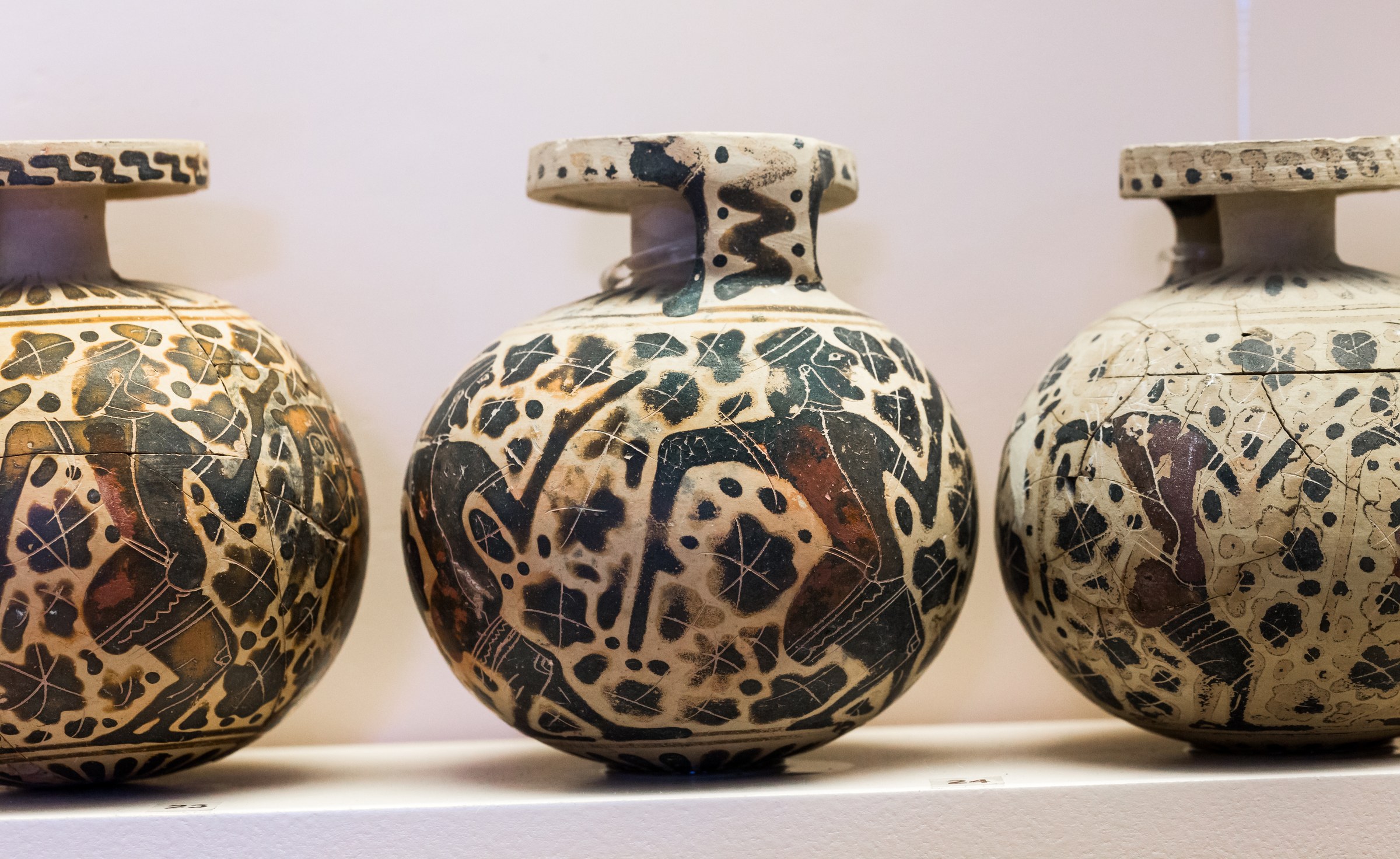
Thirteen Thousand Painter - CVPAP 114 1-3 - padded dancers - Rhodos AM 13004-13006 - 02
ArchaiOptix
- Source:
- Wikimedia Commons
- Rights:
- Reusable with conditions: credit the creator; share any adaptation under the same licence. Source record ↗
- Recorded as:
- cc by-sa 4.0
These vessels are among the earliest detailed visual records of Greek popular performance, documenting the komasts in their characteristic padded costumes. For dance historians, they are rare evidence of a performance genre that left no written description of its actual movement or music, making the visual testimony of the painted figure essential. The objects also exemplify the integration of performance imagery into everyday material culture—these were not special commemorative pieces but functional symposium vessels that circulated widely, suggesting how central komast entertainment was to Greek elite social life.
What you are looking at
Three small ceramic vessels displayed in a museum setting. Each is a globular aryballos with a wide, flared rim and a single vertical loop handle. The vessels are decorated in the black-figure technique typical of Corinthian pottery, with cream-colored clay serving as the ground. The decoration covers the rounded body of each pot with a dense, repeating pattern of figures and ornamental details rendered in black gloss paint. The figures appear to be padded komasts—performers wearing thick costumes or protective padding—engaged in processional or celebratory movement. The bodies are rendered in silhouette with incised details; some figures are shown in profile, others with frontal or three-quarter views. Supplementary white and red pigments have been applied to parts of the design, creating highlights and tonal variation. The patterns include geometric elements—circles, dots, cross-hatching, and linear borders—interspersed with the figured scenes. The vessels are intact but show the wear of age: cracks, surface darkening, and loss of pigment in places. They are photographed against a neutral background under museum lighting that emphasizes the three-dimensionality of the forms and the contrast of the painted decoration.
The dancing
The komasts are rendered as compact, sturdy figures whose bodies are thickened by the padded costumes they wear, which give them a characteristic bulbous silhouette. Their limbs are thin and articulated by incised lines, suggesting movement and gesture despite the small scale. The figures appear to be in motion—some striding, some with raised arms or bent knees—suggesting a procession or collective performance. Several figures appear to face or address one another, suggesting interaction rather than uniform linear movement. The padding costume is the dominant feature of their anatomy, flattening and widening the torso in a way that contrasts sharply with the delicate rendering of the limbs.
The dance depicted
These vessels depict komasts, a category of performer in archaic Greek culture associated with festive processions, particularly those of Dionysian character or symposium entertainment. Komasts were known for coarse, comedic performances and often wore padded costumes—exaggerated, sexually explicit body suits—that created the bulbous silhouettes visible here. The vessels themselves, as small aryballoi, were likely used for perfumed oil in a symposium context, making the iconography of the komasts particularly apt: these were vessels for symposium use decorated with images of symposium entertainment. The scene does not depict formal dance in the classical sense but rather the carnivalesque, improvisational movement of popular performance. The dense, repetitive composition suggests the liveliness and abundance characteristic of komastos imagery from the Corinthian workshops.
How it was made
These are small terracotta vessels hand-thrown and decorated in the black-figure technique, a labor-intensive process in which the design is painted in black gloss paint and details are incised with a sharp tool before firing. The restricted size (8.8–9.5 cm in height) means the painting required fine brushwork and steady hands; the density of ornamental patterning across the entire body suggests a workshop practice of high standardization. The technique was perfected in Corinth in the seventh century BCE and exported widely throughout the Mediterranean. The combination of black-figure painting with supplementary white and red pigment (a technique called the Three-Color technique) demonstrates technical sophistication and suggests these were expensive, valued vessels. Such small aryballoi were often made in series and filled with scented oil for symposium gift-giving, making them items of both practical and social significance.
About this work
These three Corinthian aryballoi from the early archaic period are among the most legible documents of komastos performance in ancient Greece. The komasts—padded performers associated with festive, often ribald entertainment—are rendered with specificity and liveliness by the Thirteen Thousand Painter, a prolific Corinthian workshop artist. The vessels themselves functioned as containers for perfumed oil in the Greek symposium, making their decoration a form of visual pun: the image of festive, comedic performers decorates an object designed for elite male gathering and entertainment. The three vessels shown here, from the same tomb deposit at Kameiros in Rhodes, suggest a set of related dedicatory objects, possibly a funerary gift or inventory of symposium equipment.
The work is significant as evidence of both archaic Greek material culture and the visual documentation of performance genres now lost to written record. The density of komast imagery in Corinthian pottery of this period reflects their popularity as entertainment and as iconographic subjects—their padded costumes, exaggerated gestures, and carnivalesque associations made them ideal for the decorative repertoire of the ceramic workshop. Unlike the formal, mythological figures that dominate later Greek art, the komasts represent the visual recording of lower-status, improvisational, popular performance.
How to look at it
Focus on the silhouettes of individual figures within the dense composition: each komast is characterized by the bulbous padding of the costume, which dominates the visual composition and is rendered in black gloss with delicate incised details for the limbs. Notice how the figures overlap and interweave across the curved surface of the vessel, creating a sense of movement and procession despite the small scale. Observe the supplementary red and white pigments, which were applied selectively to highlight certain areas—often face, neck, or ornamental details—creating tonal variation against the dominant black. The repetitive ornamental patterns (circles, cross-hatching, linear borders) frame and punctuate the figured scenes, following the conventions of the Corinthian workshop. Consider too the physical context: these are small vessels meant to sit in the hand or on a shelf, so the decoration would have been examined closely at hand-distance, not viewed from across a room.
The artist
The Thirteen Thousand Painter is the modern scholarly designation for an extremely prolific Corinthian workshop artist active in the early Corinthian period (roughly 620–590 BCE). The name derives from a numbering system used in the standard Corinthian pottery typology compiled by Darrell Arlynn Amyx, who documented the painter's distinctive style across hundreds of surviving vessels. The painter was one of the Corinthian workshops' most productive artisans, known for a formulaic but energetic approach to decoration, especially the repetitive, densely patterned designs that characterized komastos iconography. The workshop operated within the Corinthian ceramic industry, which dominated Mediterranean trade in the seventh and sixth centuries and established many of the formal conventions of black-figure pottery that later became standard in Athenian production.
The period
The early Corinthian period (c. 625–590 BCE) was the era in which Corinth dominated ceramic export throughout the Mediterranean. This period saw the development and refinement of the black-figure technique and the establishment of a standardized repertoire of decorative motifs and scenes. Komastos imagery was particularly popular in Corinthian pottery of this era; it appears on drinking vessels, perfume containers, and utilitarian ware with remarkable frequency. The komasts themselves were performers embedded in Greek ritual and social life, particularly associated with Dionysian processions (the komos) and with entertainment at the symposium. Visual evidence suggests they were organized, repeated performers rather than spontaneous revelers—their costumes were standardized, their routines recognizable. In the archaeological record, the proliferation of komast imagery in portable, tradeable vessels like these aryballoi suggests that the image of the padded performer had become a symbol of festivity and abundance appealing to Mediterranean audiences far beyond Corinth.
Where it lives
These three vessels (Rhodes Archaeological Museum inv. nos. 13004, 13005, 13006) were excavated from tomb 118 at Kameiros in the Macri Langoni area of Rhodes in the early twentieth century. They are part of the holdings of the Rhodes Archaeological Museum and are documented in the standard corpus of Corinthian vase-painting (CVA Rhodos, 1934) and in Darrell Arlynn Amyx's definitive monograph on Corinthian pottery. They appear to form a set, likely a tomb deposit or funerary gift, and their findspot suggests they were valued objects in the hands of a Rhodes inhabitant of the early Corinthian period.
Dance in this work
Questions about this work
What is a komast?
A komast was a performer in ancient Greek culture, typically associated with festive processions (the komos) and symposium entertainment. They were known for coarse, comedic, often ribald performance and characteristically wore padded costumes that exaggerated the body—a bulbous torso with thin limbs. Komasts performed music, acrobatics, and dialogue, and their entertainment was a standard feature of the Greek symposium (elite male drinking and social gathering).
Why is the costume so padded?
The padding served multiple purposes: it created a visually striking, instantly recognizable silhouette; it could exaggerate and sexualize the body for comic or provocative effect; and it may have provided some protection if the performance involved acrobatics or physical contact. The padded suit became the identifying mark of the komastos in visual representation and was apparently consistent enough across performances that audiences recognized the costume type.
What was an aryballos used for?
An aryballos was a small ceramic vessel designed to contain perfumed oil (often precious, imported oils). They were particularly used in symposium contexts as containers for anointing oil and were common gift items. The small size (these are 8.8–9.5 cm) and the loop handle made them portable and suited to hand use. The fact that komast imagery decorates these functional vessels suggests a visual association between the performer and the symposium context for which the vessel was made.
Who was the Thirteen Thousand Painter?
The Thirteen Thousand Painter is a modern scholarly designation for an extremely prolific Corinthian workshop artist of the early Corinthian period (c. 620–590 BCE). The name derives from a numbering system in Darrell Arlynn Amyx's standard Corinthian pottery typology. The painter is known for a standardized, formulaic decorative style across hundreds of surviving vessels, particularly komast scenes rendered with dense, energetic patterning. The painter was not an individual artist in the modern sense but likely a workshop designation covering multiple hands executing a consistent style over decades.
More dance artwork





