49 works in this view — arrow keys or swipe to move between them.
Dance in Art
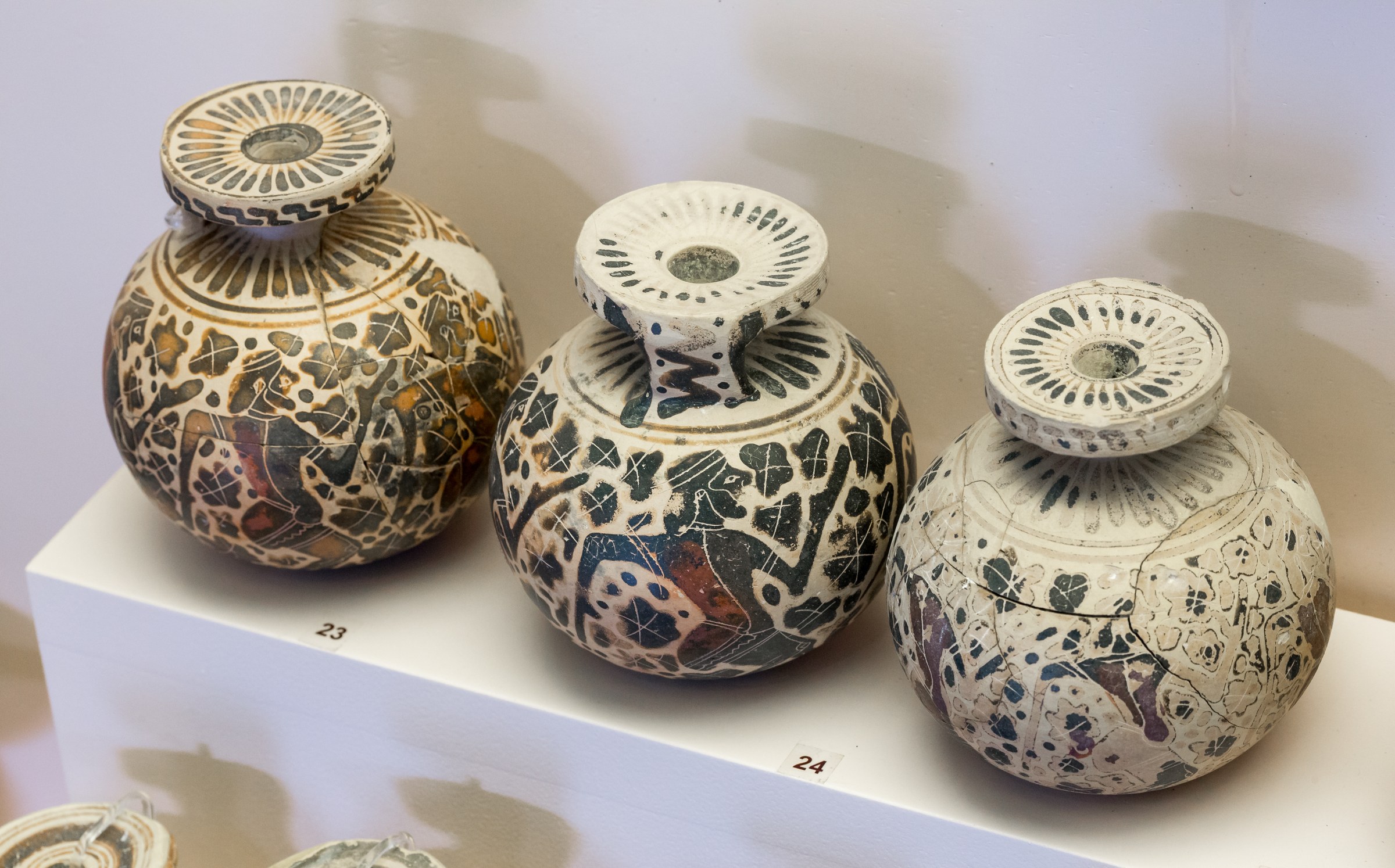
Thirteen Thousand Painter - CVPAP 114 1-3 - padded dancers - Rhodos AM 13004-13006 - 01
ArchaiOptix
- Source:
- Wikimedia Commons
- Rights:
- Reusable with conditions: credit the creator; share any adaptation under the same licence. Source record ↗
- Recorded as:
- cc by-sa 4.0
These vessels provide direct visual documentation of a named dance tradition from the archaic Mediterranean at a period when most dance documentation is either mythological or fragmentary. They show how a specific performance type—recognizable by costume, body shape, and pose—was understood and represented by visual artists, giving us a window into what contemporary viewers saw and valued in the performance. For anyone studying the history of costume-based or comedic dance, or the relationship between performance and visual representation in early Mediterranean cultures, these pieces are primary evidence.
What you are looking at
Three globular ceramic vessels displayed in museum display lighting, each topped with a wide, flared rim that resembles a shallow dish or cap. The vessels are burnished clay in varying states of preservation: the leftmost is richly colored in deep browns and blacks with areas of golden tan, suggesting age and oxidation; the center vessel shows more uniform dark patterning on a cream-colored ground; the rightmost is predominantly cream with darker accents. All three are decorated with the same repeating motif: silhouetted figures of padded dancers in black figure technique, arranged in horizontal bands around the globular body. The dancers appear throughout the composition in stocky, compact poses. The rims feature radiating linear patterns suggesting pleating or fluting, rendered in fine black lines. The vessels cast distinct shadows on the white museum shelf, emphasizing their three-dimensionality and spherical form.
The dancing
The padded dancers are depicted in profile or three-quarter view, rendered as solid black silhouettes with minimal interior detail. Their bodies are squat and heavily padded, with thick torsos and relatively short limbs, creating a characteristic stumpy profile. The figures wear what appear to be padded costumes or armor-like garments that obscure natural body proportions. Legs are typically shown in a wide, planted stance suggesting stability rather than active movement. The dancers appear singly or in small groups arranged in horizontal registers around the vessel; their positioning suggests a processional or group dance context rather than paired partnering or formal holds.
The dance depicted
These vessels depict komasts—padded male dancers of ancient Corinth who performed in festive, often satirical processions. The padded costume was the defining feature of komast performance, exaggerating the male body for comic or ritualistic effect. The black-figure technique freezes the dancers in a state of ceremonial procession or group movement rather than capturing a specific choreographic moment. The repetition of the same figure type across the vessel's surface suggests these were standardized performers or character types, likely part of ritualized festival dances (possibly connected to Dionysian celebrations, though the record does not specify). The vessels themselves—small aryballoi used for perfumed oils—were luxury items, suggesting komast imagery held cultural prestige worth reproducing in fine pottery.
How it was made
These are Corinthian black-figure pottery vessels, produced by hand-throwing the clay body and attaching the rim separately. The black-figure technique involved painting images in glossy black slip onto the natural clay ground, then incising details through the black to reveal the lighter clay beneath—visible here in the linear patterns of the rims and in anatomical detail work on the dancers' bodies. Firing in a reducing kiln produced the characteristic black gloss. The small size (8.8–9.5 cm) and the precision of the decoration indicate these were luxury objects produced by specialist craftspeople, likely sold as high-value commodities in trade networks. The technique allowed for mass-reproducible imagery while maintaining the prestige of hand-made ceramics.
About this work
These three Corinthian aryballoi from the early archaic period (ca. 620–590 BC) document the komast dancers of ancient Corinth through the black-figure pottery technique. Komasts were a recognized performance tradition—padded male comedians who danced in festival processions—and their appearance on fine pottery indicates they held a stable place in Corinthian culture by this period. The vessels themselves were functional luxury items (perfume containers), meaning this imagery circulated among the urban merchant and aristocratic classes who could afford imported fine pottery.
These pieces are significant as among the earliest datable representations of a specific dance tradition in the Mediterranean world. The consistency of the figure type and pose across three separate vessels suggests komast dancing was a standardized, recognizable genre with visual conventions that potters and painters understood and could reproduce. The image and the object together document both the dance itself and its social standing—prestigious enough to dignify fine pottery, yet popular enough to appear on vessels intended for daily (if luxury) use.
How to look at it
Study the repeated figure of the padded dancer around each vessel's body—note how the painter maintained the same profile pose, same exaggerated torso padding, same planted-leg stance across each repetition. This repetition is not laziness but convention: the padded figure is recognizable because it is consistent. Observe the vessel's rim closely, where the radiating lines create a visual cap or crown above the dancers' heads, perhaps mimicking the actual rim of a costume or headdress the real dancers wore. The small scale of these vessels means the decoration is precise and deliberate—every line and silhouette was chosen. Consider why a perfume merchant or wealthy household owner would choose to buy a container decorated with these particular figures: what about komast dancers made them worth displaying?
The artist
The Thirteen Thousand Painter is a modern scholarly name for an unidentified Corinthian black-figure potter-painter group or individual, named by convention from a reference number in Darrell Arlynn Amyx's fundamental catalogue of Corinthian vase painting (1988). The painter worked in the early Corinthian period and specialized in small vessels, particularly aryballoi and other perfume containers. The consistent style and subject matter across attributable vessels suggests either a single long-working painter or a workshop with a stable visual formula. Nothing is known of the artist's identity, workshop location within Corinth, or clientele beyond what the vessels themselves reveal.
The period
The early archaic period (seventh to early sixth century BC) was the moment when Corinth emerged as a dominant pottery-producing center in Greece, developing the black-figure technique that would define Mediterranean ceramic art for two centuries. This was also a period of Corinthian political and commercial expansion—the polis was establishing colonies and trade networks throughout the Mediterranean. The komast dancers represented here were part of a living Corinthian performance tradition, likely connected to Dionysian or fertility festivals, and their appearance on fine pottery suggests they were understood as a legitimate, recognizable cultural practice. Black-figure pottery was the dominant luxury commodity in this trade network, circulating through the Mediterranean and reaching Egypt, Etruria, and the Near East—these vessels, if they traveled, carried imagery of Corinthian komast culture across the known world.
Where it lives
These three vessels are held in the Rhodes Archaeological Museum (inventory numbers 13004, 13005, and 13006). They were recovered from a tomb (Macri Langoni tomb 118) at Kameiros on Rhodes, a major ancient settlement, indicating they were imported luxury goods buried with a deceased individual. The tomb context dates their use and deposition. The vessels have been documented in the scholarly literature since at least 1931 and are part of the museum's permanent archaic pottery collection.
Dance in this work
Questions about this work
What were komasts and where did they perform?
Komasts were costumed male performers who danced in festive Corinthian processions, likely connected to Dionysian or fertility celebrations. They are identifiable by their padded costumes, which exaggerated the male body for comic or ritualistic effect. While we know they existed and were significant enough to depict on fine pottery, the sources do not specify exact venues or ritual occasions. Their appearance on vessels made for trade and export suggests the tradition was well-established and widely recognized by the early sixth century BC.
Why is the figure so stocky and padded-looking?
The padded costume was the defining performance garment of komast dancers. We do not know whether this padding was literal (quilted or stuffed fabric) or cosmetic illusion created by the costume design, but its visual effect was to compress and distort the male body, creating a comic or grotesque silhouette. The padding may have been ritually or ceremonially significant—exaggeration was part of the performance's meaning. By the time these vessels were made, the padded figure was iconic enough that potters rendered it as a fixed type.
What does the repetition of the same figure tell us?
The repetition across the vessel's surface suggests the padded dancer was a standardized, recognizable character type rather than a portrait of a specific performer. This is typical of black-figure pottery conventions: a single figure or pose is repeated to fill the available space, but it also reflects the fact that komast dancing was a genre with visual conventions—viewers would recognize the figure as 'a komast' instantly. The repetition makes the dancer iconic rather than narrative.
Why are these vessels called aryballoi and what were they used for?
Aryballoi are small, globular clay vessels designed to hold expensive perfumed oils—aromatic substances prized in the Mediterranean world. The flared rim at the top helped control pouring. These were luxury objects, used by wealthy households and merchants. Because they were prestige items, their decoration mattered: fine pottery with recognizable, culturally significant imagery would have been more desirable and valuable. The fact that komast dancers appear on perfume vessels tells us the tradition held cultural prestige.
More dance artwork





