49 works in this view — arrow keys or swipe to move between them.
Dance in Art
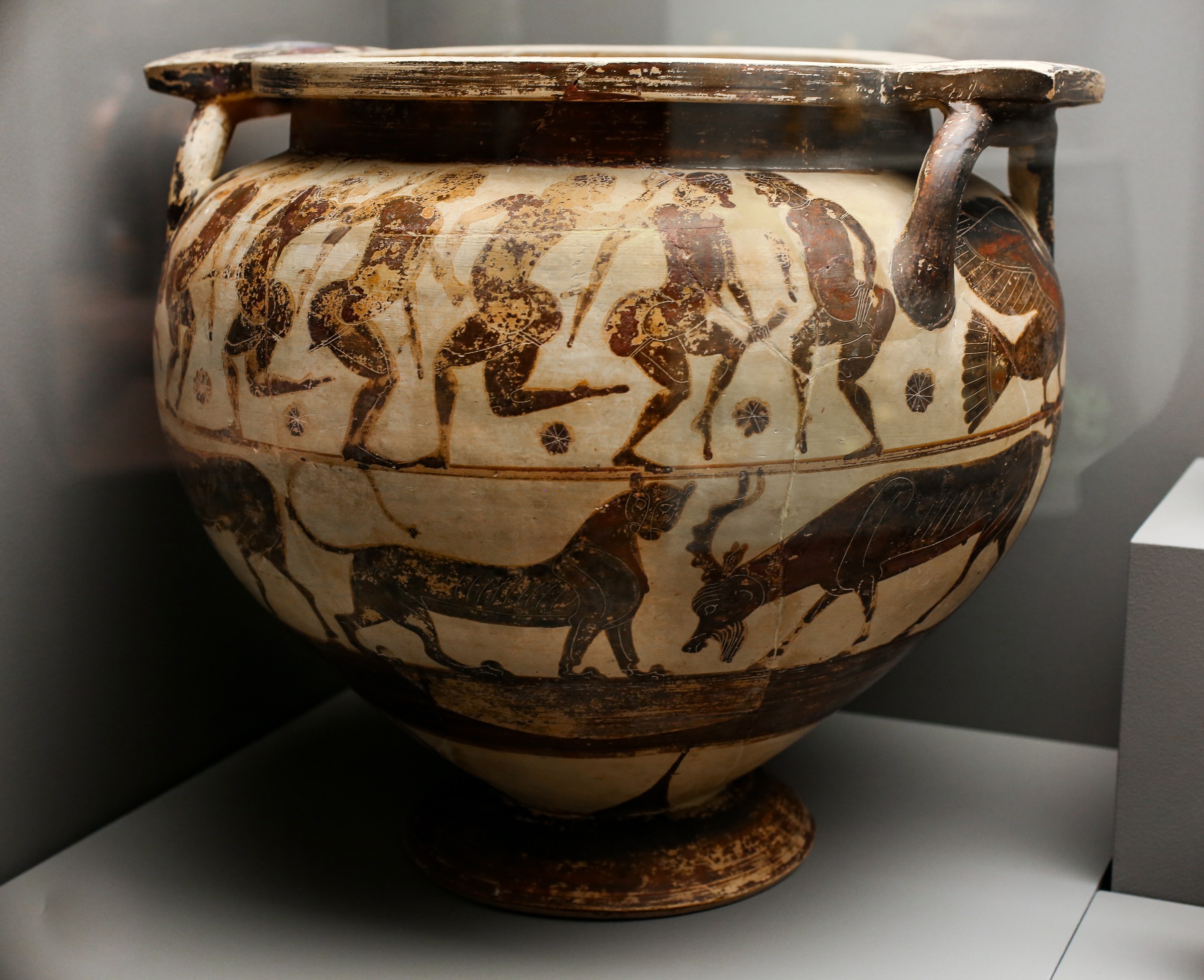
Middle corinthian column-krater - padded dancers - animal friezes - Athens MCA AA0221 - 01
ArchaiOptix
- Source:
- Wikimedia Commons
- Rights:
- Reusable with conditions: credit the creator; share any adaptation under the same licence. Source record ↗
- Recorded as:
- cc by-sa 4.0
Komast dance appears rarely in the visual record and this image is among the clearest surviving examples of how these performers dressed and moved. For historians of ancient performance and social ritual, the krater provides material evidence of a genre that shaped male identity in Archaic Greece, revealing not only the costume but the embodied physicality that marked aristocratic participation in symposium culture.
What you are looking at
A terracotta column-krater with horizontal figural friezes displays the characteristic black-figure technique of Corinthian pottery. The upper frieze depicts a processional scene of padded dancers (komasts) in profile, moving left to right across the vessel's body. These figures wear distinctive padded suits that emphasize their torsos and limbs, creating a bulbous silhouette; their bodies lean forward with knees bent in an active stride. Between and beneath the human figures are small floral rosette ornaments. The lower frieze contains a parade of animals—horses, wild boar, and other creatures—rendered in the same dark glossy technique. The vessel itself is a wide, squat form with a horizontal rim, two sturdy loop handles rising from shoulder to neck, and a high pedestal foot. The cream-colored clay body contrasts sharply with the lustrous dark painted decoration, and the surface shows the wear and age-darkening typical of ancient ceramic.
The dancing
The komasts are rendered as stocky, striding figures with pronounced bent-leg postures. Their bodies are encased in padded costumes that create a blocky, almost geometric form—the padding reads as distinct bands or sections wrapping the torso and limbs. The heads are small relative to the padded bodies, and the figures move with forward momentum, their legs in a rhythmic walking or marching pattern. The arm positions vary but most figures show arms either swinging at the sides or held at mid-body. The procession reads as a group activity rather than paired or partnered movement; the dancers occupy individual spaces across the frieze without the interlocking or close spatial relationship one would see in later Greek dance imagery.
The dance depicted
The komasts depicted here are male chorus dancers from ancient Greek sympotic (drinking party) culture, performing the kōmos—a ritualized procession-dance that accompanied celebrations, often following drinking parties or festivals. The padded costumes are the diagnostic feature of komast dance; the heavy padding served both a comic or grotesque visual effect and a practical function in defining the dancer's exaggerated body silhouette. This image dates to the Middle Corinthian period and provides rare direct evidence of how padded dancers moved and carried themselves. The procession format and forward-leaning posture suggest a continuous, rhythmic forward movement rather than stationary gesture or turning figures. The inclusion of this imagery on a krater—a vessel used for mixing wine—reinforces the association between komast performance and symposium culture.
How it was made
This is a hand-thrown terracotta vessel decorated in the black-figure technique, in which figures and ornament are incised into or painted onto the clay surface with a glossy black pigment (likely iron oxide-based), creating images that read in silhouette against the unpainted clay ground. The technique was applied after the pot was thrown and the surface leather-hard, allowing fine linear detail in the incised lines marking musculature, costume divisions, and ornamental motifs. Firing in the kiln oxidized the pigment to a permanent glossy black. This was a labor-intensive decorative method that limited output and required skilled painters; pots decorated in this style circulated as prestige objects among the Greek aristocracy and wealthy trading partners around the Mediterranean. The scale, form, and iconography suggest this was a display piece as well as a functional vessel.
About this work
This Middle Corinthian column-krater preserves one of the most direct visual records of komast dance in ancient Greece. The padded figures striding across the vessel's upper frieze show us the distinctive costume and posture of a performance genre central to male aristocratic culture in the Archaic period. The presence of this imagery on a wine-mixing vessel documents the intimate connection between komast dancing and the Greek symposium—the formalized drinking party where such performances took place. As an object, the krater itself was both functional and decorative, designed to be seen and handled by the men who gathered to drink and witness performances. The black-figure technique allowed the unknown painter to capture enough detail to distinguish individual dancers and their padded silhouettes, preserving a snapshot of a performative tradition that is otherwise known to us only through literary references and scattered vase imagery.
How to look at it
Look at the posture and forward lean of the komasts: their bent knees and tilted bodies capture a moment of active forward motion, not a static pose. The exaggerated padding is the key to understanding the genre—notice how the artist emphasized the bulbous, segmented costume rather than the human form beneath it. The repetition of the figure across the frieze suggests a group moving together in processional rhythm. The small scale of the heads relative to the padded bodies is not naturalistic but deliberate and comic, an exaggeration built into the costume itself. The animal frieze below offers no narrative connection but functions as decorative counterpoint, filling the visual field in the conventional manner of Corinthian design.
The artist
The painter is unattributed, as is typical for the majority of Corinthian black-figure pottery. Corinth was a major pottery production center in the 6th century BCE, and its workshops produced vast quantities of decorated vessels for local use and export. Corinthian potters and painters were known for their precision, their formulaic repetition of figure types, and their productivity; the standardization visible in this krater—the repeated komast figures, the consistent animal frieze—reflects workshop practices that prioritized efficient production and market appeal over individual artistic expression.
The period
The Middle Corinthian period (ca. 590–570 BCE) saw the flowering of black-figure pottery as the dominant decorated ware in Greece. This was the era when the Greek city-state (polis) was consolidating political and social structures; the symposium was emerging as a central institution of aristocratic male culture, and performance—choral, musical, and choreographic—played a crucial role in defining citizenship and social status. Komast imagery became especially popular on wine vessels during this period, reflecting the growing codification and visibility of sympotic practices. By the time this krater was made, the kōmos was already an established tradition, but vase paintings like this one suggest it was still evolving and still regarded as worthy of prominent placement on high-status vessels.
Where it lives
This vessel is held in the Museum for Cycladic and Archaic Art in Athens (inventory AA0221). It entered the collection at an unknown date and from an unknown archaeological context; the find spot is not recorded. As a Corinthian product, it may have originated in Corinth or in an Athenian market influenced by Corinthian fashion, but the exact provenance remains uncertain.
Dance in this work
Questions about this work
What is a komast?
A komast (plural komasts or komastai) was a male dancer and reveler who performed in the kōmos, a ritualized procession-dance that took place during Greek symposia and festivals. The performance was marked by heavy, comic padded costumes and was associated with celebration, drinking, and aristocratic male bonding. Komasts appear frequently in black-figure vase painting from the Archaic and Classical periods, often depicted in procession or in exaggerated, burlesque postures.
Why did komasts wear padded costumes?
The padding served multiple functions: it created a grotesque or comic visual silhouette, exaggerating the dancer's body for humorous effect; it protected the performer during acrobatic or vigorous movement; and it functioned as a visual marker of the komast role, making the performer instantly recognizable. The padding also allowed for more exaggerated gestural vocabulary, since the thick suits amplified and distorted the dancer's actual body movement.
What is a krater and how was it used?
A krater is a large, open mixing vessel designed to hold wine or water during Greek symposia. The host would use it to blend wine (typically mixed with water before serving, as drinking undiluted wine was considered barbaric). The krater's size and prominent placement made it a focal point of the gathering, and many were decorated with elaborate imagery. This particular krater, with its komast frieze, would have been a prestige object signaling the host's wealth and cultural sophistication.
What is the black-figure technique?
Black-figure is a pottery painting technique in which figures and ornament are rendered in glossy black pigment (applied as a slip) against the unpainted clay ground. The technique involved incising fine lines into the black surface to indicate anatomical detail and costume elements. The vessel was then fired in the kiln, which oxidized the pigment to a permanent glossy black. This technique dominated Greek pottery from roughly 700 to 480 BCE and allowed for precise, durable decoration.
More dance artwork





